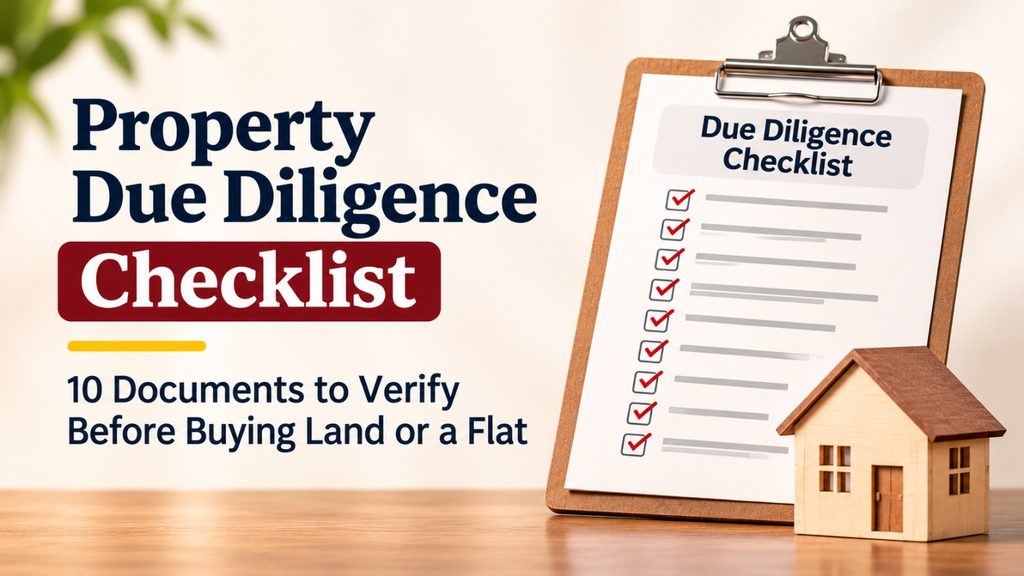
Buying land or a flat is often the biggest purchase of your life, and one missing paper can cost you the property. This property due diligence checklist covers the 10 documents to verify before buying property, the laws behind them and what to do if something is wrong. Due diligence simply means checking the facts before you commit your money.
Legal Framework
- Transfer of Property Act, 1882: Section 54 requires a registered sale deed for property worth ₹100 or more. Section 55 makes the seller disclose defects and produce title documents.
- Registration Act, 1908: Section 17 lists documents that must be registered. Section 49 says unregistered documents are not valid proof of title.
- Indian Stamp Act, 1899 and state stamp laws: require stamp duty to be paid on documents.
- Real Estate (Regulation and Development) Act, 2016 (RERA): Section 3 requires projects to be registered. Section 12 gives compensation for false information, Section 14 covers structural defects for five years and Section 18 allows refund for delay.
- Benami Transactions (Prohibition) Act, 1988: a property bought in another person’s name can be confiscated.
- Hindu Succession Act, 1956 and Indian Succession Act, 1925: decide who the legal heirs of an inherited property are.
- Income-tax Act, 1961: Section 194-IA requires 1% TDS (tax deducted at source) on purchases above ₹50 lakh.
- State land revenue and municipal laws: govern mutation, property tax and building approvals, and vary by state.
The 10 Documents to Verify
| # | Document | What to check |
|---|---|---|
| 1 | Title deed and chain of documents | Unbroken ownership for about 30 years |
| 2 | Encumbrance certificate (record of loans or charges) | No mortgage or litigation entries |
| 3 | Mutation and revenue records | Seller’s name matches the record |
| 4 | Property tax receipts and utility bills | Dues are cleared |
| 5 | Approved building plan | Construction matches the sanction |
| 6 | Occupancy or completion certificate | Building is legally fit for use |
| 7 | RERA registration certificate | Project is registered, with matching details |
| 8 | Land use and conversion order | Land is permitted for residential use |
| 9 | Seller’s ID, authority and legal heir papers | Seller can legally sell |
| 10 | Bank or society NOC and no-dues | Loans are closed and society dues cleared |
Land vs Flat: What Changes
- Land: focus on conversion orders, boundaries, survey records and any dispute with neighbours or heirs.
- Flat: focus on RERA registration, the occupancy certificate, society NOC and the builder’s approvals.
Remedies if Something Goes Wrong
| Problem | Remedy |
|---|---|
| False advertising or information by a builder | Complaint to the RERA authority, with compensation under Section 12 |
| Project delayed | Refund and interest under Section 18 |
| Structural defect within five years | Builder must repair it, under Section 14 |
| Fraud by the seller | Civil suit and a criminal complaint for cheating under the Bharatiya Nyaya Sanhita, 2023 |
| Benami holding | Risk of confiscation, so verify who truly owns the property |
FAQs
About 30 years is common practice, though there is no fixed legal rule.
No. Registration proves the transfer, but you still need to verify the seller’s title.
It records registered transactions and charges on a property over a period.
Yes for a flat in a completed building, since it shows the building is legally fit to live in.
Only with a valid, properly executed and verified Power of Attorney. Many buyers avoid it.
Want the deeper dive? Grab the reference book.