


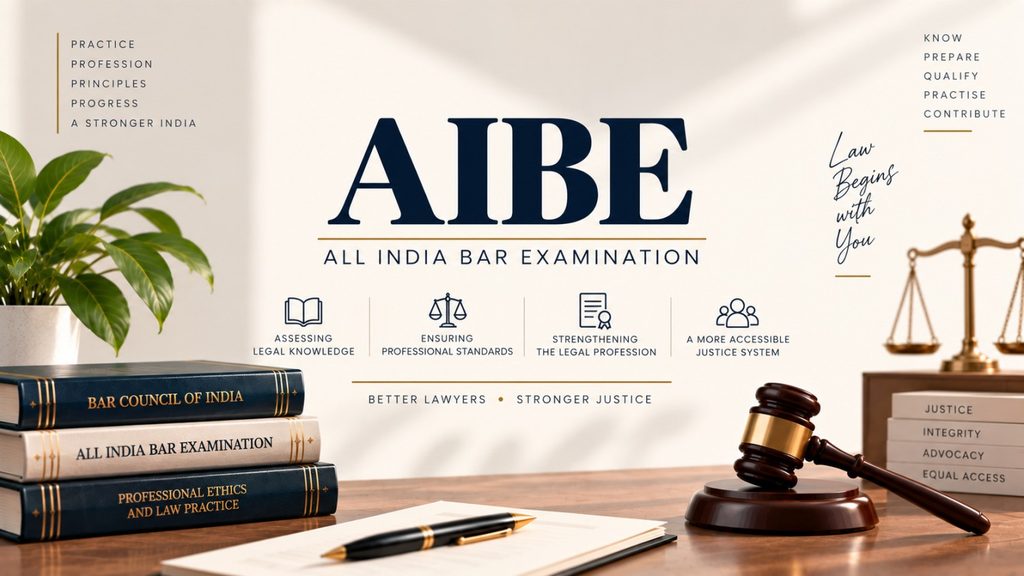
If you’re a law graduate gearing up to practice in Indian courts, the All India Bar Examination (AIBE) is the final step between you and your Certificate of Practice (CoP). The 22nd edition of this exam, AIBE 22, is drawing extra attention this year because the Bar Council of India (BCI) has moved to conducting the exam twice a year instead of once.
This guide covers everything currently confirmed about AIBE 22: the exam date, registration timeline, eligibility, syllabus, exam pattern, and preparation tips, all sourced from BCI’s official notification, so you don’t need to go hunting elsewhere for the basics.
AIBE 22 Exam Date 2026
The Bar Council of India confirmed to the Supreme Court that AIBE would now be held twice annually, giving law graduates more frequent chances to qualify. Early estimates in mid-2026 pointed to a December exam, but BCI’s official notification has since fixed a firmer schedule.
| Event | Date |
|---|---|
| Exam Name | All India Bar Examination XXII (AIBE 22) |
| Conducting Body | Bar Council of India (BCI) |
| Notification Released | July 18, 2026 |
| Registration Start | August 19, 2026 |
| Registration Deadline | October 27, 2026 |
| Fee Payment Last Date | October 28, 2026 |
| Correction Window Closes | October 30, 2026 |
| Admit Card Release | November 14, 2026 |
| Exam Date | November 29, 2026 (tentative, per official notification) |
| Mode of Exam | Offline (pen and paper) |
| Official Website | allindiabarexamination.com |
main article :AIBE Registration 2026: Last Date, Fees & How to Apply
A note on the date confusion: several reports published earlier in 2026 projected AIBE 22 for December 2026, before BCI’s formal notification came out. The official notification has since set the exam date at November 29, 2026, with the answer key and results expected to follow in December. Since this is the first cycle of the new twice-a-year format, it’s worth checking the notification section of allindiabarexamination.com directly in case of any revision or corrigendum.
What Is the AIBE and Why Does It Matter
The AIBE is a mandatory qualifying exam for law graduates who want to practice law in India. It is not a competitive exam, so there’s no ranking or merit list. You simply need to clear the minimum qualifying score for your category. Clear it, and you become eligible for the Certificate of Practice, which formally authorizes you to argue cases in Indian courts. There is no limit on the number of attempts and no upper age limit.
Why AIBE Is Now Held Twice a Year
Historically, AIBE was conducted only once a year, meaning candidates who missed the cutoff had to wait a full year to try again. In 2026, BCI shifted to a twice-yearly format: AIBE 21 was held on June 7, 2026, and AIBE 22 will follow later in the year. This change effectively halves the waiting period for graduates trying to qualify.
AIBE 22 Eligibility Criteria
- A valid 3-year or 5-year LLB degree, or a final-year marksheet
- State Bar Council enrollment certificate and enrollment number
- Final-year and final-semester LLB students with no backlogs can also apply, using the undertaking option on the official portal.
- Candidates who appeared in AIBE 20 or AIBE 21 but did not clear it do not need to register again. They can log in with their existing user ID and password and apply for AIBE 22 using their previous registration details
AIBE 22 Exam Pattern and Passing Marks
- 100 multiple-choice questions, one mark each, across a 3 hour 30 minute window
- Conducted offline, in pen-and-paper mode, at designated exam centres nationwide
- No negative marking. You get one mark per correct answer, and no deduction for wrong or unattempted questions
- Passing marks: 45 out of 100 for General and OBC candidates; 40 out of 100 for SC, ST, and PwD candidates
- Not a fully open-book exam. You may carry clean bare acts without notes, comments, or handwritten markings, but no textbooks or guides
- The exam is offered in multiple regional languages in addition to English and Hindi
AIBE 22 Syllabus 2026
Main article: AIBE XXII Prep Guide: Bare Acts, Cutoff & Attempt Rules
The AIBE 22 syllabus covers 19 law subjects drawn from the standard LLB curriculum, tested across the same 100 MCQs described above.
A key update this cycle: BCI now tests both the new and old criminal-law frameworks side by side, since India has transitioned to new codes.
| Earlier Law | New Law |
|---|---|
| Indian Penal Code (IPC) | Bharatiya Nyaya Sanhita (BNS) |
| Code of Criminal Procedure (CrPC) | Bharatiya Nagarik Suraksha Sanhita (BNSS) |
| Indian Evidence Act | Bharatiya Sakshya Adhiniyam (BSA) |
Highest-weightage subjects (around 10 questions each):
- Constitutional Law
- Code of Civil Procedure (CPC)
- Criminal Procedure Code / BNSS (main article : BNS important sections for AIBE)
Moderate-weightage subjects (6 to 8 questions each):
- IPC / BNS
- Evidence Act / BSA
- Law of Contract
Lower-weightage subjects rounding out the full list of 19 include Family Law, Law of Torts, Professional Ethics, Company Law, Cyber Law, Intellectual Property Law, Environmental Law, Land Acquisition Act, Alternative Dispute Resolution, and Public Interest Litigation, among others.
BCI publishes the official syllabus PDF alongside the exam notification. Download it directly from allindiabarexamination.com so you’re working from the authoritative version rather than a third-party summary.
How to Register for AIBE 22
- Visit the official portal at allindiabarexamination.com
- Fill in personal and academic details in the online application form
- Upload required documents: LLB degree certificate or final-year marksheet, and State Bar Council enrollment proof
- Pay the prescribed application fee online
- Download and retain your submitted application and payment confirmation for future reference
If you spot an error after submitting, use the correction window (open until October 30, 2026) to fix it before it locks in. Candidates who did not clear AIBE 20 or AIBE 21 should log in with their existing credentials rather than creating a new registration.
AIBE 22 Preparation Tips
- Get comfortable navigating bare acts quickly. Since you’re allowed to carry clean, unmarked bare acts into the exam, prioritize familiarity with structure and section numbers over rote memorization.
- Prioritize the highest-weightage subjects first: Constitutional Law, CrPC/BNSS, and CPC, each carrying roughly 10 questions.
- Study both the old and new criminal codes together, since AIBE 22 tests IPC alongside BNS, CrPC alongside BNSS, and the Evidence Act alongside BSA.
- Practice with previous years’ papers and mock tests to build speed and get used to the question style.
- Don’t skip Professional Ethics. It’s a moderate-weightage, high-scoring section that many candidates underprepare for.
- Track official updates directly on allindiabarexamination.com, since exam dates, admit card release, and correction windows are all governed by BCI notifications and can shift.
Frequently Asked Questions
November 29, 2026, per BCI’s official notification, conducted offline in pen-and-paper mode.
On the official BCI portal, allindiabarexamination.com, alongside the exam schedule, syllabus, and eligibility details. Always download it from the official site rather than a third-party link, since BCI occasionally issues corrigenda.
Registration runs from August 19 to October 27, 2026, with fee payment accepted until October 28, and the correction window open until October 30.
19 law subjects, 100 MCQs, no negative marking. See the syllabus section above for the full subject-wise weightage breakdown.
A 3-year or 5-year LLB degree, or a final-year marksheet, plus State Bar Council enrollment. Final-year students without backlogs can apply using the portal’s undertaking option, and candidates who didn’t clear AIBE 20 or 21 can reapply using their existing login.
Some of the top books for AIBE:
- R.V. Kelkar’s Lectures on Criminal Procedure: Based on Bharatiya Nagarik Suraksha Sanhita, 2023
- V. P. Sarathi’s Law of Evidence: Based on Bharatiya Sakshya Adhiniyam, 2023
- B.M. Gandhi’s Penal Law: Covering Bharatiya Nyaya Sanhita 2023, Dowry Prohibition Act, JJ Act, MTP Act, POCSO Act, DV Act, and More
- EBC’s Master Guide To All India Bar Examination (AIBE Exam Guide)
- All India Bar Examination Bare Acts Without Notes and Comments | AIBE Bare Acts Combo Set of 25 Books | Covering Old and New Criminal Laws
- All India Bar Examination – Solved Papers 2015-2025
- Universal’s Guide to All India Bar Examination | AIBE Complete Syllabus Guide

AIBE Exam Result 2025: Date, Cut-Off, Scorecard & CoP
[…] AIBE 22 Exam 2026: Complete Guide to Dates, Registration, Syllabus, and Eligibility […]
BNS Important Sections for AIBE: Key Sections to Know
[…] AIBE 22 Exam 2026: Complete Guide to Dates, Registration, Syllabus, and Eligibility […]
AIBE XXII Preparation Guide: Bare Acts, Cutoff & Rules
[…] Click here to know the official details of AIBE: AIBE 22 Exam 2026: Complete Guide to Dates, Registration, Syllabus, and Eligibility […]
AIBE 21 Exam Analysis: Subject-Wise Breakdown & Answer Key
[…] Main Article: AIBE 22 Exam 2026: Complete Guide to Dates, Registration, Syllabus, and Eligibility […]
AIBE vs Judiciary Exam: Key Differences Every Law Graduate Should Know - Blog - EBC Webstore
[…] Main Article: AIBE 22 Exam 2026: Complete Guide to Dates, Registration, Syllabus, and Eligibility […]
AIBE 22 Subject Wise Preparation Strategy 2026
[…] Main article: https://blog.ebcwebstore.com/aibe-22-exam-date-2026/?utm_source=blogcta&utm_medium=blog&utm_… […]
SLAT 2027: Exam Date, Registration, Syllabus & Eligibility
[…] AIBE 22 Exam 2026: Complete Guide to Dates, Registration, Syllabus, and Eligibility […]
Delhi APP Bar Experience: Can AIBE 22 Candidates Apply?
[…] Main article: AIBE 22 Exam 2026: Complete Guide to Dates, Registration, Syllabus, and Eligibility […]
AIBE Open Book Exam: Time Management With Bare Act
[…] Main article: AIBE 22 Exam 2026: Complete Guide to Dates, Registration, Syllabus, and Eligibility […]
How to Prepare for AIBE in 1 Month While Working or Interning - Blog - EBC Webstore
[…] AIBE 22 Exam 2026: Complete Guide to Dates, Registration, Syllabus, and Eligibility […]
BNS BNSS BSA Notes for AIBE 22: Revision Guide (2026)
[…] Main article: AIBE 22 Exam 2026: Complete Guide to Dates, Registration, Syllabus, and Eligibility […]
AIBE 22 Constitutional Law: Important Articles (2026)
[…] Main article: AIBE 22 Exam 2026: Complete Guide to Dates, Registration, Syllabus, and Eligibility […]
AIBE 22 Time Management: Open Book Exam Tips & Bare Act Guide
[…] Main article: AIBE 22 Exam 2026: Complete Guide to Dates, Registration, Syllabus, and Eligibility […]
Top 10 Mistakes to Avoid During AIBE 22 Exam Day
[…] Main Article: AIBE 22 Exam 2026: Complete Guide to Dates, Registration, Syllabus, and Eligibility […]
Certificate of Practice After Passing AIBE 22: Complete Guide
[…] Main article: AIBE 22 Exam 2026: Complete Guide to Dates, Registration, Syllabus, and Eligibility […]
SLAT Exam: Beginner’s Guide to Symbiosis Law Admissions
[…] Main article: AIBE 22 Exam 2026: Complete Guide to Dates, Registration, Syllabus, and Eligibility […]