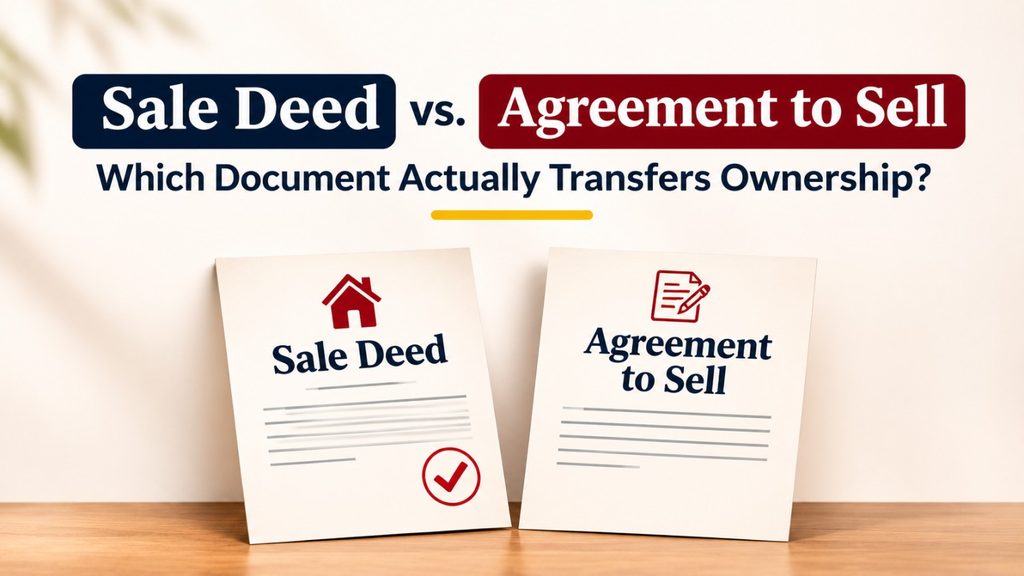
Many buyers believe that paying money and signing an agreement makes them the owner. It does not. In the sale deed vs agreement to sell question, only one document transfers ownership. This guide explains the difference, the laws behind it, the process and what to do if a seller backs out.
Legal Framework
- Transfer of Property Act, 1882: Section 54 defines a sale as the transfer of ownership for a price. Immovable property worth ₹100 or more can be transferred only by a registered instrument. It also says a contract for sale does not itself create any interest in the property. Section 53A (part performance) protects a buyer in possession who has paid or is willing to perform. Section 55 lists the seller’s and buyer’s duties, such as disclosing defects and paying the price.
- Registration Act, 1908: Section 17 lists documents that must be registered. Section 17(1A) requires registration of agreements covered by Section 53A. Section 23 requires presenting a document within four months. Section 49 makes unregistered documents inadmissible as proof of transfer, with limited exceptions.
- Indian Stamp Act, 1899 and state stamp laws: set stamp duty (a tax on documents). A document with too little duty cannot be used as evidence until the duty and penalty are paid (Section 35).
- Specific Relief Act, 1963: lets a buyer ask a court to enforce a contract. Section 16 requires the buyer to show readiness and willingness to perform.
- Limitation Act, 1963: Article 54 sets three years to sue for specific performance.
- Indian Contract Act, 1872: governs the contract itself, including damages under Section 73.
- Real Estate (Regulation and Development) Act, 2016 (RERA): Section 13 bars a promoter from taking more than 10% of the price without a registered agreement for sale.
- Income-tax Act, 1961: Section 194-IA requires TDS (tax deducted at source) of 1% on purchases above ₹50 lakh.
Sale Deed vs Agreement to Sell at a Glance
| Feature | Agreement to Sell | Sale Deed |
|---|---|---|
| Nature | A promise to sell in future | A completed transfer |
| Ownership | Stays with the seller | Moves to the buyer |
| Registration | Required only in some cases (Section 17(1A)) | Compulsory for property of ₹100 or more |
| Stamp duty | Lower, varies by state | Full duty on property value |
| Remedy if breached | Suit for specific performance or damages | Title dispute or fraud remedies |
| Main purpose | Fixes terms, price and timeline | Proves title |
What an Agreement to Sell Actually Does
An agreement to sell records the price, advance, timeline and conditions. It creates a right to enforce the contract, not ownership. Until the sale deed is registered, the seller remains the legal owner and can be sued, but the buyer cannot claim title.
Under Section 53A, a buyer in possession under a written, signed agreement can defend that possession against the seller. It is a shield, not a title.
What a Sale Deed Does
A registered sale deed completes the transfer. It should state the parties, full property description, price, possession and the seller’s title. Always check the seller’s title papers and encumbrance details (records of mortgages or loans) before signing.
Remedies If a Seller Backs Out
- Specific performance: sue to force completion, within three years under the Limitation Act.
- Refund and damages: recover the advance and compensation for loss.
- Forfeiture clauses: these allow the seller to keep an advance if the buyer defaults, and courts examine whether the amount is reasonable.
An unregistered sale deed gives no valid title, so register promptly and pay the correct stamp duty.
Recent Changes
- Specific Relief (Amendment) Act, 2018: made specific performance a normal remedy, not a discretionary one, with limited exceptions.
- Draft Registration Bill, 2025: proposes to replace the Registration Act, 1908 and make registration of agreements to sell compulsory. Reports say it is not yet law, so check its current status.
FAQs
No. Ownership passes only on a registered sale deed.
Not always, but it is for agreements covered by Section 53A, and many states require it.
No. You have a right to enforce the contract, not title.
You can sue for specific performance, but you hold no title yet.
No. It is lower on agreements and full on the sale deed, and varies by state.
Want the deeper dive? Grab the reference book.