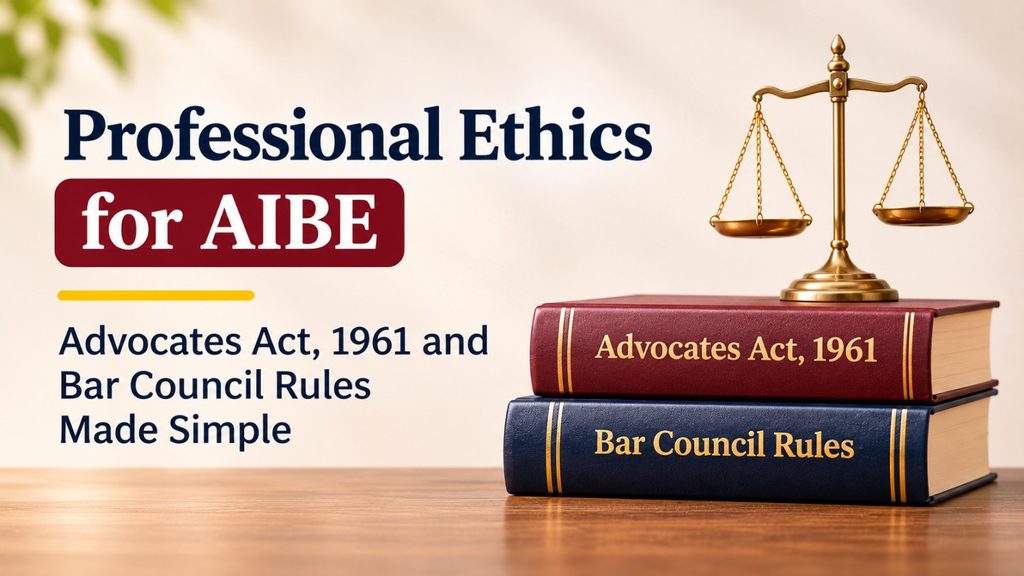
Professional ethics is one of the most scoring, yet most neglected, sections of the bar exam. If you want professional ethics for AIBE in plain language, this guide covers the essentials. It is written mainly for law students and AIBE candidates, with practising advocates as a secondary audience, so legal terms are explained when they first appear.
main article: AIBE XXI Eligibility, Registration Process, and Important Dates
Legal Framework Behind Professional Ethics for AIBE
- Advocates Act, 1961: the parent law. It creates the Bar Council of India (BCI) and State Bar Councils, and governs enrolment, practice and discipline.
- Bar Council of India Rules: framed under Section 49(1)(c) of the Act. Part VI, Chapter II lays down the Standards of Professional Conduct and Etiquette.
- Contempt of Courts Act, 1971: punishes disrespect to courts and interference with justice.
- Bharatiya Sakshya Adhiniyam, 2023: Sections 132 to 134 protect privileged communications, meaning confidential exchanges between advocate and client.
Key Provisions of the Advocates Act
- Section 7: the BCI must lay down standards of professional conduct and etiquette.
- Section 16: an advocate may be designated a Senior Advocate by the Supreme Court or a High Court, based on ability, standing or special knowledge.
- Section 24A: bars enrolment of a person convicted of an offence involving moral turpitude (dishonest or morally wrong conduct), or dismissed from service on such a charge.
- Sections 29 and 33: only enrolled advocates may practise law.
- Section 45: illegal practice is punishable with imprisonment up to six months.
Core Duties Under the BCI Rules
Duty to the court
- Behave with dignity and respect toward the judge.
- Never influence a decision by improper means or private communication.
Duty to the client
- Accept briefs (case instructions) in courts where you practise, at a fee suited to your standing (Rule 11).
- Protect the client’s interest by fair and honourable means (Rule 15).
- Give reasonable notice before withdrawing (Rule 17).
- Never charge a fee that depends on the outcome (Rule 20).
- Keep client money and confidences safe.
Duty to the opponent and colleagues
- Do not negotiate directly with a represented opposite party.
- Do not solicit work or advertise (Rule 36).
- Do not be a full-time salaried employee while practising (Rule 49).
Professional Misconduct and Punishment
Section 35 allows action against an advocate for “professional or other misconduct”, meaning conduct that breaches the Act or the Rules. Common examples are misusing client money, taking fees without working, misleading the court and touting (soliciting clients through agents). Section 35(3) allows these punishments:
- Reprimand (a formal warning)
- Suspension from practice
- Removal of the name from the State Roll
Disciplinary Process at a Glance
Complaint → State Bar Council → Disciplinary Committee inquiry (notice to Advocate General) → Order under Section 35 → Appeal to BCI (Section 37) → Appeal to Supreme Court (Section 38)
Under Section 36B, the State Bar Council must dispose of a complaint within one year, failing which the case moves to the BCI. Section 36 lets the BCI handle cases itself. Section 42 gives disciplinary committees the powers of a civil court, such as summoning witnesses. An appeal to the Supreme Court must be filed within 60 days.
Quick Reference Table
| Topic | Provision | Key Point |
|---|---|---|
| Standards of conduct | Sections 7 and 49(1)(c) | BCI frames the rules |
| Disqualification | Section 24A | Moral turpitude bars enrolment |
| Misconduct | Section 35 | Reprimand, suspension, removal |
| Time limit | Section 36B | One year at State level |
| Appeals | Sections 37 and 38 | BCI, then Supreme Court |
| Illegal practice | Section 45 | Up to six months jail |
| Client confidentiality | BSA Sections 132 to 134 | Privileged communication |
FAQs
Generally no. Rule 36 bars solicitation and advertisement, with limited exceptions such as a website carrying basic details.
Rule 11 says an advocate is bound to accept briefs, but special circumstances can justify refusal.
Not if the offence involves moral turpitude (Section 24A).
The disciplinary committee of the State Bar Council, or the BCI in cases it takes up.
60 days under Section 38.
Some of the top books for AIBE:
- R.V. Kelkar’s Lectures on Criminal Procedure: Based on Bharatiya Nagarik Suraksha Sanhita, 2023
- V. P. Sarathi’s Law of Evidence: Based on Bharatiya Sakshya Adhiniyam, 2023
- B.M. Gandhi’s Penal Law: Covering Bharatiya Nyaya Sanhita 2023, Dowry Prohibition Act, JJ Act, MTP Act, POCSO Act, DV Act, and More
- EBC’s Master Guide To All India Bar Examination (AIBE Exam Guide)
- All India Bar Examination Bare Acts Without Notes and Comments | AIBE Bare Acts Combo Set of 25 Books | Covering Old and New Criminal Laws
- All India Bar Examination – Solved Papers 2015-2025
- Universal’s Guide to All India Bar Examination | AIBE Complete Syllabus Guide