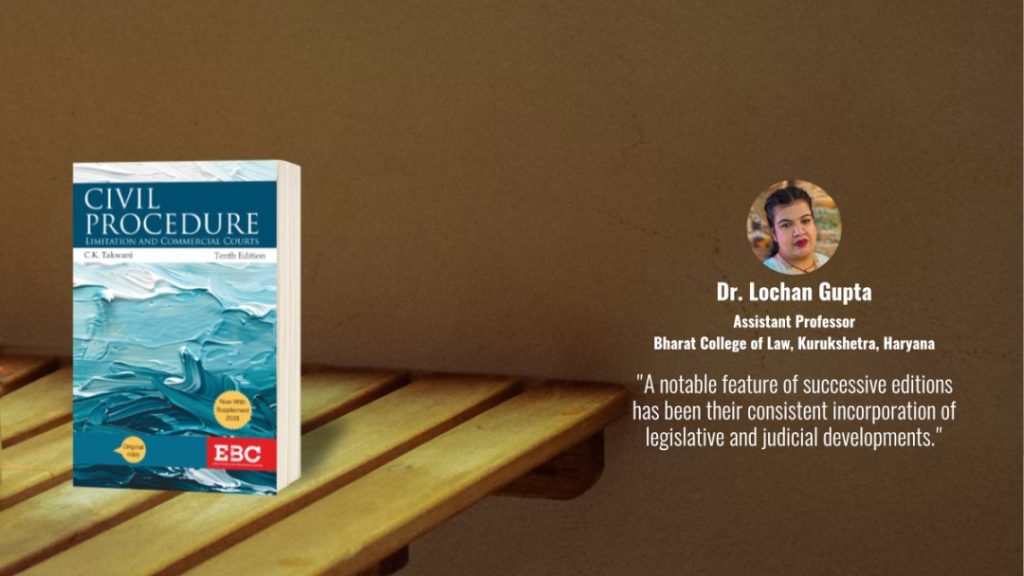
Dr. Lochan Gupta, Assistant Professor at Bharat College of Law, Kurukshetra, Haryana, shares her review of Civil Procedure by C.K. Takwani, a trusted resource on civil procedural law. In this review, she discusses the book’s clarity, practical approach, and enduring value for law students, academics, and legal practitioners.
For generations of Indian law students, academicians, judicial aspirants, and legal practitioners, C.K. Takwani’s Civil Procedure (CPC) has been one of the most trusted and widely prescribed textbooks on the Code of Civil Procedure, 1908. Its enduring popularity stems from its ability to simplify one of the most technical branches of procedural law without sacrificing doctrinal precision. Even in 2026, as India’s civil justice system continues to evolve through technological advancements, commercial litigation reforms, and alternative dispute resolution mechanisms, Takwani’s work remains a dependable guide to understanding the structure and operation of civil procedure. While the legal landscape has expanded significantly, the book continues to provide an exceptionally strong doctrinal foundation for anyone seeking a comprehensive understanding of the CPC
A Clear and Systematic Approach
One of the book’s greatest strengths is its logical organisation. The chapters follow the natural progression of civil litigation—from jurisdiction and institution of suits to pleadings, trial, judgments, appeals, revisions, review, execution, and limitation. This systematic arrangement enables readers to build concepts gradually, making an otherwise complex procedural framework far easier to understand.
The language remains one of the defining features of the text. Takwani explains intricate procedural doctrines in a lucid and accessible style without oversimplifying legal principles. Concepts such as res judicata, res sub judice, temporary injunctions, review, revision, appeals, execution proceedings, and limitation are discussed with clarity, supported by authoritative judicial precedents.
For undergraduate students and competitive examination aspirants, this balance between simplicity and legal accuracy makes the book particularly valuable.
Keeping Pace with Legislative Developments
A notable feature of successive editions has been their consistent incorporation of legislative and judicial developments. The book reflects the important amendments to the CPC, the evolving framework governing Commercial Courts, and recent statutory developments, including the Mediation Act, 2023.
The inclusion of recent Supreme Court and High Court decisions ensures that readers remain familiar with contemporary interpretations of procedural law. These updates enhance the book’s usefulness not only as an academic text but also as a practical reference for young practitioners.
Rather than merely presenting statutory provisions, the book places them within the broader procedural framework, helping readers understand how various provisions interact during the lifecycle of a civil suit.
Beyond Doctrine: Opportunities for Further Exploration
As with most doctrinal textbooks, Takwani’s principal objective is to explain the law as it presently stands. Readers seeking broader policy discussions may therefore wish to supplement the text with additional scholarly material.
Contemporary debates surrounding access to justice, judicial delays, litigation costs, procedural efficiency, case management, and the practical impact of procedural reforms are areas that have generated substantial academic literature. Likewise, developments relating to digital courts, e- filing, virtual hearings, electronic evidence, and technology-assisted court administration continue to reshape civil litigation in India.
While the book introduces important legislative reforms, these evolving themes provide excellent opportunities for readers to engage with complementary research, empirical studies, comparative scholarship, and policy-oriented discussions
Why the Book Continues to Matter
Despite the rapidly changing legal environment, Takwani’s Civil Procedure continues to perform the role it has always performed exceptionally well—it provides readers with a reliable understanding of the procedural architecture governing civil litigation in India.
Its comprehensive coverage, structured presentation, and careful treatment of judicial precedents make it an indispensable companion for:
- LL.B. and LL.M. students
- Judicial service aspirants
- Civil litigation practitioners
- Academicians teaching procedural law
- Researchers seeking a strong doctrinal foundation
The book succeeds in explaining not merely individual provisions of the CPC but also the coherence of the procedural system as a whole.
C.K. Takwani’s Civil Procedure (CPC) remains one of the most authoritative and student- friendly commentaries on the Code of Civil Procedure. Its greatest strength lies in presentingcomplex procedural law in a structured, accessible, and analytically sound manner while keeping pace with important statutory and judicial developments.
For readers interested in exploring wider questions concerning procedural reform, technology, access to justice, or empirical studies of court administration, the book serves as an excellent starting point upon which further scholarship can be built.
Ultimately, Takwani’s work continues to occupy a distinctive place in Indian legal education—not merely because it explains what the law is, but because it equips readers with the doctrinal foundation necessary to engage thoughtfully with the future development of India’s civil justice system.