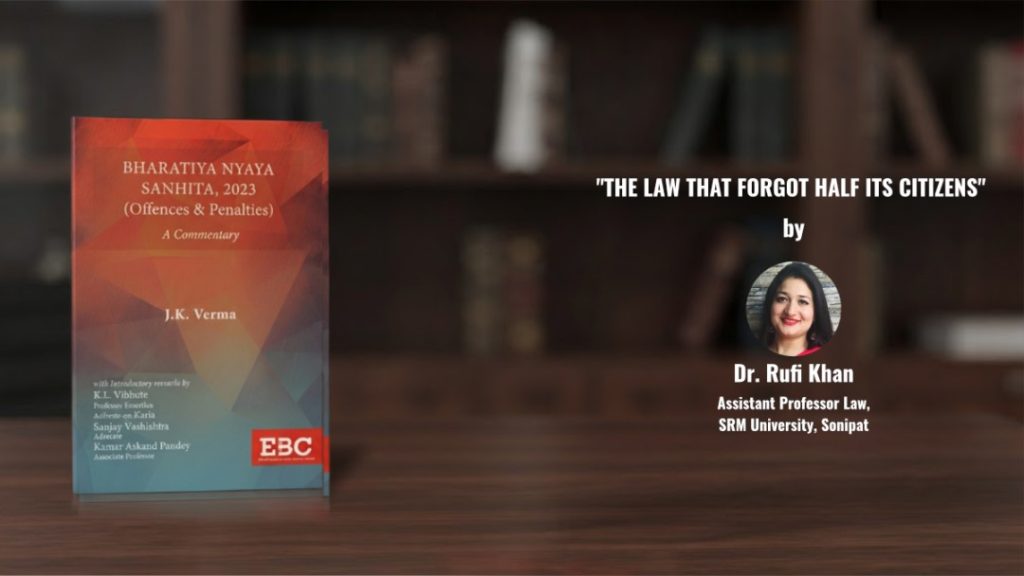
The removal of Section 377 under the Bharatiya Nyaya Sanhita left an important question unanswered: how the law protects male victims of sexual assault. Dr Rufi Khan, Assistant Professor of Law at SRM University, Sonipat, explores this gap and what it means going forward.
How the Bharatiya Nyaya Sanhita Created a Constitutional Void in Which a Man Can Be Sexually Assaulted Inside a Police Station and His Abusers Charged Only With “Hurt”
On the night of 17 June 2026, a 30-year-old bank employee undergoing chemotherapy for bone cancer was stopped at a checkpoint in Kurukshetra, Haryana. A minor dispute over a cloth covering his face, worn to protect his immunocompromised body, escalated inside the police station into something far graver. The man alleges he was mocked about his illness, struck on his cancer-affected leg, and subjected to sexual assault by two Assistant Sub-Inspectors and a Home Guard volunteer.
The Haryana Police registered an FIR, but crucially, it charged the accused only with causing “hurt” under Section 114 of the Bharatiya Nyaya Sanhita (BNS). When the Investigating Officer was asked why sexual assault charges were absent despite the complainant specifically alleging sodomy, his answer was disturbingly candid: it would “hardly make a difference,” he said, because Section 377 of the Indian Penal Code, which previously covered such acts, no longer exists.
That single sentence encapsulates one of the most serious oversights in recent Indian legislative history. This article examines the legal vacuum created by the BNS, its constitutional implications, what lessons other jurisdictions offer, and what Parliament must urgently do to restore the law’s integrity.
The Legislative Journey: Section 377, Navtej Johar, and the BNS Omission
To understand the magnitude of the current crisis, one must trace the legislative and judicial history of the provision that used to protect male victims of sexual violence and how it came to be deleted without replacement.
| 1860 | Section 377, Indian Penal Code, enacted. It criminalised “carnal intercourse against the order of nature” with any man, woman or animal – encompassing both consensual and non-consensual acts, thereby providing protection to all victims regardless of gender. |
| 2009 | Naz Foundation v. Govt. of NCT of Delhi – The Delhi High Court read down Section 377 to decriminalise consensual same-sex acts between adults, while explicitly preserving the provision’s application to non-consensual offences and acts against minors. |
| 2013 | Suresh Kumar Koushal v. Naz Foundation – The Supreme Court reversed the Delhi High Court’s judgment, reinstating Section 377 in full and holding that Parliament, not courts, must decide on decriminalisation. |
| 2018 | Navtej Singh Johar v. Union of India – A five-judge Constitution Bench unanimously held that Section 377, insofar as it criminalised consensual same-sex acts between adults, violated Articles 14, 15, 19 and 21. Critically, the judgment read down, not struck down, Section 377. Non-consensual acts against adults, all acts against minors, and bestiality remained criminal offences. |
| Nov 2023 | Parliamentary Standing Committee Report -The Committee on Home Affairs explicitly flagged the omission: Section 377 still had a necessary protective role for non-consensual carnal intercourse with adults and minors, as well as bestiality. It recommended retaining the provision. The government did not accept this recommendation. |
| 1 Jul 2024 | BNS comes into force. Section 377 was deleted entirely. No replacement enacted. Rape under Section 63 of the BNS is defined exclusively with reference to a female victim. Male and transgender victims of penetrative sexual violence are left without protection under criminal law. |
| Aug 2024 | PIL filed before the Delhi High Court by advocate Gantavya Gulati challenging the omission. The Court directed the Centre to treat it as a representation and respond within six months. As of June 2026, no substantive response has been filed. |
| Jun 2026 | Kurukshetra case – The theoretical void becomes a lived reality. A cancer patient is allegedly sexually assaulted inside a police station, and his attackers can be charged only with “hurt”: a bailable, non-cognisable offence carrying a maximum one-year sentence. |
Until 1 July 2024, Section 377 of the Indian Penal Code criminalised non-consensual carnal intercourse against the order of nature with any man, woman, or animal. After the Supreme Court’s landmark judgment in Navtej Singh Johar v. Union of India (2018), consensual same-sex acts between adults were decriminalised. Still, Section 377 remained on the books for non-consensual acts, acts against minors, transgender persons and bestiality. It was imperfect law rooted in colonial morality, but it served one critical protective function: it gave male and transgender victims of sexual violence a legal remedy.
When Parliament enacted the Bharatiya Nyaya Sanhita (BNS) and it came into force on 1 July 2024, Section 377 was deleted entirely. No replacement was enacted. The BNS defines rape under Section 63 exclusively in relation to a female victim. There is no gender-neutral sexual assault provision anywhere in the new code. The Parliamentary Standing Committee on Home Affairs had explicitly flagged this omission in its November 2023 report and recommended retaining Section 377’s protective function. Parliament did not accept that recommendation.
“When the protectors become perpetrators, and the law provides no adequate name for the crime, the constitutional promise of equal protection has failed.”
Reform Proposals: What the BNS Amendment Must Contain
The legislative fix is neither technically complicated nor particularly controversial. What is required is the political will to acknowledge that the BNS, in this critical respect, was inadequately drafted. The following five reform proposals are offered for legislative consideration:
1. Enact a Gender-Neutral Provision for Penetrative Sexual Assault:
A new provision modelled on South Africa’s 2007 Act or England’s Section 2 of the Sexual Offences Act 2003 should define sexual assault by penetration as a distinct offence covering all victims regardless of gender. The offence must carry a minimum sentence commensurate with penetrative sexual violence and must be classified as non-bailable and cognisable.
2. Extend Custodial Sexual Assault Provisions to All Genders
Section 67 of the BNS already provides enhanced punishment for police officers who commit rape on women in custody. This custodial aggravation should be explicitly extended to cover all victims, with the same minimum sentencing floor, ensuring that the institutional dimension of custodial sexual violence is recognised in law.
3. Amend the Transgender Persons Act to Match BNS Sentencing
The two-year maximum under Section 18 of the Transgender Persons (Protection of Rights) Act, 2019, is grossly inadequate for penetrative sexual assault. It must be amended to align sentencing with the proposed gender-neutral sexual assault provision under the BNS, ending the current hierarchy of grievability between different categories of victims.
4. Extend the D.K. Basu Framework to All Custodial Institutions
The D.K. Basu guidelines should be extended beyond policing to every institution where a person is held in any form of custody hospitals, prisons, welfare homes, and immigration detention centres. Parliament should codify this through a statutory amendment to the Bharatiya Nagarik Suraksha Sanhita (BNSS).
5. Mandatory SIT Protocol for Custodial Sexual Assault
The BNS and BNSS should incorporate a mandatory requirement that any allegation of custodial sexual assault be investigated by an SIT drawn from a different district, with mandatory reporting to the National Human Rights Commission within 24 hours of FIR registration. This would remove the institutional conflict of interest that allowed the Kurukshetra investigating officer to dismiss the charge of sodomy as making “hardly any difference.”
The Kurukshetra case is not merely a story of alleged police brutality. It is a story of legislative failure of the first order. When Parliament enacted the Bharatiya Nyaya Sanhita, it promised to modernise 163 years of criminal law to make Indian criminal justice more responsive to contemporary society, more protective of individual dignity, more aligned with constitutional values. In one critical respect, the BNS delivered the precise opposite. By deleting Section 377 without any replacement, Parliament created a legal landscape in which a man can be sexually assaulted inside a police station by uniformed officers of the State, and the law’s most powerful response is to charge his attackers with causing “hurt.” A cancer patient sat in a government building and begged his tormentors to stop, telling them he was ill. The law, as it stands today, has no adequate word for what was allegedly done to him. Every day Parliament delays is a day that every male and transgender person in India is unprotected by the sexual assault provisions of the law that governs them.
Want to dive deeper? You may check out this resource for more insights.