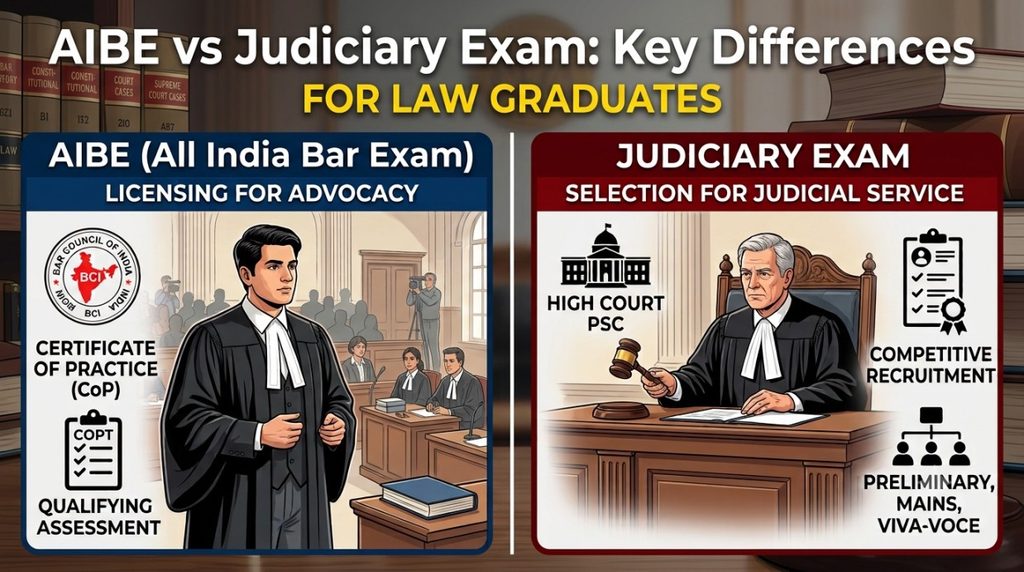
Navigating a legal career in India requires a clear understanding of post-graduation milestones. Fresh law graduates often weigh two pivotal examinations: the All India Bar Examination (AIBE) and the State Judicial Services Examination (commonly referred to as the Judiciary Exam). While both evaluate legal knowledge, their objectives, statutory frameworks, and career outcomes differ fundamentally. Understanding the difference between AIBE and Judiciary Exam helps candidates align their preparation with their long-term professional goals.
Background and Regulatory Context
The statutory foundation for legal practice and judicial recruitment in India rests on distinct legislative enactments.
[LL.B. Graduation from BCI-Recognized University]
                                         │
                   ┌─────────────────────┴─────────────────────┐
                   ▼                                           ▼
   [Advocates Act, 1961 Framework]            [Article 233/234 Framework]
   Provisional State Bar Enrolment            State Public Service Commission
                   │                                           │
                   ▼                                           ▼
      [All India Bar Examination]                 [Judiciary Examination]
                   │                                           │
                   ▼                                           ▼
    Licence to Practice Law (CoP)              Appointment as Civil Judge /
    across Courts in India                     Judicial Magistrate
Advocates Act, 1961: Section 24 sets out the conditions for admission as an advocate on a State Roll, while Section 49 empowers the Bar Council of India (BCI) to frame rules regarding practice standards. Under the Bar Council of India Rules, clearing the AIBE is mandatory to secure a permanent Certificate of Practice (CoP).
Constitutional Framework for Judicial Services: Articles 233 and 234 of the Constitution of India govern the recruitment of district judges and the judicial service of a State, executed via respective State Judicial Services Rules.
Core Operational Differences
1. Purpose and Career Outcome
- AIBE: Functioning as a national qualifying licensing assessment, the AIBE evaluates whether a law graduate possesses basic capabilities to practice law. Passing the exam yields a permanent Certificate of Practice issued by the BCI.
- Judiciary Exam: A competitive selection exam designed to recruit judicial officers (Civil Judge Junior Division / Judicial Magistrate First Class) into the state subordinate judiciary.
2. Examination Structure and Selection Mechanism
- AIBE Structure: Conducted twice annually as a single-stage, objective-type paper comprising 100 multiple-choice questions. It is a qualifying exam with no merit ranking. Candidates must secure 45% (General/OBC) or 40% (SC/ST/PwD) to pass.
- Judiciary Exam Structure: A rigorous three-tier competitive selection process comprising:
- Preliminary Examination: Objective screening test.
- Mains Examination: Descriptive essay and problem-solving papers covering substantive law, procedural law, judgment writing, and local state statutes.
- Viva-Voce / Personal Interview: Comprehensive evaluation of personality and legal aptitude.
3. Regulatory Authorities and Frequency
- AIBE: Regulated nationally by the Bar Council of India.
- Judiciary Exam: Administered at the state level by the respective High Court in coordination with the State Public Service Commission. Exam frequency depends on state-specific judicial vacancies.
Comparative Analysis: AIBE vs. Judiciary Exam
| Parameter | All India Bar Examination (AIBE) | State Judicial Services Examination |
| Primary Objective | Grant of permanent Certificate of Practice (CoP) | Selection for judicial office (Civil Judge) |
| Statutory Authority | Bar Council of India (Advocates Act, 1961) | State High Courts & Public Service Commissions |
| Evaluation Type | Qualifying criterion (Pass/Fail) | Competitive ranking based on merit cutoff |
| Passing Criteria | Fixed threshold (45% General, 40% SC/ST/PwD) | Variable cutoffs across Prelims, Mains, and Interview |
| Syllabus Focus | Pan-India central statutes & basic court procedure | Central laws, local state acts, language, judgment writing |
| Attempt Limit | Unlimited within provisional enrolment limits | Age-restricted (generally 21 to 35 years, subject to state relaxation) |
Rights, Obligations, and Procedural Requirements
- Mandatory Provisional Enrolment: To sit for the AIBE, a candidate must first be provisionally enrolled with a State Bar Council under Section 24 of the Advocates Act, 1961.
- Two-Year Compliance Rule: Under BCI rules, an advocate must clear the AIBE within two years of provisional state enrolment to avoid temporary suspension of their right to practice court litigation.
- Judicial Service Eligibility: Applicants must hold a recognized LL.B. degree and meet state-specific age criteria (typically between 21 and 35 years) under local State Judicial Services Rules.
Frequently Asked Questions (FAQs)
Yes. Candidates holding a recognized LL.B. degree can appear for Civil Judge Junior Division exams in most states upon graduation, provided they satisfy state eligibility conditions.
It is mandatory only for law graduates who intend to practice litigation before courts, tribunals, or authorities in India.
There is no limit on the number of attempts for the AIBE. However, provisional enrolment validity requires clearing the exam within two years to maintain active practice standing.
No. The AIBE is a qualifying licensing assessment that grants the legal right to practice as an advocate; it is not a government recruitment exam.
The standard qualifying mark is 45% for General/OBC candidates and 40% for SC/ST/PwD candidates.