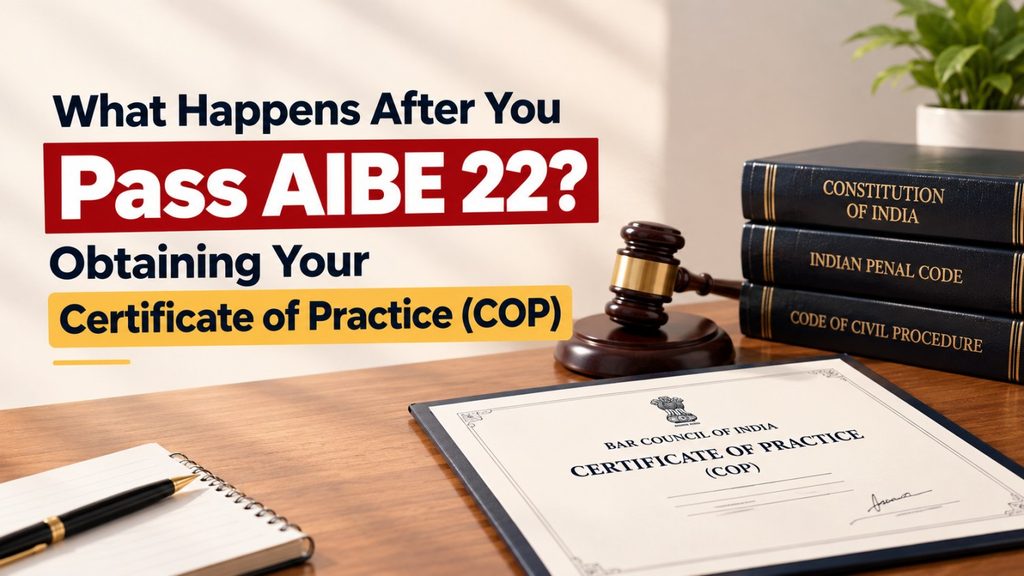
Clearing the All India Bar Examination is a monumental milestone for every law graduate in India. However, qualifying in the exam is only half the battle. Once results are declared, candidates must transition from holding temporary provisional practice rights to obtaining their permanent Certificate of Practice (COP) after passing AIBE 22. Issued under the authority of the Bar Council of India (BCI), this official document legally empowers law graduates to practice as full-fledged advocates across Indian courtrooms.
main article:
Rights and Obligations After Obtaining the COP
Acquiring a COP converts temporary provisional status into permanent legal authorization:
- Rights Granted: The advocate secures an absolute right to file a Vakalatnama (authorizing document to represent a client), appear before judicial forums, tribunals, commissions, and authority panels, and vote in local Bar Association elections.
- Mandatory Obligations: Under the Bar Council of India Rules (Chapter II, Part VI), an advocate holding a COP must maintain professional standards, adhere to dress codes, avoid taking up full-time salaried employment, and periodically submit verification forms (Form A) to retain active status.
Step-by-Step Procedure to Receive Your COP
Obtaining the physical or digital document involves administrative processing between national and state regulatory bodies:
- Verification of Result and Enrollment Record: The Bar Council of India cross-checks exam results with the enrollment master register sent by the respective State Bar Council.
- Dispatch to State Bar Councils: The BCI prints and dispatches physical certificates to individual State Bar Council headquarters.
- Collection or AIBE Mobile App Download: Advocates can collect their physical COP from their State Bar Council office or local district bar association, or download a digitally signed PDF copy via the official BCI mobile app.
- Form A Submission: The advocate completes the verification form declaring their primary place of practice and membership in a local Bar Association under the 2015 Verification Rules.
Consequences of Non-Compliance and Delay
Under Rule 9 of the All India Bar Examination Rules, if an advocate fails to clear the exam within two years of provisional enrollment, their provisional right to practice stands automatically suspended. They cannot file a Vakalatnama or appear in court until the exam is cleared and the COP is formally requested. Continued court practice during a period of suspension violates Section 45 of the Advocates Act, 1961, carrying penalties of up to six months of imprisonment.
Frequently Asked Questions (FAQs)
The physical COP is usually distributed through State Bar Councils within two to four months after result declaration, while digital copies are often available sooner on official BCI portals.
Yes, once your passing status is published on the official BCI portal, you can rely on your downloaded result summary alongside your State Bar provisional card until the hard copy is issued.
Submit an application for correction to your State Bar Council along with a copy of your State Bar enrollment certificate and AIBE scorecard for rectifications.
Yes, under Section 30 of the Advocates Act, 1961, a COP authorizes an advocate to practice in any court, tribunal, or authority across India.
While the COP itself marks permanent qualification, advocates must submit verification forms (Form A) every five years under the BCI Verification Rules, 2015 to keep their practicing status active.