Getting the BNS important sections for AIBE right can be the difference between comfortably clearing the exam and running out of time on criminal law questions. Since AIBE is a 100-question multiple choice test with no negative marking, knowing which sections repeatedly show up matters more than memorising the entire Bharatiya Nyaya Sanhita (BNS), 2023 cover to cover.
Click here to know the official details of AIBE: AIBE 22 Exam 2026: Complete Guide to Dates, Registration, Syllabus, and Eligibility
Why BNS Matters for AIBE Now
The BNS replaced the Indian Penal Code (IPC), 1860, with effect from 1 July 2024. It works alongside two companion laws: the Bharatiya Nagarik Suraksha Sanhita (BNSS), which replaced the Code of Criminal Procedure, and the Bharatiya Sakshya Adhiniyam (BSA), which replaced the Indian Evidence Act. Since AIBE tests candidates on currently applicable law, BNS has fully taken over from IPC in the criminal law portion of the syllabus. Candidates still familiar with IPC section numbers from law school need to actively relearn the new numbering, since old references no longer apply in the exam.
High Weightage BNS Sections for AIBE
Criminal law, including BNS, typically carries around 8 to 10 questions in the AIBE paper. Based on subject patterns, these areas consistently draw the most questions:
- General exceptions and definitions (Sections 14 to 44): covers concepts like private defence, insanity, consent, and mistake of fact. These are conceptually tested and appear frequently as MCQs.
- Offences against the human body (Sections 100 to 146): includes murder, culpable homicide, hurt, and kidnapping. Section 101 defines murder, replacing the earlier Section 302 of the IPC.
- Offences against women and children (Sections 63 to 99): rape is now defined under Section 63, with an added recognition of digital and electronic evidence in such cases.
- Offences against property (Sections 303 to 334): theft, robbery, extortion, and the newly created standalone offence of snatching.
- Criminal conspiracy and abetment (Sections 45 to 62): frequently tested through scenario-based questions.
- New and reorganised offences: organised crime, terrorism, and mob lynching are separately codified under BNS, unlike under the older IPC framework, and are increasingly likely to be tested given their novelty.
Key Statutory Provisions to Know
Beyond the sections above, candidates should be familiar with a few structural provisions:
- Section 4, BNS: lists the types of punishments recognised under the law, including the newly added community service.
- Section 2, BNS: contains consolidated definitions, replacing scattered definition sections under the old IPC.
- Section 152, BNS: covers acts endangering the sovereignty, unity, and integrity of India, replacing the older sedition provision.
- Section 111, BNS: defines organised crime as a distinct offence for the first time in Indian criminal law.
Rights and Obligations Under the New Framework
For candidates, understanding BNS is not just about memorising sections but also grasping how rights and obligations shift compared to the old law. The accused retains the right to general exceptions such as private defence and lack of criminal intent. Victims, particularly in offences against women, benefit from expanded definitions that now explicitly recognise digital evidence and deceptive sexual conduct as separate offences. Investigating agencies carry new obligations under the related BNSS, though procedural law itself is tested separately from BNS in the AIBE paper.
IPC to BNS Quick Comparison
| Old IPC Section | Subject | New BNS Section |
|---|---|---|
| 302 | Murder | 101 |
| 375 | Rape | 63 |
| 420 | Cheating | 318 |
| 124A | Sedition | 152 (redefined) |
| 34 | Common intention | 3(5) |
Suggested Study Sequence
A simple way to structure preparation:
General exceptions and definitions leads to offences against the body leads to offences against women and children leads to property offences leads to new offences like organised crime and terrorism leads to final revision using an IPC to BNS comparison chart.
This sequence mirrors how questions are usually distributed and avoids jumping between unrelated chapters.
Exceptions and Recent Developments
BNS removed certain provisions entirely, including adultery under the old Section 497 and the consensual portion of the earlier Section 377. Candidates should be aware these are no longer offences under the new law, a common point tested through elimination-based MCQs.
FAQs
No, BNSS and BSA are tested separately, though BNS carries significant weightage.
No, focus on high-frequency sections listed above rather than all 358 sections.
Only for comparison purposes; the exam tests current BNS numbering.
It has been redefined under Section 152 with a different scope.
Community service, added as a sentencing option under Section 4.
Recommended Reference Books:
For candidates who want to go beyond exam-focused summaries and study these laws in depth, the following reference texts are widely used by law students and practitioners:
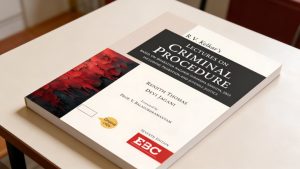
R.V. Kelkar’s Lectures on Criminal Procedure
By Renjith Thomas and Devi Jagani. Fully updated to the Bharatiya Nagarik Suraksha Sanhita, 2023, this book covers arrest, bail, investigation, trial procedure, and appeals in a structured lecture format, useful for building a strong grasp of criminal procedure alongside BNS.
View on EBC Webstore
V.P. Sarathi’s Law of Evidence
By Kumar Askand Pandey. This edition is based on the Bharatiya Sakshya Adhiniyam, 2023, and offers a comparative analysis against the earlier Evidence Act, 1872, with detailed treatment of electronic and digital evidence, a high-yield area for both AIBE and judiciary exams.
View on EBC Webstore
B.M. Gandhi’s Penal Law
Revised by K.A. Pandey. Updated in line with the Bharatiya Nyaya Sanhita, 2023, this is a standard reference for substantive criminal law, covering offences, punishments, and general exceptions in detail.
View on EBC Webstore
These titles are recommended for deeper study and are not required reading for AIBE; the exam itself only permits candidates to carry bare acts into the exam hall.
You May Also Like:
AIBE 22 Exam 2026: Complete Guide to Dates, Registration, Syllabus, and Eligibility
AIBE XXII Prep Guide: Bare Acts, Cutoff & Attempt Rules