1. Introduction: The Role of Academic Publications in Legal Education
Legal education forms the foundation of a well-informed and competent legal community. It enables students to understand the principles of law, appreciate judicial reasoning and develop the analytical skills necessary to interpret and apply legal provisions. In this process, authoritative academic publications play a vital role by offering structured knowledge, fostering critical thinking and providing reliable reference material for students, academicians, researchers and legal practitioners. They bridge the gap between theoretical understanding and the practical dimensions of the legal system.
Among the established publications in Indian legal education, P.S.A. Pillai’s Law of Tort (Revised by Dr. Avtar Singh, 9th Edition) holds considerable academic relevance. It serves as an important reference for understanding the principles governing civil wrongs, legal responsibilities and remedies available under tort law.
2. Understanding the Scope and Foundations of Tort Law
Tort law constitutes an important branch of civil law concerned with wrongful acts or omissions that infringe upon legally recognised rights and interests. It establishes the circumstances in which an individual may be held legally responsible for causing harm to another and provides remedies for addressing such violations
(i) Nature and Principles of Civil Wrongs
The subject encompasses several important principles, including negligence, nuisance, defamation and liability. These principles help explain the nature of legal obligations and the circumstances in which a breach of duty may give rise to civil liability.
(ii) Legal Duties, Liability and Remedies
A sound understanding of tort law enables students to examine the relationship between individual conduct, legal duties and accountability. It also introduces them to the remedies available to individuals whose legally protected interests have been infringed
(iii)Relevance of Tort Law in Contemporary Society
In contemporary society, questions concerning negligence, personal rights, civil liability and individual accountability frequently arise. The study of tort law therefore remains essential for understanding how the legal system protects individuals and addresses civil wrongs.
3. P.S.A. Pillai’s Law of Tort: An Established Academic Reference
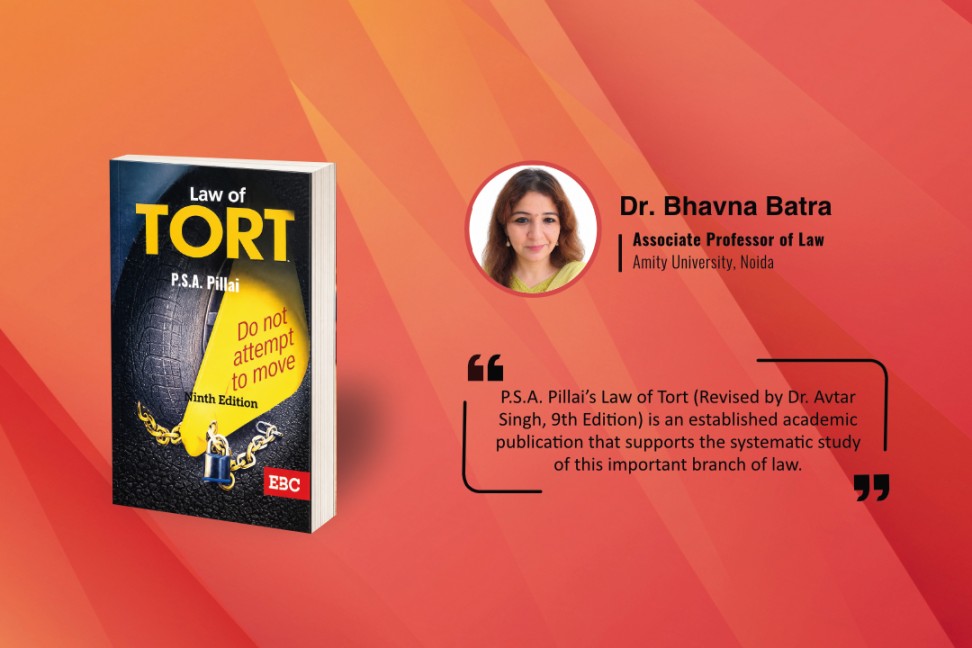
P.S.A. Pillai’s Law of Tort (Revised by Dr. Avtar Singh, 9th Edition) is an established academic publication that supports the systematic study of this important branch of law. Its continued recognition among legal readers reflects the importance of comprehensive textbooks in developing a sound understanding of foundational legal principles.
(i)Exploring the Ninth Edition
The revised ninth edition represents the continued academic relevance of this publication.
Established textbooks remain valuable because they provide students with a structured
foundation for approaching complex legal subjects and understanding the principles that govern them
(ii)Importance for Law Students and Academicians
For law students, a comprehensive reference work can assist in understanding fundamental concepts, preparing academic assignments and developing subject knowledge. For teachers and academicians, such publications provide useful material for classroom discussions, lectures and academic instruction.
(iii)Relevance for Researchers and Legal Practitioners
Researchers may find established academic works useful when examining legal doctrines and their broader implications. Legal practitioners may also refer to such publications to revisit fundamental concepts and strengthen their understanding of the underlying principles of tortious liability.
(iv)The Significance of Revised Editions in Legal Education
Legal education is dynamic and continually responds to judicial interpretations, legislative developments and changing social circumstances. Academic publications must therefore remain relevant to the evolving requirements of legal learning
4(i) Keeping Pace with Evolving Legal Principles
Revised editions help sustain the relevance of established legal knowledge by presenting
academic material within the context of developing jurisprudence. They encourage readers to remain engaged with the continuing evolution of legal principles.
(ii) Supporting Teaching, Research and Independent Learning
Updated academic resources are particularly beneficial in educational institutions, where
teachers require dependable reference material for lectures, discussions and research activities. Students, in turn, benefit from having organised academic resources that support independent learning.
(iii) Strengthening Conceptual Understanding
A systematic study of legal subjects encourages students to move beyond memorisation and develop a deeper understanding of legal doctrines. Such conceptual clarity is essential for interpreting legal issues and appreciating their practical implications
(iv) Scope for Further Academic Enrichment
While P.S.A. Pillai’s Law of Tort remains a valuable academic reference, certain additions could further enhance its pedagogical and practical usefulness in future editions.
5(i) Greater Inclusion of Practical Illustrations and Problem-Based Questions
The inclusion of additional problem-based questions, contemporary case studies and practical illustrations could strengthen the learning experience. Such exercises would encourage students to apply theoretical principles to hypothetical and real-life situations.
They would also help readers identify legal issues, analyse relevant principles and develop reasoned conclusions. This approach could further promote analytical thinking and prepare students for the practical dimensions of legal education
(ii) Wider Comparative Legal Perspectives
Another possible area of enrichment would be greater engagement with comparative legal developments and contemporary jurisprudential trends. Examining how different jurisdictions approach similar questions of tortious liability could broaden students’ understanding of legal principles.
A comparative perspective would also encourage critical thinking and enable researchers to appreciate the relationship between Indian legal principles and developments in international legal thought.
(iii) Encouraging Analytical and Critical Thinking
Greater emphasis on discussion-based exercises and analytical questions could further encourage independent reasoning among students. These additions would provide opportunities to evaluate different legal interpretations and understand the broader implications of civil liability.
These suggestions are intended as constructive recommendations for further strengthening an already established academic publication.
6. The Contribution of Comprehensive Textbooks to Legal Scholarship
The importance of authoritative legal textbooks extends beyond classroom instruction. They contribute to the development of informed legal professionals by providing a foundation for understanding individual rights, civil obligations and legal accountability.
(i) Building a Strong Foundation in Legal Studies
Publications such as P.S.A. Pillai’s Law of Tort contribute to the development of foundational legal knowledge by making important legal concepts accessible to students and other members of the legal community
(ii) Promoting Academic Research and Classroom Learning
Comprehensive academic resources support institutional teaching and research activities. They provide teachers with dependable reference material while encouraging students to engage more meaningfully with their subjects.
(iii) Connecting Legal Theory with Practical Understanding
A strong understanding of legal principles is essential for appreciating their application in real- world situations. Academic publications help establish this connection by encouraging readers to examine the relationship between legal doctrines and the responsibilities arising from them.
(iv)Acknowledgement and Concluding Observations
I express my sincere gratitude to Eastern Book Company (EBC) for the thoughtful gesture of providing a complimentary copy of P.S.A. Pillai’s Law of Tort (Revised by Dr. Avtar Singh, 9th Edition) for academic review. Initiatives of this nature provide academicians with an opportunity to engage with established legal publications, assess their academic usefulness and share constructive observations for the benefit of the wider legal community. In my assessment, P.S.A. Pillai’s Law of Tort remains a useful academic resource for law students, academicians, researchers and legal practitioners. Its established recognition and continued relevance reinforce the importance of dependable textbooks in developing a strong foundation in legal education.
I wish Eastern Book Company continued success in its endeavour to promote quality legal literature, support academic excellence and contribute meaningfully to the advancement of legal education in India
Want the deeper dive? Grab the reference book.