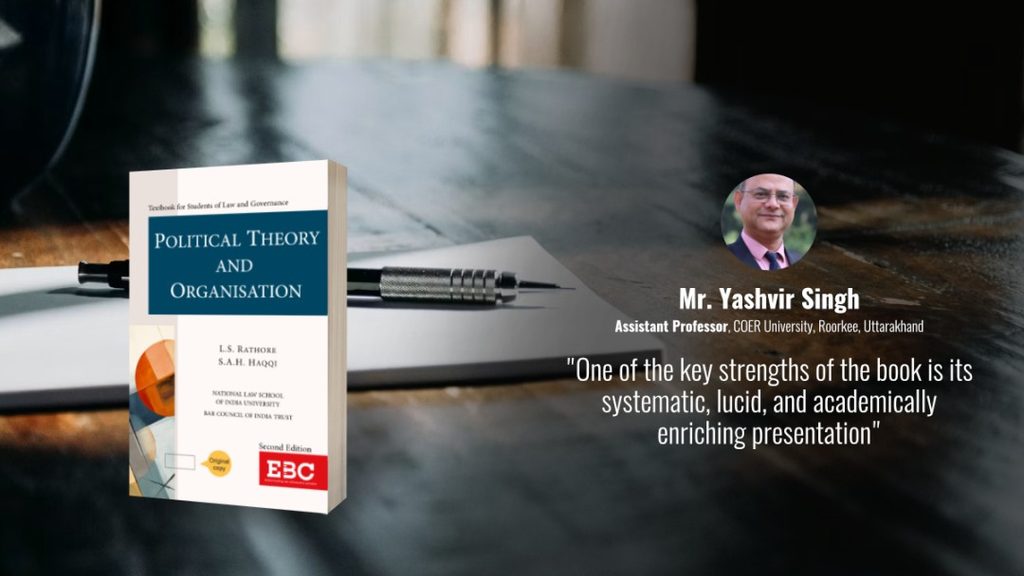
Reviewed by Mr. Yashvir Singh, Assistant Professor at COER University, Roorkee, Uttarakhand, this piece examines a text that has long served as the entry point for first-year law students into the abstractions of sovereignty, liberalism, and the state. The book traces the evolution of political thought, from Western liberalism to Marxist and Gandhian ideas, while grounding these theories within the Indian constitutional context. Drawing on his academic experience in legal education, Mr. Singh evaluates how the 2nd Edition (2026) holds up as both a foundational teaching text and a conceptual reference amid ongoing debates on federalism and separation of powers. This review offers his assessment of the book’s continued relevance for today’s law students.
A Comprehensive Guide to Political Theory and Organisation
Political Theory and Organisation, 2nd Edition is a valuable and insightful academic work that offers readers a structured understanding of the fundamental concepts, principles, and dimensions of political theory and organisation. The book is particularly relevant for students of Political Science, while also serving as a useful reference for teachers, researchers, and scholars engaged in the study of political thought and institutions.
Clear and Systematic Presentation
One of the key strengths of the book is its systematic, lucid, and academically enriching presentation. The subject matter is organised in a manner that enables readers to approach various political concepts with greater clarity and understanding. The accessible style of presentation makes the book suitable for students who are developing their foundational knowledge as well as for readers seeking to strengthen their conceptual understanding of Political Science.
Comprehensive Coverage of the Subject
The book provides comprehensive coverage of important aspects of political theory and organisation, allowing readers to develop a broader perspective on the discipline. By bringing together fundamental concepts and their theoretical dimensions in an organised manner, the book facilitates a meaningful engagement with the subject and encourages readers to appreciate the significance of political ideas and organisational structures.
Analytical and Academically Relevant Approach
Another significant feature of the book is its analytical approach. Rather than limiting the discussion to basic definitions and concepts, the work provides an academic framework through which students and scholars can engage with the subject in a more thoughtful manner. This makes it particularly useful for classroom discussions, academic assignments, examinations, and further research.
Useful Resource for Students and Teachers
The book can serve as a valuable teaching and learning resource in academic institutions. Its clarity and structured treatment of the subject can assist teachers in explaining important concepts and help students in developing a strong conceptual foundation. It may also prove beneficial to researchers and scholars looking for a reliable reference while exploring themes related to political theory and organisation.
Relevance for Contemporary Academic Study
The book also holds considerable relevance for contemporary academic study, as a sound understanding of political theory and organisation is essential for analysing the functioning of political systems, institutions, and governance. Its structured treatment of the subject can encourage students to develop a more critical and informed perspective while connecting theoretical knowledge with broader academic discussions. The book can therefore contribute meaningfully to conceptual learning, critical thinking, classroom engagement, and independent academic study, making it a useful resource for those pursuing Political Science at different levels.
Overall, Political Theory and Organisation, 2nd Edition is a well-structured and academically useful work that combines comprehensive coverage with clarity and an analytical perspective. Its systematic presentation makes it accessible to students, while its broader academic approach enhances its relevance for teachers and researchers. The book is therefore a worthwhile addition to the academic resources available to students and scholars of Political Science.
Want the deeper dive? Grab the reference book.