A Classic Text Reimagined for Criminal Procedure Under the BNSS
Criminal procedure is one of the most important branches of the legal system, providing the framework through which criminal law is administered, investigated, and adjudicated. For law students, judicial service aspirants, academicians, and practising advocates, understanding criminal procedure requires more than familiarity with statutory provisions. It demands a clear understanding of how the law operates at every stage of a criminal case, from the initial investigation to the final
execution of a sentence.
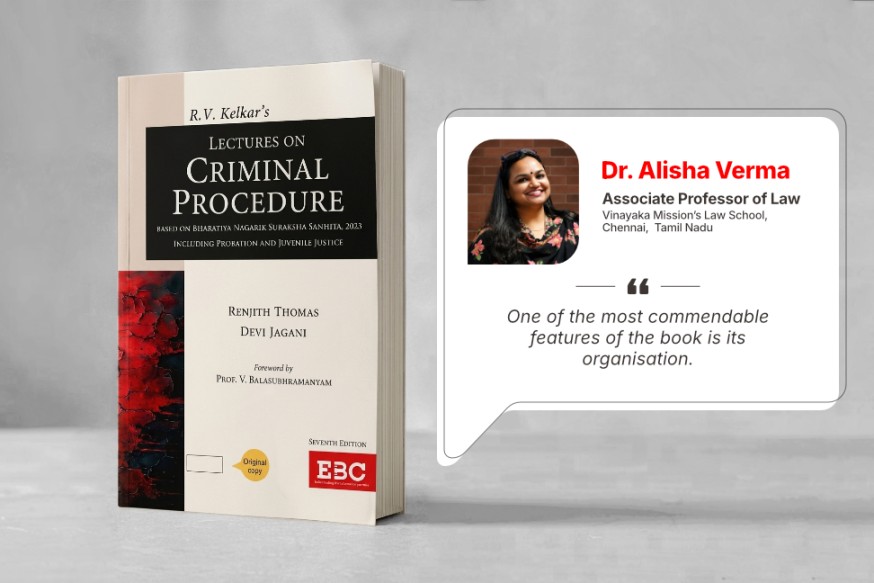
In this context, the seventh edition of R.V. Kelkar’s Lectures on Criminal Procedure, revised by Renjith Thomas and Devi Jagani, is a noteworthy contribution to legal education. Building upon the reputation of an established textbook, this edition addresses the changing landscape of criminal procedure under the Bharatiya Nagarik Suraksha Sanhita, 2023 (BNSS). Rather than treating the new legislation as a mere replacement for the Code of Criminal Procedure, 1973 (CrPC), the book seeks to explain procedural law in a manner that is accessible, systematic, and relevant to contemporary legal practice.
The result is a work that retains the pedagogical strengths of its predecessor while adapting its approach to the requirements of the new criminal law framework.
A Structure That Follows the Life of a Criminal Case
One of the most commendable features of the book is its organisation. The twenty-two lectures are arranged to follow the progression of a criminal case, rather than simply reproducing the numerical sequence of statutory provisions. This approach makes the subject considerably easier to understand, particularly for readers encountering criminal procedure for the first time.
The discussion begins with foundational aspects such as arrest, search and seizure, and investigation. It then moves to cognizance, bail, and the principles governing a fair trial before examining the different forms of criminal trials. The later lectures address judgments, appeals, revision, and the execution of sentences.
This sequence reflects the practical development of a criminal proceeding. Readers can appreciate not only what the law provides at a particular stage but also why that stage matters in the broader administration of criminal justice.
For students who often find procedural law fragmented across numerous sections, this arrangement offers a valuable conceptual framework. It enables them to connect individual provisions with the larger process and understand how procedural decisions made at one stage may influence subsequent proceedings The lecture-based format also makes the book suitable for structured classroom teaching and
independent study. Each topic can be approached as a distinct unit while remaining connected to the overall subject.
Clarity Without Compromising Legal Rigour
Another major strength of R.V. Kelkar’s Lectures on Criminal Procedure is its clear and precise language. Criminal procedure involves numerous technical concepts, statutory requirements, and judicially developed principles. Presenting these elements in a way that is easy to follow without oversimplifying the law is a significant challenge. The book addresses this challenge effectively. Its explanations are accessible to beginners, yet the treatment remains sufficiently rigorous for readers seeking a deeper understanding of procedural law. Statutory provisions are considered alongside judicial decisions that explain their interpretation and practical significance.
This combination is particularly important because criminal procedure cannot be understood through statutory language alone. Judicial decisions frequently clarify the limits of investigative powers, the rights of accused persons, the exercise of judicial discretion, and the safeguards necessary to ensure a fair trial.
By bringing legislation and case law together, the book helps readers appreciate how procedural rules function in practice. It also encourages a more analytical approach to legal study, moving beyond the memorisation of sections towards an understanding of the principles underlying them. For young advocates, this clarity can be especially useful when navigating procedural questions in
day-to-day practice. For students, it provides a sound foundation for further engagement with judicial precedents and statutory interpretation
Adapting to the New Criminal Procedure Framework
The transition from the CrPC to the BNSS represents a significant development in Indian criminal law. For legal educators and practitioners, the challenge lies not merely in learning new statutory references but in understanding the changes introduced by the new framework and their implications for criminal proceedings.
The seventh edition responds to this challenge by reorganising and revising the material around the BNSS. Its approach goes beyond replacing old section numbers with new ones. It seeks to engage with the developments that distinguish the new legislation and place them within the broader framework of criminal procedure.
Among the areas addressed are the increased role of technology in procedural processes, changes to the plea-bargaining framework, and safeguards associated with arrest. These subjects are particularly relevant to contemporary legal practice, where questions of procedural fairness, efficient investigation, and the protection of individual rights remain central.
The book’s treatment of the new regime is valuable because students and practitioners need to understand both the statutory framework and the practical context in which it operates. A revised textbook must help readers move from familiarity with the earlier law to a meaningful understanding of the present framework.
The inclusion of dedicated attention to probation and juvenile justice further broadens the book’s scope. hese subjects highlight the importance of rehabilitation, individual circumstances, and the distinct considerations that may arise in criminal justice administration
A Valuable Resource for Students, Teachers, and Practitioners
The book’s usefulness extends beyond its explanatory chapters. The exercises provided at the end of each lecture are an important feature, encouraging readers to engage actively with the material rather than passively absorb information.
Such exercises can help students develop the ability to interpret statutory provisions, identify procedural issues, and apply legal principles to practical situations. This approach is particularly beneficial in legal education, where the ability to reason through a problem is as important as knowledge of the law itself.
For teachers, the twenty-two-lecture structure provides a convenient framework for planning a semester-long course. The organisation of the material allows topics to be introduced progressively, helping students build their understanding from the foundational stages of criminal procedure to more advanced questions concerning judgments and appellate remedies.
Judicial service aspirants may also find the book useful as a foundational reference. Its systematic arrangement and accessible explanations can assist in building conceptual clarity, which is essential for examinations that test both statutory knowledge and the application of legal principles. Similarly, young practitioners transitioning from the CrPC to the BNSS may benefit from the book’s structured presentation. It offers a starting point for understanding the new procedural framework while reinforcing the importance of reading statutory provisions in conjunction with relevant judicial decisions
Scope for Further Development
While the seventh edition makes a meaningful effort to address the new procedural regime, there remains scope for further development in future editions. One particularly useful addition would be a more explicit discussion of the relationship between the BNSS and the Bharatiya Sakshya Adhiniyam, 2023 (BSA). Criminal procedure and the law of evidence are closely connected. Questions concerning investigation, the collection and preservation of evidence, the admissibility of electronic records, and the conduct of criminal trials frequently require an understanding of both procedural and evidentiary principles. A more integrated discussion of these connections would help readers appreciate how the three new criminal laws operate together. For example, procedural rules governing investigation and the collection of material must often be considered alongside the evidentiary principles that determine how such material may be presented and evaluated in court. Future editions could therefore benefit from comparative illustrations, cross-references, or practical examples showing how the BNSS and BSA interact in common procedural situations. Such additions would strengthen the book’s practical orientation and help readers develop a more comprehensive understanding of the contemporary criminal justice framework. This suggestion does not diminish the value of the present edition. Rather, it identifies an opportunity to build upon its existing strengths and make it an even more effective resource for legal education and practice.
The seventh edition of R.V. Kelkar’s Lectures on Criminal Procedure, revised by Renjith Thomas and Devi Jagani, demonstrates how an established legal textbook can retain its relevance while adapting to legislative change. Its greatest strengths lie in its logical organisation, accessible language, engagement with judicial decisions, and attention to the procedural framework introduced by the BNSS.
By presenting criminal procedure through the progression of a criminal case, the book makes a complex subject easier to navigate. Its lecture-based format and end-of-lecture exercises support both classroom teaching and independent learning, while its treatment of the new legislation makes it a useful starting point for readers adjusting to the contemporary legal framework. Although a closer integration of procedural law with the Bharatiya Sakshya Adhiniyam would further enhance future editions, the book already offers a strong foundation for understanding criminal procedure under the new laws.
Ultimately, R.V. Kelkar’s Lectures on Criminal Procedure is more than a revised textbook. It is a bridge between established principles of criminal procedure and the evolving statutory framework governing criminal justice in India. For law students, judicial service aspirants, teachers, and young practitioners, it deserves serious consideration as an essential reading resource.
Want the deeper dive? Grab the reference book.