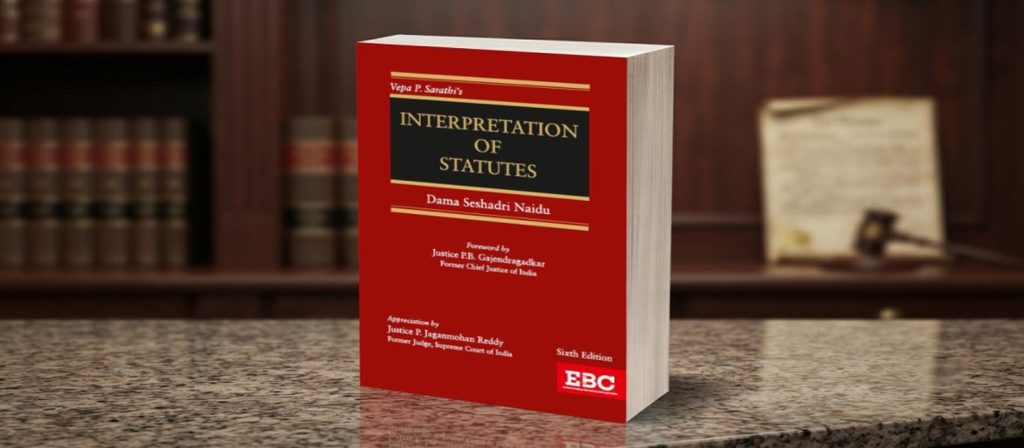
If you have ever read a law and wondered why courts sometimes go beyond its plain words, you have already brushed against one of the oldest debates in legal theory: the difference between interpretation and construction of statute. Though commonly used as if they mean the same thing, these are two distinct techniques Indian courts use to understand and apply the law. Getting this distinction right matters, because it directly affects how rights, duties, and penalties under any Indian statute are decided in practice.
What Does “Interpretation” of a Statute Mean?
Interpretation is the process of finding the true meaning of the words a statute actually uses, without adding to or altering what the legislature wrote. Courts look at the plain, grammatical meaning of the text and apply it directly when it produces a clear, sensible result. This approach is used when the language of a provision is already clear and free from ambiguity.
What Does “Construction” of a Statute Mean?
Construction comes into play when the words of a statute are unclear, silent on a point, or open to more than one meaning. Here, courts do not merely read the words; they draw reasoned conclusions about legislative intent by examining the object of the law, the scheme of the whole Act, and the surrounding context. Construction allows courts to give an ambiguous provision a workable meaning consistent with the law’s purpose.
Key Statutes Governing Interpretation and Construction in India
India does not have one standalone “Interpretation Act” like some countries. Instead, several provisions guide rules of statutory interpretation in India:
- General Clauses Act, 1897: The primary statute used for interpretation and construction of statute in India. Section 3 defines common terms (such as “person,” “immovable property,” “financial year”) that apply to all Central Acts and Regulations unless the specific statute says otherwise. Section 6 governs the effect of repeal of an Act, guiding how existing rights are treated once a law is withdrawn.
- Article 367 of the Constitution of India: States that the General Clauses Act, 1897 applies to interpreting the Constitution itself, unless the context requires otherwise, linking ordinary statutory rules to constitutional interpretation.
- Definition Clauses (Section 2) in Individual Statutes: Most major laws, including the Indian Contract Act, 1872, the Transfer of Property Act, 1882, and the Bharatiya Nyaya Sanhita, 2023, contain their own Section 2 defining key terms used in that Act. These internal definitions override general dictionary meanings.
- Definitions in Delegated Legislation: Rules and regulations framed under an Act often carry their own definitions section, which must be read in harmony with the parent statute.
Comparison Table: Interpretation vs. Construction of Statute
| Aspect | Interpretation | Construction |
|---|---|---|
| Meaning | Finding the true meaning of words already used in the statute | Drawing legal conclusions when words are ambiguous or silent |
| When Used | When the language is plain and unambiguous | When words are vague, ambiguous, or capable of multiple meanings |
| Scope | Confined to the text of the statute | Goes beyond the bare text to legislative intent and context |
| Approach | Grammatical and literal | Purposive and contextual |
| Governing Principle | Literal rule of interpretation | Golden rule, mischief rule, purposive construction |
| Result | Direct application of the words | Filling gaps or resolving ambiguity through reasoned inference |
Rights, Duties, and Practical Implications
This distinction has real consequences beyond the classroom:
- Rights: A party may argue for the literal meaning of a provision if it favours them, while the other side may push for a purposive construction, particularly in welfare legislation.
- Duties: Lawyers drafting statutes, contracts, or pleadings must anticipate both interpretive approaches to avoid unintended outcomes.
- Administrative bodies: Regulators interpreting rules under delegated legislation must stay within the bounds of the parent Act, since construction cannot be used to expand power beyond legislative intent.
Frequently Asked Questions
Interpretation finds the meaning of words already present in a statute, while construction draws conclusions about legislative intent when the words are unclear or silent.
No. India relies mainly on the General Clauses Act, 1897, along with definition clauses in individual statutes, rather than one dedicated interpretation law.
The General Clauses Act, 1897 is the primary statute, applying to all Central Acts and Regulations unless a specific law provides otherwise.
Largely yes. Article 367 applies the General Clauses Act, 1897 to constitutional interpretation, unless the context requires a different approach.
When the statutory language is ambiguous, silent, or capable of more than one reasonable meaning.
Want the deeper dive? Grab the reference book.