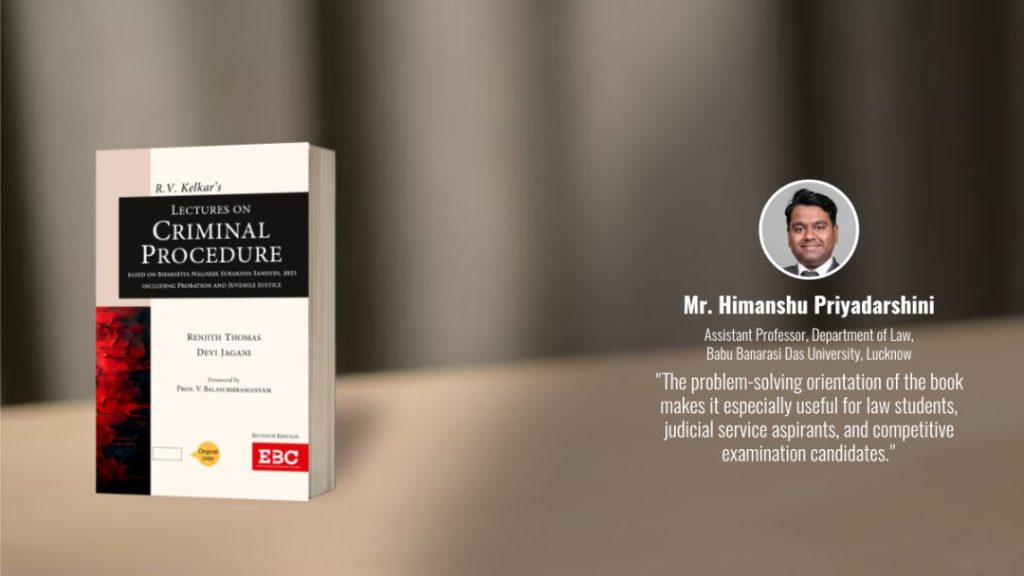
With the Bharatiya Nagarik Suraksha Sanhita, 2023 reshaping criminal procedure in India, R.V. Kelkar’s Lectures on Criminal Procedure, revised by Renjith Thomas and Devi Jagani, remains a vital academic resource. In this review, Mr. Himanshu Priyadarshi, Assistant Professor at the Department of Law, Babu Banarasi Das University, Lucknow, examines how well the book bridges the shift from the CrPC to the new BNSS framework.
The enactment of the Bharatiya Nagarik Suraksha Sanhita, 2023 (BNSS) marks a transformative moment in India’s criminal justice system, replacing the long-standing Code of Criminal Procedure, 1973. In this period of transition, legal scholars, students, practitioners, and judicial aspirants require reliable resources that not only explain the new statutory framework but also place it within the broader context of criminal procedure. The 7th Edition of Prof. R.V. Kelkar’s Lectures on Criminal Procedure, revised by Dr. Renjith Thomas and Devi Jagani, successfully fulfills this need and emerges as an indispensable guide to understanding contemporary criminal procedure
A Thoughtful Transition from CrPC to BNSS
One of the most commendable aspects of this edition is the manner in which it navigates the shift from the CrPC to the BNSS. The revising authors have meticulously incorporated the legislative changes introduced by the new law while preserving the intellectual depth and clarity that have made Prof. Kelkar’s work a trusted resource for generations. Readers are able to appreciate both the continuity and the evolution of procedural law, making the book particularly valuable during this period of legal transition.
A Chronological and Practical Approach
Unlike many procedural law texts that merely provide section-wise commentary, this book adopts a chronological approach to the criminal process. Beginning with investigation and police powers, it takes readers through arrest, bail, inquiry, trial, sentencing, and post-conviction remedies in a logical and engaging manner. This thematic organization allows readers to understand criminal procedure as an interconnected system rather than a collection of isolated provisions
Comprehensive Coverage Beyond Core Procedure
The book’s scope extends beyond the primary provisions of criminal procedure. Important areas such as probation laws, juvenile justice, and related procedural safeguards are discussed alongside the main text, offering readers a holistic understanding of the criminal justice framework. Such comprehensive treatment ensures that students and practitioners gain exposure to the broader ecosystem within which criminal procedure operates.
Excellence in Pedagogical Design
What truly distinguishes this work is its exceptional pedagogical structure. The lecture-based format makes the subject approachable without sacrificing academic rigor. Each chapter concludes with carefully designed exercises and questions that encourage analytical thinking and deeper engagement with the subject. The inclusion of constitutional issues, problem-based learning exercises, and references to important academic literature transforms the book from a mere textbook into a complete learning resource.
A Valuable Resource for Students and Faculty
The problem-solving orientation of the book makes it especially useful for law students, judicial service aspirants, and competitive examination candidates. At the same time, law teachers will find the discussion questions and analytical exercises highly effective for classroom discussions, assignments, seminars, and research-based learning. The book therefore serves the needs of multiple stakeholders within legal education.
Relevance in Contemporary Criminal Jurisprudence
As India’s criminal justice system adapts to the BNSS framework, there is a growing demand for authoritative resources that explain the practical implications of procedural reforms. This edition succeeds in bridging the gap between legislative changes and their application in legal practice. By integrating contemporary developments with established principles of criminal jurisprudence, the authors have ensured that the text remains both relevant and future-oriented.
The 7th Edition of R.V. Kelkar’s Lectures on Criminal Procedure successfully preserves the strengths of the original work while adapting it to the realities of the BNSS era. Its clear exposition, thematic organization, comprehensive coverage, and pedagogical excellence make itM one of the most valuable resources available on criminal procedure today. For students, teachers, judicial aspirants, and legal practitioners seeking a thorough understanding of procedural law in contemporary India, this book is an essential addition to their library.