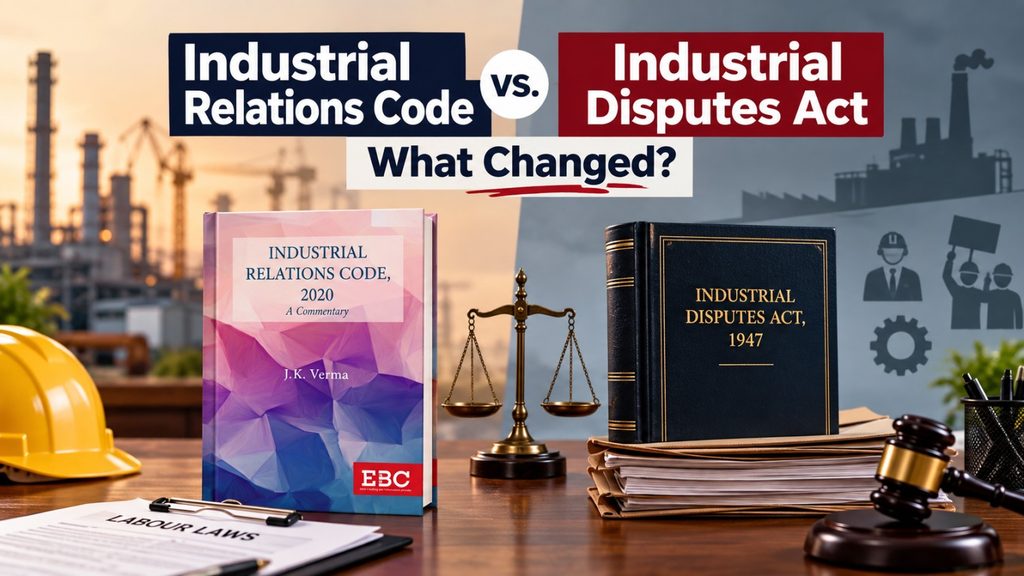
The Industrial Relations Code, 2020 (IR Code) replaced the Industrial Disputes Act, 1947 (ID Act) when it came into force on 21 November 2025. For anyone comparing the Industrial Relations Code vs Industrial Disputes Act, the headline is simple: higher thresholds for employers, strike notice for every establishment, and a new reskilling fund. This guide explains each change in plain language.
Background
Section 104 of the IR Code repeals three laws: the Trade Unions Act, 1926, the Industrial Employment (Standing Orders) Act, 1946 and the ID Act. The Industrial Relations (Central) Rules, 2026 were notified on 8 May 2026 to operate the Code. State rules also matter, so check your State.
Industrial Relations Code vs Industrial Disputes Act: Key Differences
| Issue | ID Act, 1947 | IR Code, 2020 |
|---|---|---|
| Worker definition | Supervisors earning up to ₹10,000 a month | Supervisors up to ₹18,000, plus working journalists and sales promotion employees |
| Standing orders | 100 or more workers | 300 or more workers (Section 28) |
| Government permission for layoff, retrenchment, closure | 100 or more workers | 300 or more workers (Section 77) |
| Strike notice | Public utility services only | All industrial establishments, 60 days (Section 62) |
| Adjudication | Labour Courts and Tribunals | Two-member Industrial Tribunals |
| Union recognition | No statutory process | Negotiating union with 51% support (Section 14) |
| Reskilling | None | Worker Re-skilling Fund (Section 83) |
Standing Orders
Standing orders are written rules on service conditions such as shifts, leave and misconduct. Under Section 28, they now apply to establishments with 300 or more workers, up from 100 under the 1946 Act. Model standing orders fill the gap for smaller units.
Strike Notice Rules
Under Section 62, no worker may strike without 60 days’ notice. Strike also covers concerted mass casual leave. Strikes are barred within 14 days of giving notice, before the notice expires, and during conciliation, tribunal or arbitration proceedings and for set periods afterwards. Earlier, notice was needed only in public utility services.
Retrenchment Under the Industrial Relations Code
Retrenchment means ending a worker’s service for surplus labour. Under Section 70, the employer must give one month’s notice, pay 15 days’ average pay for every completed year of service and inform the government. Section 83 adds a Worker Re-skilling Fund, to which the employer contributes 15 days’ wages for each retrenched worker. Rules also require employers to inform eligible retrenched workers of vacancies.
Government permission for layoff, retrenchment or closure now applies to establishments with 300 or more workers (Section 77).
Fixed-Term Employment and Trade Unions
Fixed-term employees get the same working hours, wages and allowances as permanent workers. Gratuity is payable after one year under the Code on Social Security, 2020.
A trade union needs at least 10% of the workers or 100 workers, whichever is less, with a minimum of seven members, to register. Under Section 14, a union with 51% membership is the sole negotiating union. Otherwise, a negotiating council of unions is formed.
How Disputes Are Resolved
Grievance Redressal Committee (20 or more workers)
↓
Conciliation Officer
↓
Industrial Tribunal
↓
High Court (writ jurisdiction, Article 226)
Penalties and Remedies
Chapter XIV provides fines, and imprisonment for some offences, for breaches such as illegal strikes, missing notice or wrongful retrenchment. Many offences can be compounded, meaning settled by paying a fee. Workers can use the grievance committee, conciliation or the Tribunal.
Frequently Asked Questions
No. Section 104 of the IR Code repeals it.
Yes. Section 62 covers all industrial establishments.
Only from standing orders and permission rules. Other duties still apply, and governments may change thresholds by notification.
Yes, if it is concerted, the Code treats it as a strike.
Yes, the same as permanent workers, with gratuity after one year.
For a deeper understanding, you can refer to these resource: