The Civil Procedure Code, 1908 (CPC) forms the backbone of civil litigation in India. From the institution of a suit to the execution of a decree, the CPC provides the procedural framework that governs how civil disputes are resolved in courts. For advocates, judges, law students, and legal professionals, a thorough understanding of procedural law is just as important as knowledge of substantive law.
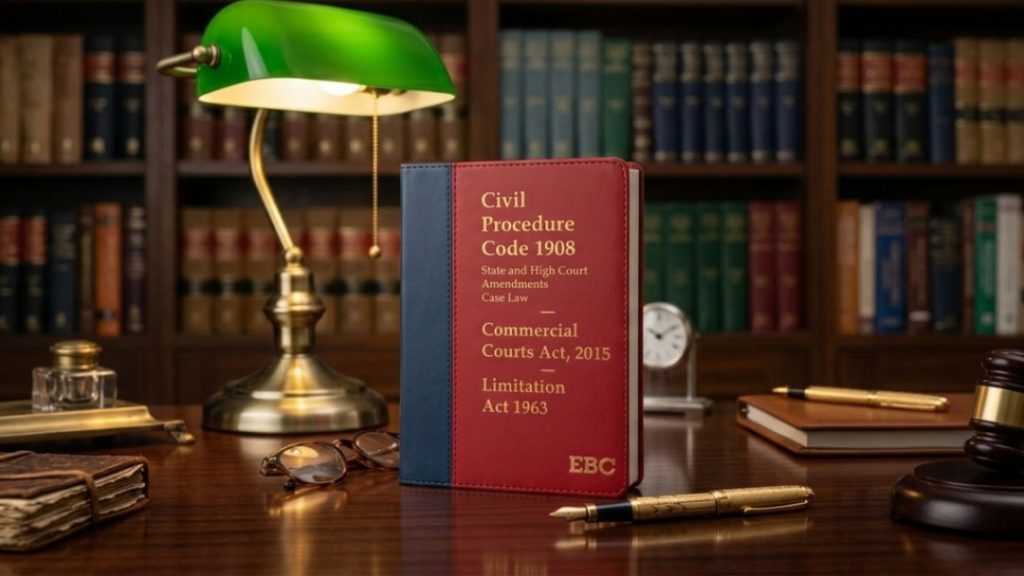
In a profession where quick access to legal provisions can make a significant difference, the Civil Procedure Code, 1908 (Coat Pocket Edition) emerges as a valuable and practical resource. Designed to be portable without compromising on content, this updated edition serves as a reliable reference for anyone engaged with India’s civil justice system.
Why the Civil Procedure Code Matters
Procedural law is often described as the machinery through which substantive rights are enforced. Even the strongest legal claim can fail if the proper procedure is not followed. The CPC lays down the rules governing:
- Institution of suits
- Service of summons
- Framing of issues
- Examination of witnesses
- Interim reliefs and injunctions
- Appeals and revisions
- Execution of decrees
For legal practitioners and students alike, understanding these procedural requirements is essential for effective participation in civil litigation.
Given the complexity and volume of procedural provisions, having a concise yet comprehensive reference at hand can significantly improve efficiency and accuracy.
A Compact Edition Designed for Practical Use
One of the most notable features of this edition is its coat pocket format. Unlike bulky legal commentaries that are often confined to office desks or libraries, this volume is designed for mobility and convenience.
Whether appearing before a court, preparing arguments, conducting legal research, or studying for examinations, users can easily carry this edition and access relevant provisions whenever needed.
The compact design makes it particularly useful for:
- Courtroom appearances
- Client consultations
- Judicial proceedings
- Academic study
- Competitive examination preparation
The portability of the book does not come at the expense of substance. Instead, it successfully combines convenience with comprehensive legal coverage.
Updated with the Latest Legislative Developments
Law is constantly evolving, and procedural statutes are no exception. This edition has been updated up to Act 37 of 2025 and incorporates amendments effective as of 7 April 2026.
This ensures that readers have access to the most current version of the law without needing to cross-reference multiple sources.
For legal professionals, staying updated is not merely a matter of convenience—it is a professional necessity. An outdated procedural provision can lead to incorrect advice, procedural errors, or unnecessary delays in litigation.
By incorporating recent legislative changes, this edition provides readers with a dependable and current legal resource.
Inclusion of State and High Court Amendments
One of the practical challenges in applying the CPC is that procedural rules often vary due to State Amendments and High Court Amendments.
These local modifications can have a significant impact on litigation practice and procedural requirements.
This edition addresses that challenge by incorporating relevant amendments, allowing readers to gain a more complete understanding of how the CPC operates across different jurisdictions.
For practitioners appearing before various courts, such inclusions enhance the book’s practical value and usefulness.
Special Focus on Commercial Litigation
The growth of commercial disputes has transformed civil litigation in India. To address the need for faster and more efficient resolution of commercial matters, the legislature introduced the Commercial Courts Act, 2015.
This edition incorporates:
- The Commercial Courts Act, 2015.
- CPC amendments applicable to commercial disputes.
- Relevant procedural provisions affecting commercial litigation.
As commercial litigation continues to expand in importance, understanding these specialized procedures has become increasingly necessary for legal professionals.
The inclusion of commercial law provisions makes this edition particularly relevant for advocates handling business and corporate disputes.
Added Value Through the Limitation Act, 1963
Another major advantage of this volume is the inclusion of the Limitation Act, 1963.
Limitation periods often determine whether a legal claim can be entertained by a court. Missing a statutory deadline can result in the loss of valuable legal rights.
Since questions of limitation frequently arise alongside procedural issues, the inclusion of the Limitation Act allows readers to consult both statutes in a single volume.
This integrated approach enhances convenience and reduces the need to carry multiple books.
Who Should Read This Book?
This edition has been designed to meet the needs of a diverse legal audience.
It is particularly useful for:
Advocates
Who require immediate access to procedural provisions during litigation.
Judges and Judicial Officers
Who need a reliable and portable procedural reference.
Law Students
Preparing for examinations, internships, moot courts, and legal research.
Legal Academicians
Teaching and researching procedural law.
Corporate Legal Departments
Handling civil disputes and compliance-related matters.
Litigants
Seeking a better understanding of the procedural aspects of their cases.
For further reading and detailed analysis, refer to this resource.