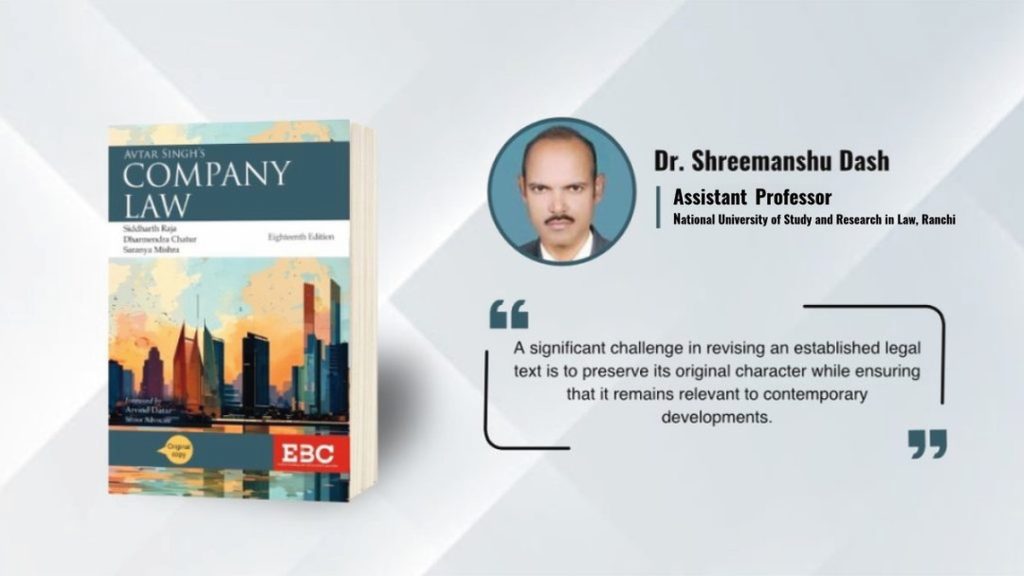
A Classic Work in a Changing Corporate Landscape
Avtar Singh’s Company Law occupies an important place in the literature on Indian company law. Over the years, the work has been valued for presenting a complex area of law in a structured and accessible manner. The 18th edition, revised by Siddharth Raja, Dharmendra Chatur and Saranya Mishra, seeks to carry this established legacy forward while engaging with the considerable changes that have shaped Indian corporate law in recent years. The evolution of corporate regulation under the Companies Act, 2013, together with continuing legislative amendments, regulatory developments and judicial decisions, has significantly altered the environment in which companies function. Against this background, the revised edition attempts to provide readers with both the foundational principles of company law and an understanding of its contemporary application.
From Fundamental Principles to Contemporary Corporate Law
One of the notable features of the book is its systematic approach. Instead of treating company law as a series of disconnected statutory provisions, the work develops the subject progressively.. The discussion begins with foundational concepts such as incorporation, registration and corporate personality before moving into the memorandum and articles of association, promoters, prospectus, securities, shareholders and share capital. The subsequent treatment of directors, meetings, dividends, accounts and audit, borrowing, investments and debentures gradually introduces the reader to the functioning and governance of companies. The later chapters address areas such as majority and minority rights, oppression and mismanagement, investigation, corporate restructuring and winding up. This arrangement allows readers to appreciate how different aspects of company law interact with one another.
Keeping the Legacy of Avtar Singh Relevant
A significant challenge in revising an established legal text is to preserve its original character while ensuring that it remains relevant to contemporary developments. The 18th edition appears to approach this task by retaining the conceptual foundation associated with Avtar Singh’s work while incorporating developments in modern corporate regulation. The contemporary company does not operate in isolation. Its activities are influenced by a network of statutory authorities and regulatory institutions, including the Ministry of Corporate Affairs, Registrar of Companies, National Company Law Tribunal, National Company Law Appellate Tribunal and Securities and Exchange Board of India. The revised edition places company law within this wider institutional framework. This makes the book relevant not merely as a study of statutory provisions but also as an introduction to the regulatory environment in which corporate entities operate.
The Importance of Case Law
Company law is an area in which judicial decisions have played a particularly important role inm shaping legal principles. The language of legislation often acquires its practical meaning through judicial interpretation. The book’s engagement with judicial decisions therefore adds considerable value to its treatment of the subject. Doctrines such as separate legal personality, lifting of the corporate veil, majority rule, minority protection, directors’ responsibilities and oppression and mismanagement are easier to understand when their development is examined through judicial decisions. For students, this approach helps bridge the gap between learning a statutory provision and understanding how that provision operates in practice. For researchers and practitioners, the incorporation of case law provides a useful foundation for further examination of specific corporate-law questions.
A Useful Resource for Legal Education
The pedagogical value of the book is one of its strongest features. Company law can initially appear intimidating to students because it combines legislation, regulatory requirements, corporate terminology and a substantial body of case law. The structured presentation of the book helps address this difficulty by taking the reader through the subject in a logical sequence. It can therefore serve as a useful reference for undergraduate and postgraduate law students as well as teachers engaged in company-law education. At the same time, the breadth of the work makes it relevant beyond the classroom. Advocates, researchers, company secretaries, chartered accountants and in-house legal professionals may also find the book useful when seeking a comprehensive understanding of the subject.
Comprehensiveness: A Strength and a Challenge
The extensive treatment of company law is undoubtedly one of the book’s principal strengths. However, the same comprehensiveness may prove demanding for a reader encountering company law for the first time. Students approaching the subject primarily from an examination perspective may find the volume of statutory provisions, regulatory material and case law difficult to navigate initially. The book is therefore likely to be most beneficial to readers willing to engage with company law at a deeper conceptual level. In an academic setting, teachers may supplement the text with classroom discussions, practical illustrations, diagrams and recent regulatory developments to help students navigate some of the more detailed portions.
Connecting Doctrine with Corporate Practice
Another valuable feature of the revised edition is its effort to move beyond a purely section-by section presentation of the Companies Act. Company law is ultimately concerned with the organisation, functioning, governance and accountability of corporate entities, and these aspects cannot be understood solely by memorising statutory provisions. By connecting legal principles with statutory rules and judicial developments, the book encourages readers to view company law as a dynamic discipline. This is particularly significant in the present corporate environment, where legal and regulatory developments continue to influence corporate decision-making and governance.
An Updated Reference for Contemporary Company Law
The 18th edition can therefore be viewed as an attempt to bring an established company-law text into conversation with the contemporary corporate landscape. Its value lies not only in the extent of material covered but also in its attempt to maintain continuity between foundational company law principles and modern developments. For students, it provides a comprehensive foundation. For teachers, it offers material for systematic classroom engagement. For researchers and practitioners, its detailed treatment of statutory provisions and judicial developments makes it a substantial reference work.
Avtar Singh’s Company Law, 18th Edition, succeeds in preserving the enduring relevance of a classic work while adapting it to the changing character of Indian corporate law. The revised edition brings together foundational principles, statutory developments, regulatory structures and judicial decisions in a comprehensive framework. Its greatest strength is perhaps its ability to demonstrate that company law is not merely a collection of technical rules. It is a developing legal discipline concerned with corporate personality, governance, accountability, shareholder interests and the relationship between companies and the regulatory state.
For readers seeking a detailed and systematic engagement with Indian company law, the 18th edition offers a valuable academic and professional resource. It is particularly suited to those who wish to move beyond examination-oriented learning and develop a broader understanding of the principles and practices that shape the contemporary corporate world. visions without appreciating the economic and institutional rationale behind them. The revising team has themselves highlighted the need to balance foundational principles with increasing regulatory detail.
The foreword by Arvind Datar, Senior Advocate, adds further credibility to the work. The continued recognition of Avtar Singh’s Company Law as a foundational text demonstrates the enduring influence of the original work, while the revised edition shows that its conceptual framework can still serve contemporary legal education and practice. The National Law School of India University also described the 2025 edition as containing substantive as well as incremental changes from the earlier edition, reflecting the evolution of the statutory and judicial landscape.
In conclusion, Avtar Singh’s Company Law is more than a conventional textbook. It is an attempt to preserve a respected tradition of Indian legal scholarship while adapting it to the realities of modern corporate regulation. Its systematic structure,comprehensive coverage, incorporation of amendments and case law, and emphasis on underlying legal principles make it a valuable resource for both academic and professional purposes. Although its size and detail may initially appear demanding, these very features make it a dependable reference for sustained study. For students seeking conceptual foundations, teachers requiring a reliable classroom reference, and practitioners looking for a comprehensive treatment of Indian company law, the 18th edition is a worthy and substantial addition to the corporate-law library.
Want the deeper dive? Grab the reference book.