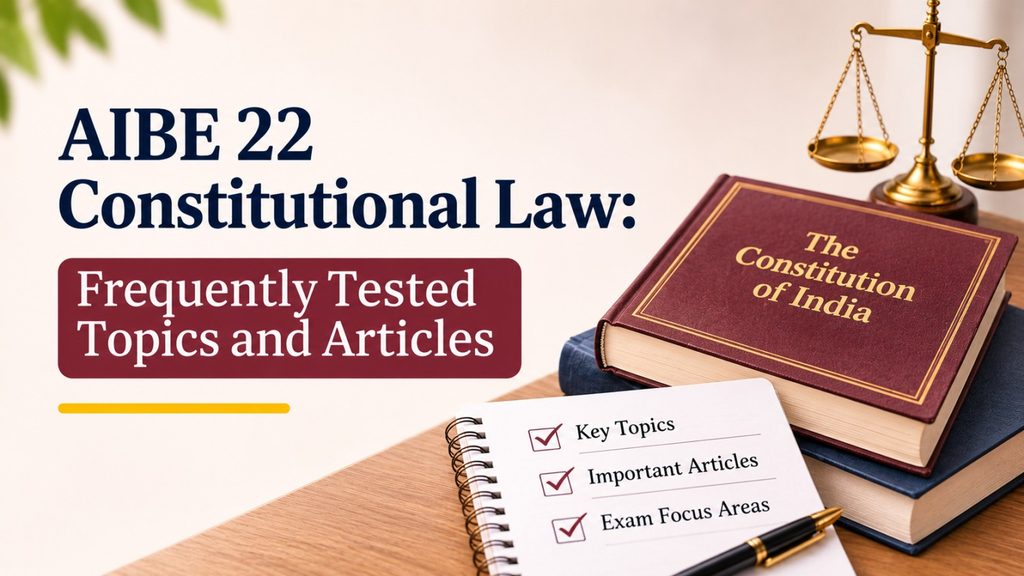
AIBE 22 Constitutional Law is the largest block on the paper. It is advertised at 10 questions, yet it ran 12, 15 and 14 in the last three papers. This guide is written for law graduates preparing for the All India Bar Examination (AIBE) on November 29, 2026, so legal terms are explained plainly. The topic lists below are commonly cited by prep sources, not published by the Bar Council of India (BCI), so treat them as guidance.
Why Constitutional Law Matters
| Paper | Advertised questions | Actual questions |
|---|---|---|
| AIBE XIX | 10 | 12 |
| AIBE XX | 10 | 15 |
| AIBE XXI | 10 | 14 |
Preparing it at the same depth as a 10-mark subject under-prepares the biggest block.
Legal Framework
- Constitution of India: the supreme law, and the source of every topic below.
- Advocates Act, 1961: Section 24 sets enrolment eligibility, and Section 49 lets the BCI make rules.
- BCI Certificate and Place of Practice (Verification) Rules, 2015: make AIBE a condition for a Certificate of Practice, meaning permission to practise in courts.
- Bharatiya Nyaya Sanhita, 2023: Sections 318 and 319 cover cheating and cheating by personation.
AIBE Constitutional Law Topics and Articles
| Topic | Key Articles | What to revise |
|---|---|---|
| Fundamental Rights | 12 to 35 | “State” (12), equality (14 to 18), six freedoms (19), life and liberty (21), education (21A), arrest safeguards (22) |
| Directive Principles | 36 to 51 | Policy goals, not enforceable in court (37) |
| Fundamental Duties | 51A | List of duties |
| Writs | 32, 226 | Five writs, and Supreme Court vs High Court powers |
| Amendment | 368 | Procedure and special majority |
| Union and States | 52 to 78, 153 to 167 | President, Governor, councils of ministers |
| Judiciary | 124 to 147, 214 to 231 | Supreme Court and High Courts |
| Constitutional bodies | 76, 148, 280, 315, 324 | Attorney General, CAG, Finance Commission, UPSC, Election Commission |
| Centre-State relations | 245 to 263 | Seventh Schedule lists |
| Emergency | 352, 356, 360 | National, State and financial emergency |
Several prep sites name Fundamental Rights, Directive Principles, writs, amendments, constitutional bodies and the judiciary as recurring areas.
Fundamental Rights, Directive Principles and Duties Compared
| Feature | Fundamental Rights | Directive Principles | Fundamental Duties |
|---|---|---|---|
| Part and Articles | Part III, 12 to 35 | Part IV, 36 to 51 | Part IVA, 51A |
| Enforceable in court | Yes | No (Article 37) | Not directly |
| Nature | Rights of individuals | Guidelines for the State | Duties of citizens |
The five writs are habeas corpus (produce a detained person), mandamus (compel a public duty), certiorari (quash a lower decision), prohibition (stop a lower body) and quo warranto (question a person’s right to hold office).
How a Constitutional Amendment Works
Bill → special majority in both Houses → ratification by half the States (if federal features) → President’s assent
A special majority means a majority of the total membership of the House, plus two-thirds of members present and voting.
Recent Amendments to Know
- 101st Amendment (2016): introduced GST through Articles 246A and 279A.
- 103rd Amendment (2019): provided 10% reservation for Economically Weaker Sections through Articles 15(6) and 16(6).
- 106th Amendment (2023): reserves one-third of seats for women in the Lok Sabha and State Assemblies, with rollout depending on later steps such as delimitation.
Revision Plan for the Final 17 Days
Spend the first week on Articles 12 to 35, 32 and 226. Use the second week for the other rows in the table, and give 15 minutes a day to amendments. Carry only Bare Acts without notes on exam day, and note that some questions in recent papers turned on doctrine rather than text, so study principles too.
Penalties and Remedies
Cheating or personation can lead to cancellation of candidature and criminal action under the Bharatiya Nyaya Sanhita. For an exam grievance, write to the BCI helpdesk first. Serious unresolved cases can go to the High Court through a writ petition under Article 226, a request for a court order against unfair official action.
FAQs
Advertised at 10, but recent papers had 12, 15 and 14.
Articles 12 to 35, 32, 226 and 368 are commonly cited.
No. Article 37 says they are not enforceable in court.
Do not rely on them alone. Learn the principles behind each doctrine.
Yes, as a Bare Act without notes or annotations.
Some of the top books for AIBE:
- R.V. Kelkar’s Lectures on Criminal Procedure: Based on Bharatiya Nagarik Suraksha Sanhita, 2023
- V. P. Sarathi’s Law of Evidence: Based on Bharatiya Sakshya Adhiniyam, 2023
- B.M. Gandhi’s Penal Law: Covering Bharatiya Nyaya Sanhita 2023, Dowry Prohibition Act, JJ Act, MTP Act, POCSO Act, DV Act, and More
- EBC’s Master Guide To All India Bar Examination (AIBE Exam Guide)
- All India Bar Examination Bare Acts Without Notes and Comments | AIBE Bare Acts Combo Set of 25 Books | Covering Old and New Criminal Laws
- All India Bar Examination – Solved Papers 2015-2025
- Universal’s Guide to All India Bar Examination | AIBE Complete Syllabus Guide