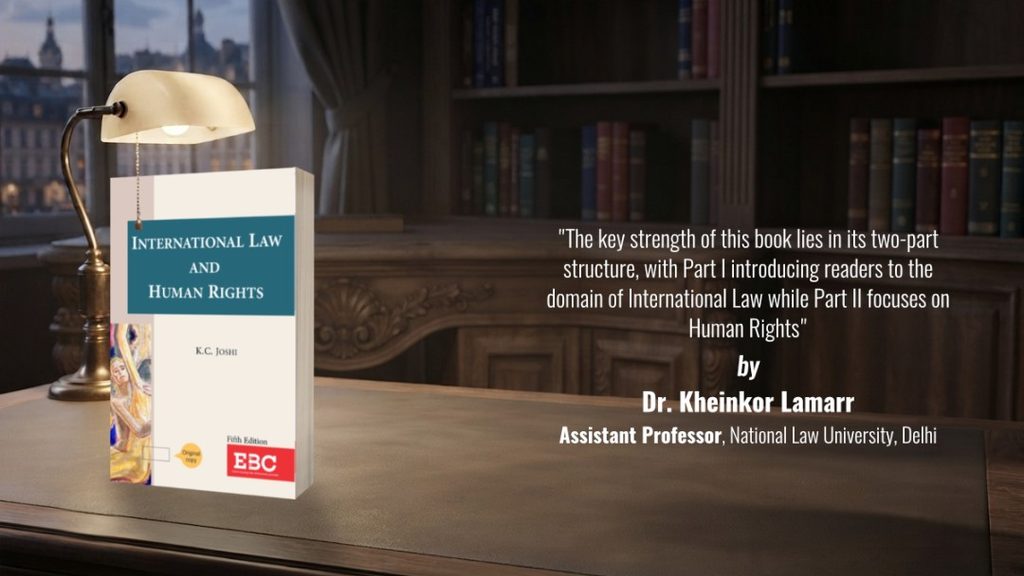
The intersection of International Law and Human Rights are one of the most significant areas of legal inquiry today. In today’s interconnected but deeply fractured world defined by conflict situations, refugee movements, technological advancements and climate crisis have made International Law and human rights inseparable from day-to-day life. The questions on justice and sovereign accountability and the protection of human dignity are more urgent than ever. The book International Law and Human Rights by K.C. Joshi contributes meaningfully to such a discussion and is a comprehensive introduction to the interconnected fields of International Law and Human Rights
A Two-Part Approach to International Law and Human Rights
The key strength of this book lies in its two-part structure, with Part I introducing readers to the domain of International Law while Part II focuses on Human Rights. Such a structure allows readers to grasp the foundational aspects first and then build upon the same to explore International Human Rights Law.
Part I: International Law
Foundational Concepts and Theories
The first part of the book succeeds in providing a succinct yet complete overview of International Law in a progressive and layered manner. The first and most notable feature of this part is the emphasis laid on basic concepts, theory and fundamental questions of International Law. The discussions on the nature and character of International Law, the basis of International Law, why states obey International Law? and in particular the major challenges of International Law, provide readers with an essential understanding of the discipline.
Sources, Subjects, Sovereignty and Territory
Important conceptual groundwork is laid down by the book by first focussing on foundational aspects such as the Sources of International Law, the relationship between international and municipal law, subjects, sovereignty, and territory prior to introducing readers to more specialized areas. The author also offers explanation of frequently used terms of significance like ‘comity’. What is interesting in the introductory portions of the book is that while introducing readers to basic concepts the author has weaved in the history and trajectory of the development of International Law.
Contemporary Sub-Fields of International Law
Part I in addition to building conceptual clarity provides a broad overview of several important sub-fields of International Law- International Humanitarian Law, International Criminal Law, International Environmental Law etc. The book is current and up to date in its treatment of the various fields and has included some recent landmark cases like “Obligations of States in respect of Climate Change”. It also engages with contemporary challenges and attempts to situate International Law within the changing landscape of international relations and technological advancements. Interestingly the author has also included discussions from the Indian Perspective with discussions ranging from India’s commitments under International Environmental Law to Surgical operations conducted by India. The book rather than treating each field in isolation has instead provided readers with a wider appreciation of the scope and operation of International Law
Part II: Human Rights
The Transition from International Law to Human Rights
The transition to human rights is smooth and appropriate given that much of human rights law is grounded in International Law. The two parts thus do not come across as separate discussions but as interconnected components of a larger framework.
Meaning and Framework of Human Rights
Part II begins by introducing the reader to the meaning of human rights and then provides readers with an understanding of the international human rights legal framework by taking them through the Core and specialised Human Rights Treaties. Subsequently it discusses the relationship between Human Rights Law and Humanitarian Law and proceeds to examine the protection of vulnerable groups-children, refugees and women.
Institutional Mechanisms for Human Rights Protection
The particular merit of this part is its systematic, thorough and up-to-date discussion of the institutional mechanisms in the arena of human rights protection. Going beyond the substantive aspects to introducing the reader to the mechanisms through which rights are protected, promoted and enforced is useful as its bridges the gap between understanding human rights norms and appreciating how they operate in practice.
International, Regional and Indian Perspectives
Also noteworthy is the progression adopted in this section to move from an international framework to regional approaches and ultimately to the Indian context providing readers with an understanding of both the universal foundations of human rights to its interpretation and implementation across regional and domestic contexts
Contemporary Challenges: Business and Human Rights and Artificial Intelligence
The inclusion of contemporary themes and debates like Business and Human Rights and Artificial Intelligence enhances the relevance and appeal of this book. This inclusion makes the book responsive to modern challenges which confronts Human Rights and International Law.
Breadth Without Unnecessary Complexity
Taken as a whole the defining feature of this book lies in its overall breadth without becoming unnecessarily unwieldy. The author has not made an attempt to exhaustively cover each and every area of International Law or human rights. The book provides a coherent overview of concepts, institutions, legal frameworks and contemporary debates
A Structured Approach for Students and Readers
This is a good approach for a textbook as it allows readers to grasp foundational concepts then progress to appreciate the legal and institutional frameworks and then situate oneself in contemporary challenges and debates. The author places particular emphasis on core aspects through extended discussion, which is particularly beneficial for readers encountering this subject for the first time.
Readability and Academic Relevance
The book is easy to read, well organised, and structured with a reader’s convenience in mind. The book’s wide-ranging analysis and logical progression make it a good book for students of law and related disciplines, academicians and anyone interested in developing a broader understanding of international and human rights law. The book’s coverage of contemporary issues gives it relevance beyond an introductory treatment and succeeds in providing readers with a map of the wider landscape of International Law and Human Rights Law.
Want the deeper dive? Grab the reference book.