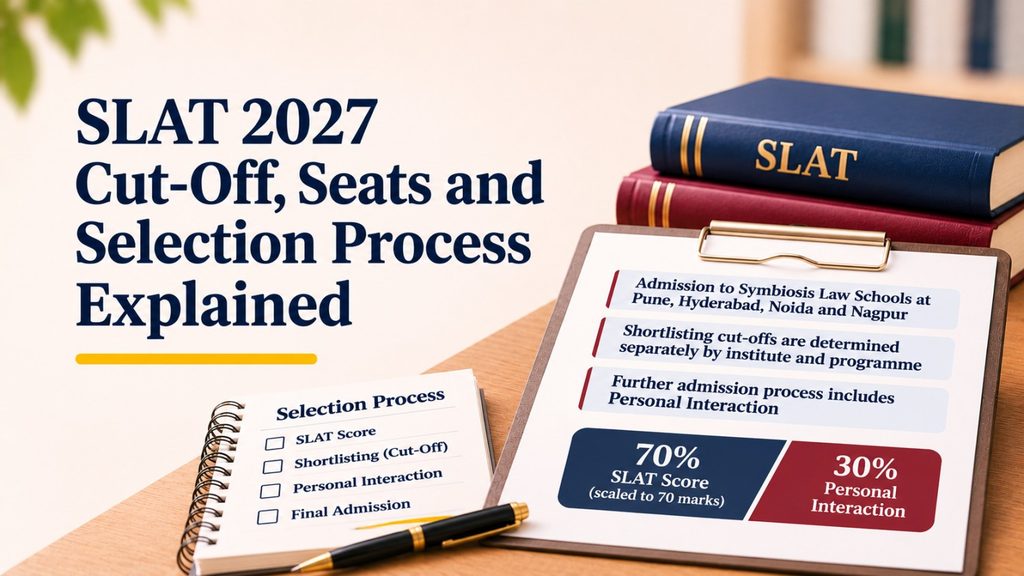
The SLAT 2027 cut off, seat count and selection rules decide who gets into a Symbiosis Law School, yet sources often disagree. This guide is for Class 12 students and parents, so legal terms are explained plainly. It covers seats, negative marking, last year’s cut-off trends and whether admission is rank or merit based. The tests are on December 19 and 26, 2026.
SLAT 2027 Seats
Reported seat numbers differ. The latest Careers360 matrix shows 1,380 seats across four campuses, while some sources still list 1,080. Confirm the final figure in the SLAT 2027 brochure.
| Campus | Programmes | Reported seats |
|---|---|---|
| SLS Pune | BA LLB 180, BBA LLB 300, BCom LLB 120 | 600 |
| SLS Noida | BA LLB 120, BBA LLB 180 | 300 |
| SLS Hyderabad | BA LLB 120, BBA LLB 120 | 240 |
| SLS Nagpur | BA LLB 120, BBA LLB 120 | 240 |
Negative Marking and Pattern
SLAT has 60 questions worth 60 marks, with 12 in each of five sections. Each correct answer earns one mark, and there is no negative marking, so attempt every question. You may take both tests, and the higher score counts.
SLAT 2027 Cutoff: Last Year’s Trends
Symbiosis does not publish official cut-offs. These are expert estimates for the 2026 cycle, used for interview shortlisting.
| Campus | Estimated cut-off (out of 60) |
|---|---|
| SLS Pune | 45 to 50 |
| SLS Noida | 42 to 47 |
| SLS Hyderabad | 38 to 43 |
| SLS Nagpur | 36 to 41 |
Another source puts Pune at 48 to 52, so treat every range as a guide, not a promise. Cut-offs move with paper difficulty, seats and applicants.
Merit or Rank Based?
Mostly merit based. Shortlisting uses your SLAT score, but final admission uses a composite score of 100: your SLAT marks scaled from 60 to 70, plus 30 for the Personal Interaction (PI), a short interview. The Writing Ability Test was removed from the process. Each campus publishes its own programme-wise merit list, followed by waiting lists. Scorecards show an All India Rank and a category rank, but rank alone does not decide admission.
SLAT score (60) → shortlist → PI (30) → composite merit (100) → campus merit list → waitlist
Last year the result came on January 15, PI rounds ran through February, and merit lists followed in February. For 2027, the result is reported for January 12.
Legal Framework
- UGC Act, 1956, Section 3: lets Symbiosis, a deemed university, run its own admission test and merit process.
- Advocates Act, 1961: Section 7 lets the Bar Council of India (BCI) set legal education standards, and Section 24 requires a recognised law degree to enrol as an advocate.
- BCI Rules of Legal Education, 2008: set standards for five-year LLB courses, so check BCI approval.
- Constitution, Article 15: bars discrimination in admissions, and Article 15(6) allows 10% reservation for Economically Weaker Sections. Check how each campus applies it.
- Rights of Persons with Disabilities Act, 2016: Sections 16 and 32 promote inclusive education and reserved seats, though their reach for a private deemed university can vary.
- Digital Personal Data Protection Act, 2023: governs your application data.
- Consumer Protection Act, 2019: covers misleading claims, such as guaranteed admission.
- Bharatiya Nyaya Sanhita, 2023 and IT Act, 2000: Sections 318 and 319, and Sections 66C and 66D, punish cheating and personation.
Penalties and Remedies
Cheating or impersonation can cancel your candidature and invite criminal action. If your scorecard or merit rank looks wrong, write to the SLAT helpdesk and keep proof. Serious unresolved cases can go to the High Court through a writ petition under Article 226, a request for a court order against unfair official action.
FAQs
Reports show 1,380 (or 1,080), so confirm in the brochure.
No.
No. Only estimates exist, and the real figures depend on that year’s paper.
No. It uses a composite merit score of SLAT (70) and PI (30).
Yes, for shortlisted candidates.
Continue the SLAT 2027 series