Preparing for the All India Bar Examination (AIBE) XXII requires more than simply revising every law studied during an LL.B. programme. Candidates need a focused preparation strategy that balances statutory understanding with the examination’s prescribed question distribution. The AIBE 22 important subjects deserve particular attention because seven major subject groups collectively account for 62 out of 100 questions. Understanding their weightage, applicable legislation and frequently tested legal principles can make revision considerably more effective.
Understanding the AIBE 22 Question Distribution
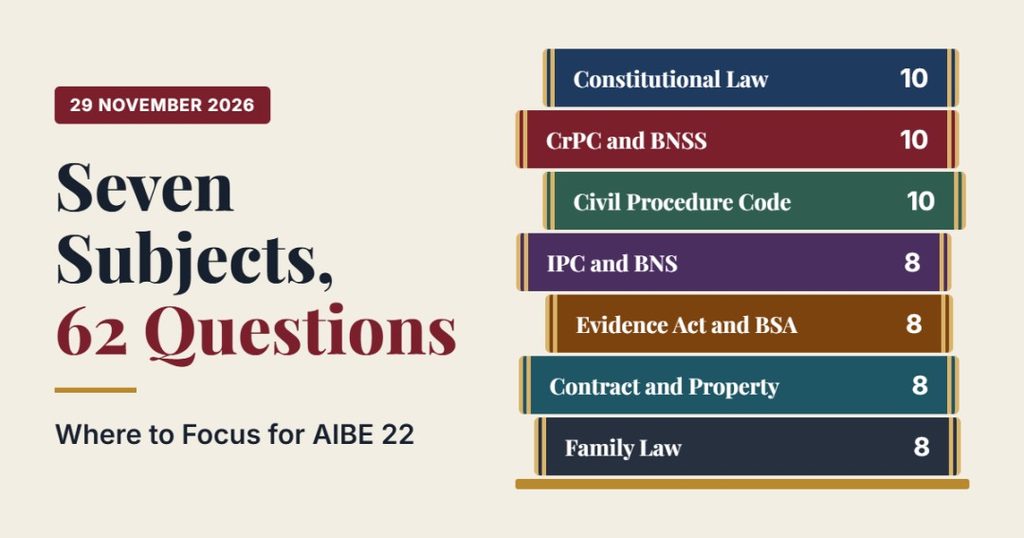
The Bar Council of India (BCI) released the AIBE XXII syllabus on 13 October 2026. It covers 19 subjects, with 100 objective-type questions. Seven subject groups carry 62 questions, making them the strongest starting point for preparation.
| Subject | Questions |
|---|---|
| Constitutional Law | 10 |
| Criminal Law: IPC and BNS | 8 |
| Criminal Procedure: CrPC and BNSS | 10 |
| Civil Procedure Code | 10 |
| Evidence Law: Evidence Act and BSA | 8 |
| Family Law | 8 |
| Contract and Related Laws | 8 |
| Total | 62 |
These figures establish revision priorities, not guaranteed marks. Candidates should still cover the remaining 38 questions.
AIBE 22 Important Subjects: Seven Areas to Prioritise
1. Constitutional Law: 10 Questions
The Constitution of India, 1950, is the foundation of Indian legal practice. Concentrate on Fundamental Rights under Articles 12 to 35, Directive Principles of State Policy under Articles 36 to 51, Fundamental Duties under Article 51A and constitutional remedies under Article 32.
Revise Articles 14, 19, 21, 22, 32 and 226, along with legislative powers, emergency provisions, constitutional amendments under Article 368 and the separation of powers. Understand how writs protect individual rights and how constitutional remedies operate.
2. Criminal Law: IPC and BNS: 8 Questions
Study the Indian Penal Code, 1860, alongside its replacement, the Bharatiya Nyaya Sanhita, 2023 (BNS), effective from 1 July 2024.
Important areas include general exceptions, criminal intention, abetment, conspiracy, offences against the human body, theft, robbery, cheating and criminal breach of trust. Pay particular attention to the ingredients of offences and the corresponding provisions under both laws.
3. Criminal Procedure: CrPC and BNSS: 10 Questions
The Code of Criminal Procedure, 1973, and Bharatiya Nagarik Suraksha Sanhita, 2023 (BNSS), govern criminal investigation and trial procedures.
Prioritise FIR registration, arrest, bail, investigation, charge sheets, cognizance, jurisdiction of criminal courts and trial procedures. Understand the distinction between cognizable and non-cognizable offences, as well as bailable and non-bailable offences. Compare relevant CrPC and BNSS provisions because the examination syllabus expressly includes both.
4. Civil Procedure Code: 10 Questions
The Code of Civil Procedure, 1908 (CPC), regulates civil litigation. Focus on jurisdiction, res judicata under Section 11, stay of suits under Section 10, pleadings, plaints, written statements, temporary injunctions under Order XXXIX and appeals.
Also revise execution of decrees, review, revision and the distinction between appeals and references. Understand how a civil suit progresses from filing to final decree and execution.
5. Evidence Law: 8 Questions
The Indian Evidence Act, 1872, has been replaced by the Bharatiya Sakshya Adhiniyam, 2023 (BSA), effective from 1 July 2024.
Important topics include relevancy of facts, admissions, confessions, burden of proof, presumptions, documentary evidence, electronic records and witness examination. Pay attention to electronic evidence and the statutory requirements governing its admissibility.
6. Family Law: 8 Questions
Family Law covers marriage, divorce, adoption, maintenance, succession and guardianship.
Important legislation includes the Hindu Marriage Act, 1955; Hindu Succession Act, 1956; Hindu Adoptions and Maintenance Act, 1956; Special Marriage Act, 1954; and Guardians and Wards Act, 1890. Also revise the Muslim Personal Law (Shariat) Application Act, 1937, and Dissolution of Muslim Marriages Act, 1939.
Understand marriage validity, divorce grounds, inheritance rights, maintenance obligations and guardianship principles.
7. Contract and Related Laws: 8 Questions
This group combines four important areas of commercial and property law.
Revise the Indian Contract Act, 1872, particularly offer, acceptance, consideration, capacity, free consent, void agreements and breach of contract. The Specific Relief Act, 1963, covers specific performance and injunctions. The Transfer of Property Act, 1882, governs property transfers, mortgages and leases. The Negotiable Instruments Act, 1881, is especially important for cheque dishonour under Section 138.
How Should Candidates Allocate Revision Time?
A practical revision sequence is:
Constitutional Law → Criminal Law → Criminal Procedure → CPC → Evidence → Family Law → Contract Laws → Remaining Subjects
| Preparation priority | Recommended approach |
|---|---|
| High-weightage subjects | Detailed bare-act revision |
| New criminal legislation | Compare old and new provisions |
| Procedural laws | Practise procedural sequences |
| Family and contract laws | Memorise essential statutory conditions |
| Remaining subjects | Complete syllabus-based revision |
The remaining subjects include ADR, PIL, administrative law, professional ethics, company law, environmental law, cyber law, labour law, taxation, torts, land acquisition and intellectual property. Relevant legislation includes the Arbitration and Conciliation Act, 1996; Advocates Act, 1961; Companies Act, 2013; Information Technology Act, 2000; Consumer Protection Act, 2019; Motor Vehicles Act, 1988; and other subject-specific enactments.
Practical Preparation Strategy
- Read updated bare acts, meaning legislation containing statutory provisions without explanatory commentary.
- Prepare comparison charts for IPC and BNS, CrPC and BNSS, and the two evidence laws.
- Practise previous examination papers and timed mock tests.
- Revise important definitions, statutory conditions, exceptions and limitation periods.
- Study professional ethics and the Bar Council of India Rules, 1975, carefully.
The BCI’s examination framework operates under the Advocates Act, 1961, particularly Section 24 and Section 49. Candidates should also understand the Certificate of Practice requirements.
Frequently Asked Questions
They collectively account for 62 of the 100 questions in AIBE XXII.
Constitutional Law, CPC and Criminal Procedure carry 10 questions each.
Yes. The notified syllabus expressly includes IPC/BNS, CrPC/BNSS and the Evidence Act/BSA.
Yes. The seven major groups deserve priority, but the remaining subjects account for 38 questions.
No. Candidates should understand statutory provisions, exceptions, definitions and their practical application.
Recommended Resources:
All India Bar Examination (AIBE) | Set of 13 Books Covering 33 Acts | Previous Paper Solution Book