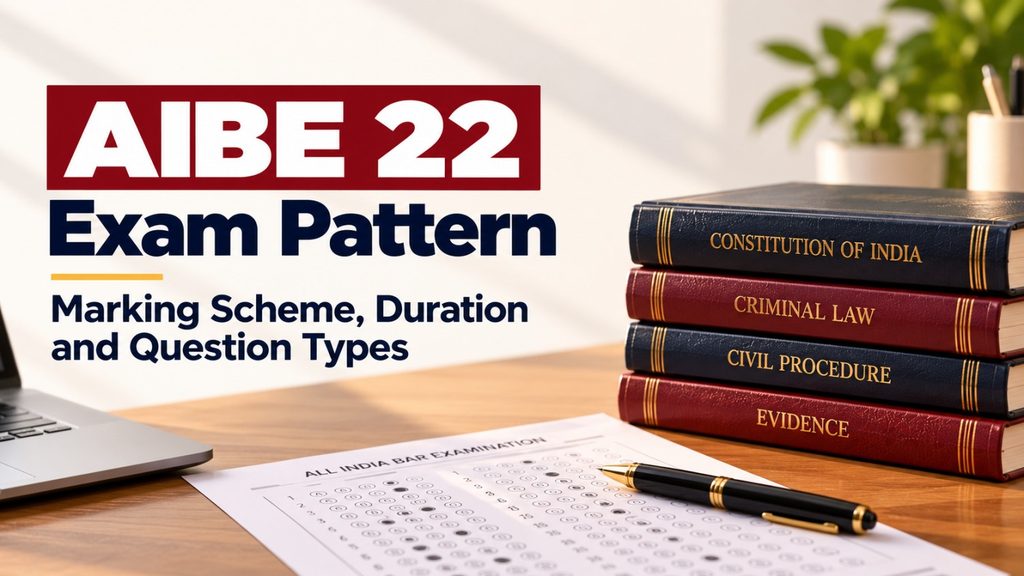
The AIBE 22 exam pattern is the first thing every law graduate should understand before sitting the All India Bar Examination (AIBE). This is the Bar Council of India’s (BCI) test of basic competence for advocates. The guide is written for LLB graduates and final-year students, so legal terms are explained simply. The AIBE 22 exam is on November 29, 2026, and registration closes on 27 October 2026.
Legal Background of the AIBE
Only an enrolled advocate can practise law in India. After enrolling with a State Bar Council, a graduate must clear the AIBE to receive a Certificate of Practice (CoP), the document that proves the right to appear in courts.
| Law or rule | Plain meaning |
|---|---|
| Advocates Act, 1961, s. 7 | Lists BCI’s functions, including setting professional standards |
| s. 24 | Conditions for enrolment as an advocate |
| ss. 29 and 33 | Only advocates may practise law |
| s. 35 | Professional misconduct and disciplinary action |
| s. 45 | Penalty for practising illegally |
| s. 49 | BCI’s power to make rules, including AIBE rules |
| Rights of Persons with Disabilities Act, 2016 | Equal access and reasonable accommodation for candidates with disabilities |
| Bharatiya Nyaya Sanhita, 2023, ss. 318, 319 | Punishes cheating and cheating by impersonation |
AIBE 22 Exam Pattern at a Glance
| Feature | Details |
|---|---|
| Mode | Offline, at designated test centres |
| Questions | 100 multiple-choice questions (MCQs) |
| Subjects | 19 law subjects |
| Total marks | 100 |
| Duration | 3 hours 30 minutes |
| Negative marking | None |
| Languages | 11 |
| Passing marks | 45 (General and OBC), 40 (SC/ST and persons with disabilities) |
One source lists the duration as 3 hours, so confirm the exact time on your admit card.
AIBE Marking Scheme Explained
- Each correct answer earns 1 mark.
- Wrong or unattempted answers earn 0, so there is no negative marking.
- There is no sectional time limit, so you can spend your 210 minutes freely.
- Because nothing is deducted, attempt all 100 questions.
Question Types in the Exam
Every question is objective, meaning you pick the right option instead of writing an answer. Questions test basic concepts from the LLB course, such as Constitutional Law, Civil and Criminal Procedure, Evidence, Contracts and Professional Ethics.
Since July 2024, the Bharatiya Nyaya Sanhita, Bharatiya Nagarik Suraksha Sanhita and Bharatiya Sakshya Adhiniyam have replaced the IPC, CrPC and Evidence Act. Check the BCI syllabus notice for how these are covered. The pattern and weightage are reported to be unchanged for AIBE 22.
AIBE Process at a Glance
Register (till 27 Oct)
|
Correction window (till 30 Oct)
|
Admit card
|
Exam (29 Nov, offline)
|
Result
|
Certificate of Practice
Rights, Obligations and Exceptions
Rights
- Candidates can appear as many times as needed to pass.
- Candidates with disabilities can seek reasonable accommodation under the RPwD Act, 2016.
Obligations
- Carry your admit card and a valid photo ID.
- Bring only permitted material. The exam has traditionally allowed bare acts (the plain text of laws without commentary), but check the current guidelines.
Exceptions
- The pass mark is relaxed to 40 for reserved categories and persons with disabilities.
FAQ
There are 100 MCQs, carrying 1 mark each.
Usually 3 hours 30 minutes. Check your admit card.
No. Attempt every question.
You need 45 marks if you are General or OBC, and 40 if you are SC/ST or have a disability.
Traditionally, bare acts and handwritten notes have been permitted, though commentaries and electronic devices are not. Read the latest BCI instructions before exam day.