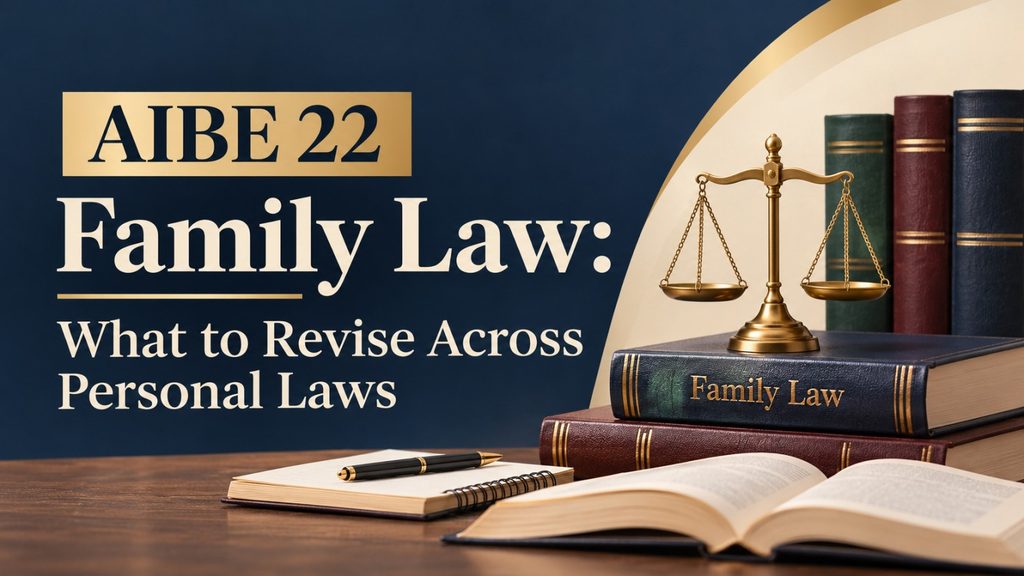
Preparing for AIBE 22 family law? This guide is written for law graduates sitting the All India Bar Examination, so the depth matches what a candidate needs. Family law, also called personal law, means the rules on marriage, divorce, adoption, maintenance and inheritance, which differ by religion. Because the exam is open book, speed in locating statutes and sections decides your score. Treat it as your AIBE revision notes on personal laws.
(Also Read : BNS important sections for AIBE)
How AIBE 22 Family Law Is Tested
The AIBE family law syllabus covers Hindu, Muslim, Christian and Parsi law, and questions are mostly statute based. Expect direct questions on section numbers, age limits, waiting periods and who can claim what. Theory matters less than precise provisions.
Hindu Law: Highest Priority
Hindu law applies to Hindus, Buddhists, Jains and Sikhs.
- Hindu Marriage Act, 1955: Section 5 lists conditions for a valid marriage (no living spouse, sound mind, minimum age of 21 for men and 18 for women, and no prohibited relationship). Section 9 allows restitution of conjugal rights, meaning a court order to resume living together. Section 13 gives divorce grounds such as cruelty, desertion for two years and adultery. Section 13B covers mutual consent divorce. Sections 24 and 25 deal with interim and permanent maintenance.
- Hindu Succession Act, 1956: Governs inheritance without a will (intestate succession). The 2005 amendment gave daughters equal coparcenary rights, meaning birthright shares in joint family property. Sections 8 and 15 cover male and female intestates.
- Hindu Adoption and Maintenance Act, 1956: Section 6 sets validity conditions, Sections 7 and 8 cover who can adopt, and Section 18 onward covers maintenance of wives, children and parents.
- Hindu Minority and Guardianship Act, 1956: The father is the natural guardian, but custody of a child under five ordinarily stays with the mother.
Muslim Law Essentials
- Muslim Personal Law (Shariat) Application Act, 1937: Applies Islamic law to Muslims in marriage, divorce, succession and gifts.
- Dissolution of Muslim Marriages Act, 1939: Lists grounds on which a wife can seek divorce, such as husband’s absence for four years.
- Muslim Women (Protection of Rights on Divorce) Act, 1986: Provides maintenance during iddat, the waiting period after divorce.
- Muslim Women (Protection of Rights on Marriage) Act, 2019: Makes instant triple talaq void and an offence punishable with up to three years.
- Key concepts: mehr (dower), khula (wife-initiated divorce), hiba (gift) and wasiyat (will, limited to one third of the estate). The Waqf Act, 1995 was amended in 2025, so revise it.
Christian and Parsi Law
- Indian Christian Marriage Act, 1872 and Indian Divorce Act, 1869: Govern Christian marriage and divorce. Section 10A allows mutual consent divorce after two years of separation.
- Parsi Marriage and Divorce Act, 1936: Provides for special Matrimonial Courts, and bigamy is punishable.
- Indian Succession Act, 1925: Governs inheritance for Christians and Parsis, and testamentary succession (wills) for most communities.
Secular and Cross-Community Laws
- Special Marriage Act, 1954: Allows inter-faith or civil marriage after a 30-day public notice.
- Section 144, Bharatiya Nagarik Suraksha Sanhita, 2023: Replaced Section 125 CrPC and gives maintenance to wives, children and parents of all religions.
- Guardians and Wards Act, 1890: The general law on child guardianship and custody.
- Protection of Women from Domestic Violence Act, 2005: Offers protection orders, residence and monetary relief.
- Prohibition of Child Marriage Act, 2006: Child marriages are voidable, and offenders face up to two years of imprisonment.
Quick Comparison of Personal Laws
| Topic | Hindu | Muslim | Christian | Parsi |
|---|---|---|---|---|
| Marriage | Sacrament | Contract (nikah) | Statutory 1872 Act | Contract with ceremony |
| Divorce law | HMA 1955 | 1939 Act and talaq | Divorce Act 1869 | 1936 Act |
| Maintenance | HAMA, BNSS 144 | 1986 Act, BNSS 144 | 1869 Act, BNSS 144 | 1936 Act, BNSS 144 |
| Succession | HSA 1956 | Shariat | ISA 1925 | ISA 1925 |
HMA: Hindu Marriage Act; HAMA: Hindu Adoption and Maintenance Act; HSA: Hindu Succession Act; ISA: Indian Succession Act.
Mutual Consent Divorce Flow
Joint petition → First motion → Cooling period (6 months) → Second motion → Decree
Under the Hindu Marriage Act, the second motion must come within 18 months of the first. Revise this flow for your AIBE 22 family law preparation.
FAQs
Yes, it is a core subject, but check the latest Bar Council of India notice for weightage.
21 for men and 18 for women.
Yes, under the 2019 Act, with up to three years’ imprisonment.
Ordinarily, the mother under Hindu law.
Generally no. Section 14 of the Hindu Marriage Act bars it, except in exceptional hardship.
Thirty days’ public notice.
Some of the top books for AIBE:
- R.V. Kelkar’s Lectures on Criminal Procedure: Based on Bharatiya Nagarik Suraksha Sanhita, 2023
- V. P. Sarathi’s Law of Evidence: Based on Bharatiya Sakshya Adhiniyam, 2023
- B.M. Gandhi’s Penal Law: Covering Bharatiya Nyaya Sanhita 2023, Dowry Prohibition Act, JJ Act, MTP Act, POCSO Act, DV Act, and More
- EBC’s Master Guide To All India Bar Examination (AIBE Exam Guide)
- All India Bar Examination Bare Acts Without Notes and Comments | AIBE Bare Acts Combo Set of 25 Books | Covering Old and New Criminal Laws
- All India Bar Examination – Solved Papers 2015-2025
- Universal’s Guide to All India Bar Examination | AIBE Complete Syllabus Guide