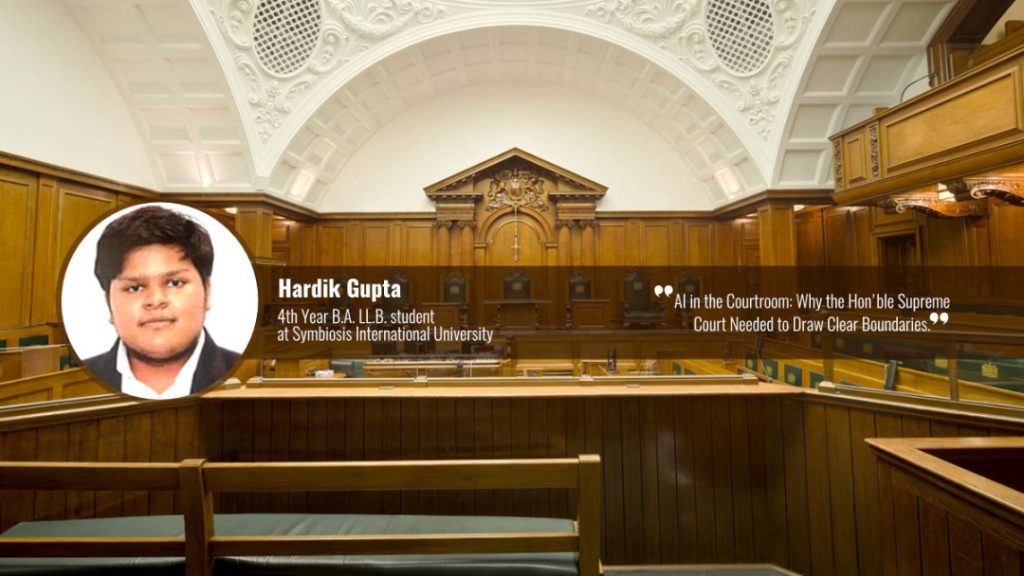
In this insightful article, Hardik Gupta, a fourth-year B.A. LL.B. student at Symbiosis Law School, Hyderabad, examines the Supreme Court’s draft AI regulations and their significance in shaping the future of technology within India’s judicial system.
The Supreme Court’s Draft for Use if Artificial Intelligence in Courts, 2026, mark an important step in defining the role of artificial intelligence within India’s justice system. While AI has often been seen as a solution to the country’s growing judicial backlog, the Court has taken a more measured view. Rather than treating AI as a replacement for human decision-making, the draft regulations recognized both its potential and its limitations.
Why the Framework Became Necessary
The need for this framework became evident after:
- Several judicial and quasi-judicial orders were found to have relied on non-existent case laws generated by AI tools, these fabricated citations often referred to as “AI hallucinations”.
- The concern extends beyond factual inaccuracies.
- Excessive dependence on AI may gradually weaken the independent reasoning and analytical skills that are fundamental to the legal profession.
- As discussed a recent LegalTechTalk 2026 panel reported by SCC Online, there is growing concern that younger lawyers who reply heavily on AI may become less inclined to critically evaluate legal themselves.
The Purpose Behind 2026 Regulations
Recognizing these challenges, the Supreme Court’s draft regulations are designed not merely to regulate technology but to preserve accountability within the judicial process. Their primary objective is to ensure that AI remains a tool that assists legal professionals rather than one that replaces their judgement.
A Clear Distinction in Use
The framework draws a clear distinction between the area where AI can be used and where human judgement is irreplaceable
| Permitted Uses of AI | Prohibited Uses of AI |
| Scheduling and Cause List Management | Bail and Sentencing Decisions |
| Speech-to-Text Transcription | Assessment of Witness Credibility |
| Assessment of Witness Credibility | Risk Scoring or Recidivism Prediction |
| Translation of Court Records | Evaluation of Facts or Evidence |
| Administrative Case Management | Exercise of Judicial Discretion |
Key Safeguards Established by the Regulations
The draft regulations embed the following three fundamental safeguard across various provisions to ensure responsible and ethical use of AI in the judicial system:
- Human-in-Loop Accountability: The regulation establish a strict Human-in-the- Loop principle. Any lawyer or judicial officer using AI remains fully responsible for the accuracy of the final work. As the technology itself cannot become an excuse for professional negligence.
- Mandatory Disclosure of AI use: The draft regulations requires parties to disclose the use of AI whenever it has assisted in preparing pleading to compiling evidence. This disclosure promotes transparency and encourages legal professional to independently verify every AI generated output before placing it before a court.
- Prohibition on Core Judiciary Functions: AI is explicitly prohibited from performing core adjudicatory functions. AI cannot be used to determine bail eligibility, assess witness credibility, undertake risk scoring, or perform any task that requires judicial discretion. Because these decisions involve far more than analysing data, as they require empathy, context and human judgement. As Justice Surya Kanth recently observed at an event reported by SCC Online, justice is ultimately an exercise of both the mind and the heart-qualities that technology cannot replicate
A Balance Path Forward
The regulations reflect a balanced approach. They neither reject technological innovation nor embrace it without limits. Instead they establish a simple but significant principle: “AI may assist judicial administration, but it must never replace human judgment. Human oversight and accountability remain indispensable at every stage of the judicial process.” As AI becomes increasingly integrated into legal practice, the message from the Hon’ble Supreme Court of India is clear-“AI can be a valuable assistant, but it cannot become the decision maker”.
To explore more resources on Artificial Intelligence and related legal topics, click here.