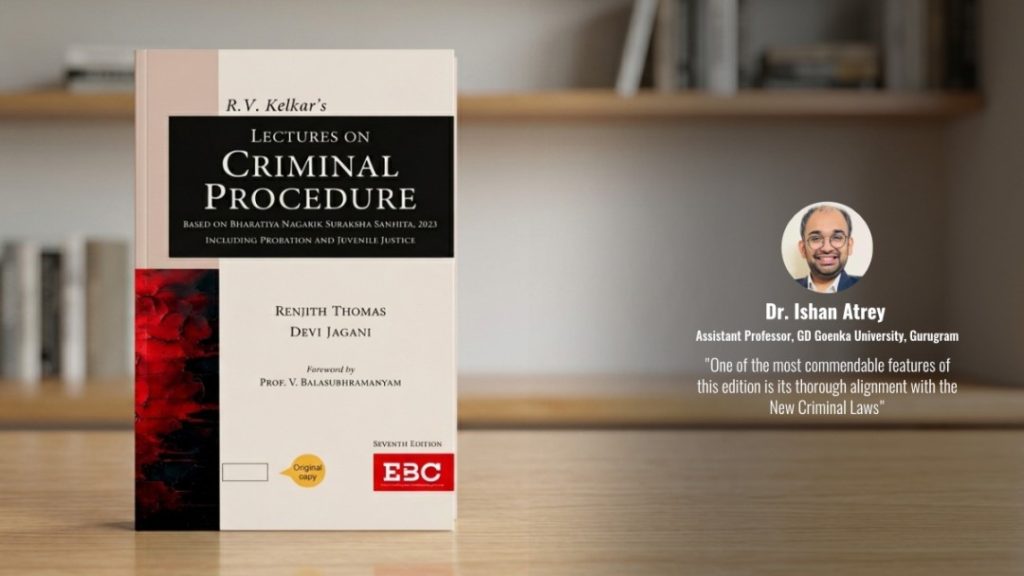
The introduction of India’s New Criminal Laws has transformed the study and practice of criminal procedure, making reliable academic resources indispensable. In this insightful review, Dr. Ishan Atrey, Assistant Professor, GD Goenka University, Gurugram, explores how R.V. Kelkar Lectures on Criminal Procedure (7th Edition, 2025) successfully bridges traditional legal scholarship with the demands of the evolving criminal justice framework.
Introduction
The transition to India’s New Criminal Laws marks one of the most significant developments in contemporary legal education and practice. In such a transformative period, students and academicians require resources that not only explain procedural law comprehensively but also contextualize it within the evolving legal framework. R.V. Kelkar Lectures on Criminal Procedure, 7th Edition (2025) successfully fulfills this need by offering a lucid, updated, and academically rigorous treatment of criminal procedure.
Renowned for its clarity and scholarly depth, the latest edition continues the legacy of making complex procedural concepts accessible to students while maintaining the analytical richness expected by legal professionals and researchers
Comprehensive Coverage of the New Criminal Laws
One of the most commendable features of this edition is its thorough alignment with the New Criminal Laws. The book has been carefully updated to reflect the current legal framework, ensuring that readers receive accurate and contemporary knowledge of criminal procedure.
The author systematically explains procedural provisions, enabling readers to understand not only the letter of the law but also its practical implications. The discussions are structured to help students appreciate the underlying principles governing criminal justice administration. This makes the book particularly useful for law students preparing for examinations, competitive tests, and practical legal training
Clear and Student-Friendly Presentation
A significant strength of the book lies in its reader-friendly approach. Criminal procedure often appears intricate due to its technical nature and procedural complexities. However, the book presents these concepts in a simplified and organized manner without compromising legal accuracy.
The language is lucid and accessible, making it suitable for both beginners and advanced learners. Each topic is explained methodically, allowing readers to build a strong conceptual foundation. The systematic arrangement of chapters further enhances readability and ensures a smooth learning experience
Effective Integration of Case Law
Case law forms the backbone of legal understanding, and this edition excels in integrating judicial precedents with statutory provisions. The relevant judgments are appropriately linked with the corresponding sections, helping readers appreciate how procedural rules have been interpreted and applied by courts.
Rather than merely listing cases, the book explains their significance and relevance to the legal provisions being discussed. This approach enables students to understand the practical application of criminal procedure and develop analytical skills necessary for legal reasoning.
The careful incorporation of judicial decisions also helps bridge the gap between theoretical learning and courtroom realities, making the book highly valuable for academic and professional purposes.
Inclusion of Recent Judicial Developments
The legal landscape continues to evolve through judicial pronouncements, making it essential for legal texts to remain current. One of the standout features of this edition is its inclusion of the latest judgments and contemporary legal developments. The recent decisions have been discussed in sufficient detail, allowing readers to understand emerging trends in criminal jurisprudence. This commitment to updating the content significantly enhances the utility of the book, particularly for students, researchers, and practitioners who seek reliable and current legal information. The inclusion of contemporary case law ensures that readers are exposed to the most recent interpretations and developments shaping criminal procedure in India.
Balanced Blend of Clarity and Depth
Many legal textbooks often struggle to balance simplicity with analytical depth. R.V. Kelkar Lectures on Criminal Procedure successfully achieves this balance. The explanations are concise yet comprehensive, providing readers with a nuanced understanding of legal concepts without overwhelming them with unnecessary complexity. The content is well-compiled and logically arranged, enabling readers to progress from foundational concepts to more advanced procedural issues. This balanced approach makes the book equally useful as an introductory text and as a reference resource for deeper academic engagement.
Utility for Students and Educators
The book serves as an excellent academic companion for law students. Its structured presentation, examination-oriented approach, and extensive discussion of case law make it particularly effective for classroom learning and self-study. For educators, the text offers a dependable resource for teaching criminal procedure. The clarity of explanations and comprehensive coverage of topics allow instructors to rely on the book as a primary teaching aid while encouraging critical engagement with the subject matter. The book’s organization also facilitates quick reference, making it useful during lectures, discussions, and research activities
Scope for Further Enhancement
While the book is undoubtedly a highly valuable resource, a few additions could further strengthen its utility. The inclusion of landmark Supreme Court precedents under each section would provide readers with an even richer understanding of the foundational principles governing criminal procedure. Additionally, greater cross-referencing and correlation with the provisions of the Bharatiya Nyaya Sanhita (BNS) and the Bharatiya Sakshya Adhiniyam (BSA) would significantly enhance the learning experience. Such comparative references would enable students to better understand the interrelationship between substantive criminal law, procedural law, and evidentiary principles, thereby promoting a more integrated understanding of the New Criminal Laws framework. These additions would make the text even more comprehensive and beneficial for students navigating the transition to the new legal regime
Conclusion
R.V. Kelkar Lectures on Criminal Procedure, 7th Edition (2025) stands out as an authoritative, well-structured, and highly relevant resource on criminal procedure under the New Criminal Laws. Its clear explanations, effective integration of case law, detailed discussion of recent judgments, and student-centric approach make it an indispensable text for legal education. The book successfully combines academic rigor with practical relevance, making it suitable for students, educators, researchers, and legal practitioners alike. With minor enhancements such as additional landmark precedents and greater correlation with the BNS and BSA, it has the potential to become an even more comprehensive guide to criminal procedure in contemporary India.
For anyone seeking a reliable and up-to-date understanding of criminal procedure in the era of the New Criminal Laws, this edition remains a highly recommended and valuable resource.