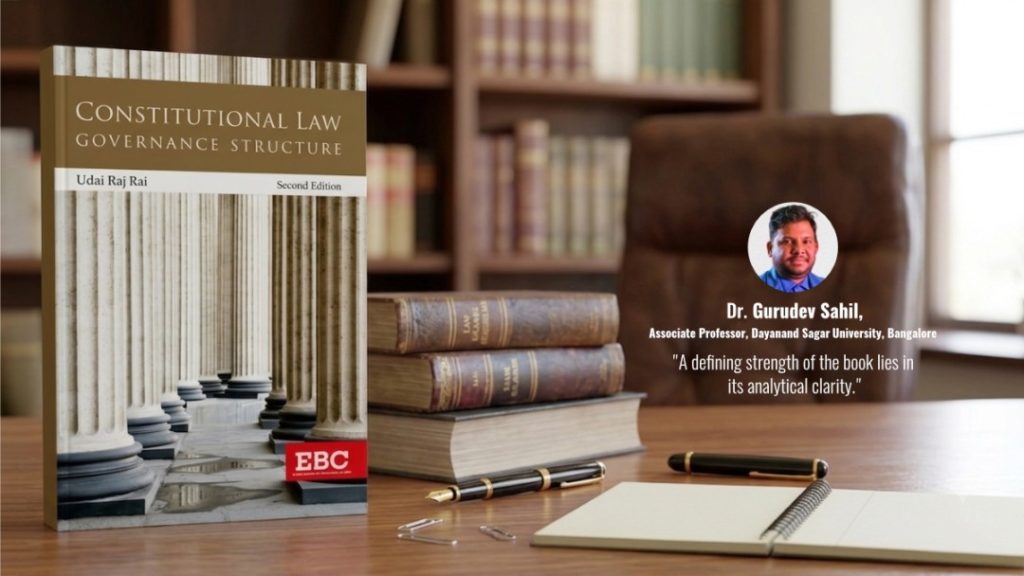
Constitutional Law by Uday Raj Rai offers a detailed and contemporary analysis of India’s constitutional framework and judicial developments. In this review, Dr. Gurudev Sahil evaluates the book’s scholarly contribution, structure, and utility for students and professionals alike.
A Scholarly and Insightful Exploration of Constitutional Law
The study of constitutional law demands not only an understanding of legal principles and judicial precedents but also an appreciation of the historical, philosophical, and political foundations that shape a nation’s constitutional framework. In this regard, Uday Raj Rai’s Constitutional Law emerges as a remarkable contribution to legal scholarship. The book is distinguished by its depth of research, analytical precision, and engaging style of expression, making it an invaluable resource for students, academicians, researchers, and legal practitioners alike.
At a time when constitutional questions occupy the centre stage of public discourse and legal debate, this work provides readers with a comprehensive and thoughtful understanding of the Constitution, its evolution, and its continuing relevance in addressing contemporary challenges.
A Work Rooted in Rigorous Research
One of the most impressive features of the book is the author’s commitment to exhaustive research. The text reflects a deep engagement with constitutional history, judicial developments, constitutional philosophy, and comparative perspectives. Rather than limiting itself to a mere exposition of legal provisions, the book explores the intellectual and historical contexts that have shaped constitutional governance.
The author successfully traces the evolution of constitutional principles and institutions, enabling readers to appreciate not only what the law is but also why it has developed in a particular manner.
This historical depth enriches the reader’s understanding and encourages a more nuanced engagement with constitutional issues
Exceptional Analytical Clarity
A defining strength of the book lies in its analytical clarity. Constitutional law often involves complex doctrines, evolving judicial interpretations, and competing constitutional values. Dr. Rai presents these intricate concepts with remarkable precision and coherence, making them accessible without sacrificing scholarly rigor.
Each topic is examined systematically, with the author carefully explaining the underlying principles, judicial reasoning, and practical implications of constitutional provisions. This methodical approach helps readers develop a strong conceptual foundation while also understanding the dynamic nature of constitutional interpretation.
The discussions are balanced and insightful, allowing readers to engage critically with constitutional debates while appreciating the multiple dimensions of legal reasoning.
Capturing the Spirit of the Constitution
Perhaps the most distinctive quality of the book is its ability to convey the spirit and living character of the Constitution. The Constitution is not merely a legal document; it is an evolving framework that reflects the aspirations, values, and democratic commitments of society. Throughout the book, the author treats the Constitution as an organic and dynamic instrument capable of adapting to changing social realities.
Every chapter reflects this broader constitutional vision. The discussions go beyond textual interpretation and invite readers to understand the larger constitutional objectives of justice, liberty, equality, and dignity. As a result, the book succeeds in presenting constitutional law not merely as a collection of legal rules but as a vibrant and evolving system of governance.
Authoritative Treatment of Constitutional Principles
The book demonstrates an impressive command over constitutional jurisprudence and judicial developments. Landmark decisions, constitutional doctrines, and significant legal developments are examined with care and scholarly depth. The author’s interpretations are supported by authoritative analysis, enabling readers to appreciate both the doctrinal foundations and practical implications of constitutional law.
The treatment of constitutional themes such as fundamental rights, separation of powers, judicial review, federalism, constitutional governance, and democratic accountability is particularly noteworthy. These discussions provide readers with a comprehensive understanding of the constitutional framework while also highlighting its contemporary significance.
Lucid and Engaging Writing Style
One of the challenges frequently associated with constitutional law texts is their tendency to become overly technical or inaccessible. Dr. Rai successfully overcomes this challenge through a writing style that is both elegant and reader-friendly.
The language is clear, engaging, and conversational, allowing complex constitutional concepts to be understood with relative ease. The author’s ability to simplify difficult legal issues without compromising intellectual depth significantly enhances the book’s value as a teaching and learning resource.
This balance between scholarly sophistication and accessibility makes the book suitable for a wide range of readers, including law students encountering constitutional law for the first time as well as advanced researchers seeking deeper insights.
Relevance to Contemporary Constitutional Questions
A particularly valuable aspect of the book is its relevance to contemporary constitutional challenges. Modern societies face increasingly complex questions relating to governance, rights, democratic institutions, technology, social justice, and constitutional accountability. The book provides readers with the conceptual tools necessary to engage meaningfully with these issues.
The author’s analysis encourages readers to view constitutional law as a living discipline that continuously responds to emerging social, political, and legal realities. In doing so, the book remains closely connected to present-day constitutional discourse while retaining a strong foundation in established legal principles
An Important Resource for Legal Education
For students of law, the book offers a comprehensive and intellectually stimulating introduction to constitutional law. Its systematic structure, clear explanations, and analytical depth make it highly suitable for academic study and examination preparation.
For teachers and researchers, the work serves as a valuable reference source that combines doctrinal analysis with historical and theoretical perspectives. Legal practitioners will also find the discussions useful for understanding the broader constitutional principles that inform contemporary legal practice
Conclusion
Dr. Uday Raj Rai’s Constitutional Law is a distinguished scholarly work that combines rigorous research, analytical excellence, and elegant expression. It successfully captures the historical foundations, evolving character, and enduring significance of constitutional law while remaining accessible to a broad readership.
The book stands out not only for its comprehensive treatment of constitutional principles but also for its ability to illuminate the deeper values and aspirations embodied in the Constitution. Through authoritative analysis and lucid exposition, Dr. Rai has produced a work that contributes meaningfully to constitutional scholarship and legal education.
For anyone seeking a deeper understanding of constitutional law—whether student, teacher,researcher, or practitioner—this book offers both intellectual enrichment and practical insight. It is a highly recommended addition to every serious legal library.