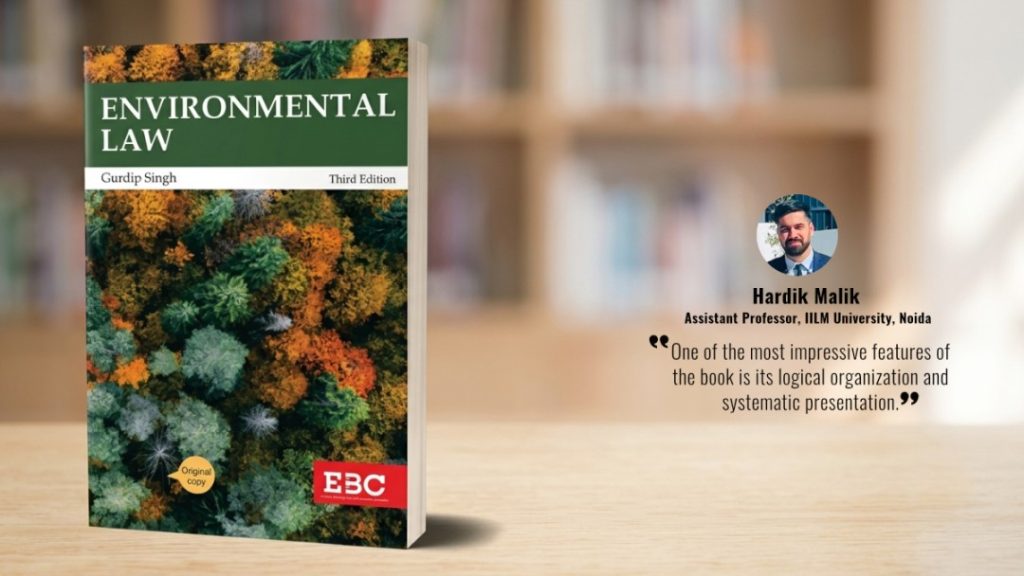
This review of Environmental Law by Gurdip Singh and Amrita Bahri has been authored by Hardik Malik, Assistant Professor at IILM University, Noida. The review offers an academic assessment of the book’s content, structure, and contribution to the study of environmental law, highlighting its relevance for students, researchers, and legal professionals.
Introduction
Environmental law has become one of the most important areas of legal study in the contemporary world. As concerns regarding environmental degradation, climate change, and sustainable development continue to grow, the need for a comprehensive understanding of environmental regulations has become increasingly significant. In this regard, Gurdip Singh’s Environmental Law serves as an invaluable academic resource that successfully bridges theoretical concepts with practical legal developments.
The book has established itself as a trusted reference for law students, academicians, and practitioners by providing a structured and accessible introduction to the subject.
Systematic and Well-Structured Coverage
One of the most impressive features of the book is its logical organization and systematic presentation. The author introduces readers to the fundamentals of environmental law before gradually moving towards more specialized topics. This progression allows students to develop a strong conceptual foundation and understand the interrelationship between various environmental statutes and principles.
The chapters are arranged in a manner that promotes easy comprehension, making the book particularly useful for both undergraduate and postgraduate students. The clear structure also enables readers to revisit specific topics efficiently while preparing for examinations or conducting research
Comprehensive Analysis of Environmental Legislation
The book provides extensive coverage of the key legislative frameworks governing environmental protection in India. Important statutes such as the Environment (Protection) Act, Water (Prevention and Control of Pollution) Act, Air (Prevention and Control of Pollution) Act, and other regulatory measures are discussed in a detailed yet accessible manner.
The explanations are concise and informative, helping students understand not only the provisions of the law but also their practical significance in environmental governance. This balanced approach ensures that readers gain both academic and practical insights into the functioning of environmental regulations.
Constitutional Dimensions of Environmental Protection
A notable strength of the book is its discussion of the constitutional basis of environmental law in India. The author effectively explains how constitutional provisions have contributed to the development of environmental jurisprudence.
Particular attention is given to Articles 21, 48A, and 51A(G), which have played a crucial role in recognizing environmental protection as a fundamental concern within the Indian legal framework. By connecting constitutional principles with environmental governance, the book helps readers appreciate the broader legal foundations of environmental rights
Insightful Treatment of Judicial Decisions
The discussion of case law is one of the book’s strongest aspects. Landmark judgments delivered by the Supreme Court and various High Courts are carefully analyzed and presented in a manner that is both informative and easy to understand.
The author highlights the judiciary’s contribution to the evolution of environmental law through doctrines such as sustainable development, the precautionary principle, public trust doctrine, and the polluter-pays principle. These discussions enable students to understand how courts have actively shaped environmental protection in India.
Understanding Law within a Policy Framework
What distinguishes this book from many conventional textbooks is its ability to place legal developments within their broader policy and social contexts. Rather than merely presenting statutory provisions, the author explains the historical and policy considerations that influenced the development of environmental legislation.
This contextual approach allows readers to appreciate the objectives behind environmental regulations and understand the challenges faced in implementing environmental policies. As a result, students gain a deeper and more meaningful understanding of the subject.
Accessibility and Student-Friendly Approach
Another commendable feature of the book is its clear and accessible language. Complex legal concepts are explained without unnecessary technical jargon, making the text approachable for students who are new to the subject.
The author’s writing style maintains academic rigor while ensuring readability. This balance makes the book an excellent classroom resource and a dependable companion for self-study. Students preparing for examinations will particularly benefit from the organized presentation and comprehensive coverage of syllabus-oriented topics
Scope for Further Research
While the book offers a strong foundation in environmental law, readers interested in emerging areas such as climate change litigation, international environmental obligations, carbon governance, and global sustainability frameworks may find it useful to supplement their reading with recent scholarly articles and contemporary research.
Given the rapidly evolving nature of environmental law, such additional resources can provide further insights into current developments and policy debates.
Final Verdict
Overall, Gurdip Singh’s Environmental Law is a well-researched, comprehensive, and highly accessible text that successfully caters to the needs of law students and educators. Its systematic structure, detailed treatment of legislation and case law, constitutional perspective, and policy-oriented approach make it one of the most reliable resources available on the
subject.
For students seeking conceptual clarity and a thorough understanding of environmental jurisprudence, this book serves as an excellent guide. It is a practical, dependable, and academically enriching addition to any law student’s library and continues to remain a recommended reference for environmental law courses across institutions
For a deeper understanding, you can refer to this resource.