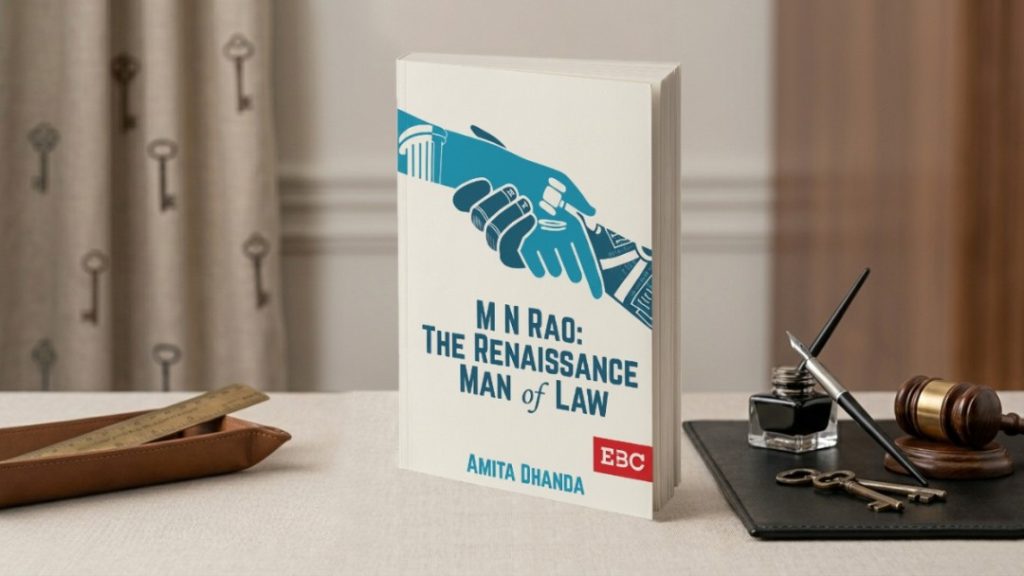
This review by Prof. Vetha Philos examines Navigating the Ethical Life of Law: Lessons from MN Rao, a biography written by Prof. Dhanda that explores the legal and ethical journey of MN Rao. Through a thoughtful analysis, the review reflects on how the book presents law not merely as a system of rules, but as a space where individuals can exercise ethical judgment within institutional constraints.
In the previous academic year, I taught a course on professional ethics that built on Iris Marian Young’s work on structural injustice and responsibility.The course moved beyond a narrow understanding of ethics as compliance with legal obligations and invited students to reflect on the various ways individuals participate in the legal system and the shared responsibilities that arise by virtue of that participation. Drawing on David Luban’s work, I argued that even within rigid institutional settings, there is room to interpret, negotiate, and shape the law in ethically salient ways.
My students, however, found these discussions overly optimistic. Most imagined their future professional lives in far more restricted terms. One in which they will be expected to simply execute tasks assigned to them. They anticipated their working conditions would be shaped by hierarchy and precarity, leaving them with little opportunity to reflect on the ethical dimensions of the tasks they were executing. In their view, ethical considerations were realistically available only to those occupying positions of authority, more particularly to individuals who had attained sufficient professional and economic security to exercise independent judgment. Beyond these limited circumstances, they felt that ethical agency in the practice of law was either negligible or prohibitively costly.
In challenging this assumption, I insisted that questions of ethics cannot be deferred until one acquires power or authority and that the ethical life of law is constituted precisely through the ways we navigate the ordinary and mundane tasks that sustain and reproduce legal institutions daily. During one of these discussions, a student asked me whether I could offer a concrete example of a legal person who had engaged with law in the manner I was describing. They were effectively querying whether these were genuinely practical possibilities or merely aspirational claims.
When I turned to biographies of lawyers and judges in search of such an example, I could not find one that served the purpose. Most biographies confined themselves to personal narratives or drifted towards hagiography, offering little insight into the ordinary realities of navigating the law. At the same time, there has been a growing body of critical work that often dismantles such figures so thoroughly that little remains beyond institutional failure and complicity. While such critiques are necessary, they can leave one with the impression that meaningful work within these institutions is impossible.
In this context, I found Prof. Dhanda’s biography of MN Rao refreshing, as it strikes a careful balance. Structured around the various roles Rao occupied over the course of his legal career, each chapter examines both the institutional significance of these roles and the ways in which Rao navigated them. Given the range of positions that Rao occupied, the work becomes valuable not only as a biography but also as a reflection on the functioning of law itself.
The book is replete with concrete examples showing that, even where the law appears to leave little room for maneuver and seems to demand only mechanical application, significant spaces for judgment and discretion remain. For instance, one might expect a district court judge to be heavily constrained by statutes and precedent, with little autonomy in decision-making. Yet the chapter on Rao’s tenure as a district judge demonstrates that trial judges exercise enormous discretion in fact-finding, an area in which appellate courts are often reluctant to interfere. The chapter illustrates how Rao’s astuteness in this task played a critical role in shaping the law’s ultimate application in practice.
The chapter on his tenure as a High Court judge further develops this theme. Here, the book demonstrates that careful, close readings of precedent often leave considerable room for interpretation and maneuver, and narrates how Rao used this interpretive space to shape the development and application of the law. Even in administrative domains, such as collegium-related work, the book shows how he worked creatively and effectively within existing institutional constraints. Taken together, these examples provide a compelling account of the maneuverable spaces within law.
Beyond adjudicatory roles, the book also highlights the possibilities for meaningful engagement with the law in a variety of other capacities, whether as a law secretary, an advocate, a public intellectual, or through philanthropic interventions. In each of these domains, the book provides concrete examples that individuals can carve out spaces for meaningful and socially significant contributions. All of this makes this a valuable tool in teaching an ethics course.
The book is also careful not to overstate the possibilities of individual action. Where institutional constraints left little or no room for meaningful intervention, the author shifts attention to the critical analysis of how these institutions are designed. As a result, the book provides a nuanced account, one that resists idealizing individual actors or reducing institutions to sites of inevitable failure. Its analysis of institutions such as the Collegium and the Backward Classes Commission makes the book valuable for readers interested in constitutional Law, judicial process, and social change lawyering.
I want to conclude this note with a brief reflection on the politics of recognition that is discussed in the book. Too often, the legal community reserves recognition and celebration for those who occupy constitutional offices or accumulate institutional prestige, treating these as the primary markers of achievement and worthy of collective remembrance. Yet some of the most meaningful labor within law takes place far away from such public celebration and institutional recognition.
This tendency to overlook significant judicial labor evidently stood out to me as I read a recent judgment of the Madras High Court concerning the legality of the Tamil Nadu Government’s acquisition of Jayalalithaa’s residence, which was being challenged by the legal heirs. Despite significant government backing for the acquisition, Justice N. Seshasayee delivered a carefully balanced ruling. What struck me was not only the judicial craft that was on display, but also how quickly such work recedes from public memory.
Perhaps that is why books like this matter. They remind us that institutions are sustained by the labour of countless individuals who strive to make the law more just and socially responsive. As a legal community, we need closer studies of how judges actually work if we are to develop a contextual understanding of the judicial process in India. Without such work, we risk continuing to understand our adjudicatory practices through theories developed in vastly different institutional and social settings. As Upendra Baxi pithily observes, the problems confronted by Lord Denning were not necessarily the same as those encountered by Justice Bhagwati.I see this book as a valuable contribution in that direction, and its account makes for a compelling read.
To know more about the book, click here.