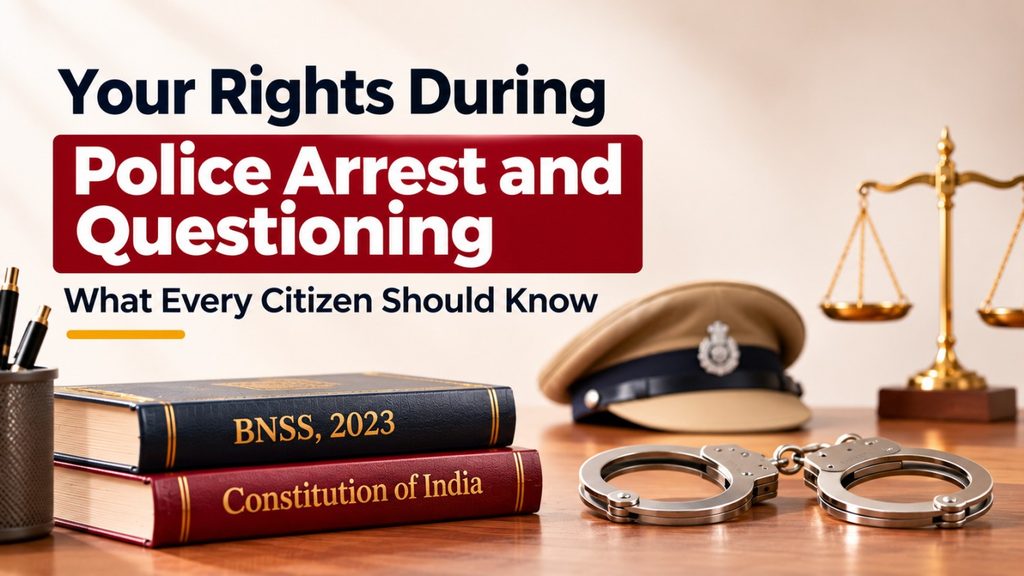
An arrest can happen to anyone, and panic often makes people give up protections they already have. Knowing your rights during police arrest in India helps you stay calm and act correctly. This guide is written for the general public, so legal terms are explained in plain language. Since 1 July 2024, arrest procedure is governed by the Bharatiya Nagarik Suraksha Sanhita, 2023 (BNSS), which replaced the Code of Criminal Procedure, 1973 (CrPC).
Your Rights During Police Arrest
1. Know the reason. Police must tell you the grounds of arrest (Article 22(1) and Section 47, BNSS). For a bailable offence, they must also tell you that you can be released on bail.
2. Identification and arrest memo. Under Section 36, officers must wear clear name tags. They must prepare an arrest memo, attested by a family member or respectable local person and countersigned by you.
3. Notice before arrest. For offences punishable up to seven years, police may issue a notice to appear instead of arresting you (Section 35(3)). If you comply, you are generally not arrested unless reasons are recorded. For offences below three years, a person above 60 or infirm can be arrested only with prior approval of an officer of Deputy Superintendent rank or above (Section 35(7)).
4. Inform someone. You may have a relative or friend told about your arrest (Section 48). Each district must also keep a designated officer who maintains arrest information (Section 37).
5. Meet a lawyer. You can consult an advocate of your choice (Article 22(1)), and Section 38 allows you to meet one during interrogation, though not throughout it.
6. Medical examination. You may be examined by a registered medical practitioner (Sections 51 and 53), which helps you document any injury.
7. Produce before a Magistrate within 24 hours. Police cannot detain you longer without a Magistrate’s order (Article 22(2) and Section 58). Travel time is excluded.
8. Special protections for women. A woman should not be arrested between sunset and sunrise except in exceptional cases, with a woman officer’s written report and prior permission of a Judicial Magistrate (Section 43). She must be searched only by another woman (Section 49).
Handcuffing is permitted only in listed serious situations, such as organised crime, terrorism or escape from custody (Section 43(3)).
Your Rights During Police Questioning
- Right to silence on self-incriminating answers. You must answer truthfully, but you can refuse questions that would expose you to a criminal charge (Article 20(3) and Section 180(2)).
- Questioning at home for protected groups. Women, men under 15 or above 60, and persons with disability or acute illness cannot be called to the police station. They can be questioned at their residence (Section 179).
- Confessions. A confession to police is not admissible (Section 23, BSA). Only a voluntary confession recorded by a Magistrate counts (Section 183, BNSS).
- No torture or coercion. Causing hurt to extort a confession is punishable under Section 120, BNS.
Rights at a Glance
| Right | Legal Source | What It Means |
|---|---|---|
| Grounds of arrest | Art. 22(1), BNSS S.47 | You must be told why |
| Notice of appearance | BNSS S.35(3) | Possible alternative to arrest |
| Arrest memo | BNSS S.36 | Written record, signed by you |
| Informing family | BNSS S.48 | Relative or friend is told |
| Lawyer | Art. 22(1), BNSS S.38 | Consultation of your choice |
| Magistrate in 24 hours | Art. 22(2), BNSS S.58 | No unauthorised detention |
| Silence on incriminating questions | Art. 20(3), BNSS S.180 | Protection from forced answers |
Remand, Bail and Remedies
On remand, the Magistrate may authorise police custody of up to 15 days in total (Section 187). Overall detention before charge sheet is capped at 60 days, or 90 days for offences punishable with death, life or at least ten years. After that, you can claim default bail.
For bailable offences, bail is a right (Section 478). For non-bailable offences, it is at the court’s discretion (Section 480). If you fear arrest, you can seek anticipatory bail (Section 482).
If your rights are violated, you can:
- Complain to the Magistrate or the Superintendent of Police.
- File a habeas corpus petition (a request to produce a detained person before the court) in the High Court or Supreme Court under Articles 226 and 32.
- Approach the State Human Rights Commission or the NHRC under the Protection of Human Rights Act, 1993.
- Seek prosecution under Sections 120 and 127 (wrongful confinement), BNS, and claim compensation.
FAQ
Yes, in cognisable offences (serious offences where police can act without a warrant) and under conditions listed in Section 35, BNSS.
Usually yes, but women, senior citizens above 60, minors under 15 and persons with disability can be questioned at home.
Only those that would incriminate you. You cannot refuse everything.
You may meet your lawyer during interrogation, but the lawyer cannot sit through the entire questioning.
You can get a free legal aid lawyer through the Legal Services Authority.
Also Read:
How to Read a Contract Before You Sign It: 12 Clauses That Can Cost You Later