Every year, lakhs of candidates apply to the Union Public Service Commission and the State Public Service Commissions. Behind each recruitment cycle is a body of law, built over decades, that decides what a commission can and cannot do. When a candidate challenges a rule, a result or an evaluation, it is that law that decides the matter.
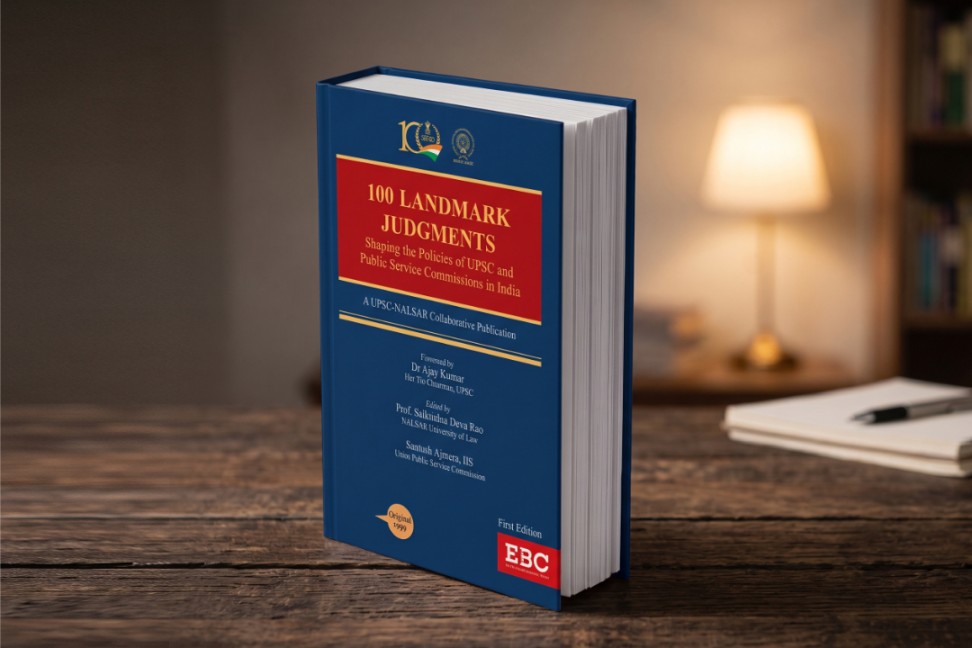
“100 Landmark Judgments: Shaping the Policies of UPSC and Public Service Commissions in India” puts that law in one place. Released by Prime Minister Narendra Modi at Bharat Mandapam on 1 October 2026 during the UPSC’s centenary celebrations, it is a joint publication of the UPSC and NALSAR University of Law, Hyderabad. It collects 100 important judgments and arranges them in ten themed chapters.
This guide explains what is inside the book, how each chapter is organised, how to read a case note, and who will get the most from it.
Book details
| Title | 100 Landmark Judgments: Shaping the Policies of UPSC and Public Service Commissions in India |
| Editors | Prof. (Dr.) Srikrishna Deva Rao, Santosh Ajmera |
| Collaboration | Union Public Service Commission (UPSC) and NALSAR University of Law, Hyderabad |
| Publisher | Eastern Book Company |
| Edition | 1st Edition, 2026 |
| Format | Hardback, 410 pages |
| ISBN | 9788168089136 |
| Language | English |
Constitutional background in 30 seconds
This is general context, not a summary of the book’s text.
- Article 14: equality before the law
- Article 16: equality of opportunity in public employment
- Part XIV (Articles 315–323): services under the Union and the States, including the Public Service Commissions
The book’s cases draw on Articles 14 and 16 and the Part XIV provisions.
How the book is organised
Front matter
- Foreword by Dr Ajay Kumar, Hon’ble Chairman, UPSC
- Acknowledgment by Shri Shashi Ranjan Kumar, IAS, Secretary, UPSC
- Introduction by Prof. (Dr.) Srikrishna Deva Rao, Vice-Chancellor, NALSAR University of Law, Hyderabad
- Table of Cases
Ten chapters, followed by a Subject Index.
The ten chapters, in three parts
The book lists the chapters in one sequence. To make them easier to navigate, we’ve grouped them into three parts. The grouping is ours and not the book’s, and the descriptions are based on the chapter titles and the publisher’s summary.
Part A: The institution
What the Commissions are, who runs them, and how far their powers go
| # | Chapter | What it deals with |
|---|---|---|
| 1 | Constitutional Foundations and Institutional Autonomy | Where the Commissions get their authority and how independent they are |
| 2 | Appointments and Eligibility Criteria | Who can be appointed, and the conditions attached |
| 8 | Administrative Discretion, Rule-Making and Institutional Powers | The limits of a commission’s discretion and rule-making authority |
| 9 | Governance, Accountability and Ethical Standards | Accountability and ethics in how recruitment is run |
Part B: The process
How selection actually works, from application to service records
| # | Chapter | What it deals with |
|---|---|---|
| 3 | Recruitment Procedures and Administrative Fairness | How selection processes must be run, and what fairness requires |
| 5 | Applications and Procedural Deficiencies | What happens when an application is incomplete, late or defective |
| 6 | Examinations and Evaluations | How exams are conducted and when evaluation can be questioned |
| 7 | Confidential Reports, DPCs and Service Records | Progression within service: reports, promotion committees, records |
Part C: Rights and special provisions
Social justice and eligibility exceptions
| # | Chapter | What it deals with |
|---|---|---|
| 4 | Reservation and Social Justice | How reservation operates in public recruitment |
| 10 | Age Relaxation and Sports Quota | Age relaxation and sports quota issues |
How to read a case note
Every judgment follows the same five-part structure:
| Section | What it gives you | Who benefits most |
|---|---|---|
| Facts | What happened | Everyone |
| Issues | The legal questions before the court | Students, lawyers |
| Decision | What the court ordered | Everyone |
| Ratio | The legal principle behind the decision | Lawyers, officials |
| Significance | Why the case matters | Aspirants, officials |
Which chapters should you read first?
| If you are a… | Start with | Why |
|---|---|---|
| Civil services aspirant | Chapters 1, 3, 4, 6 | The principles behind the exam system |
| Law student | Chapters 1, 3, 8 | Constitutional and administrative law themes |
| Practitioner | Subject Index, then 2, 5, 6, 7, 10 | Quick reference for common disputes |
| Commission or department official | Chapters 3, 5, 6, 8, 9 | Day-to-day procedure and discretion |
How it differs from other “landmark judgments” books
General landmark-judgment books for UPSC preparation usually cover broad constitutional cases. This book focuses on a single subject, the law governing public recruitment and Public Service Commissions, and is a collaboration between a constitutional body and a law university.
Frequently asked questions
No. It is a legal reference. It can help aspirants understand the principles behind the system, but it is not a syllabus-based guide.
No. The publisher lists Public Service Commissions, government departments, practitioners, scholars, students and aspirants.
Prime Minister Narendra Modi released it at Bharat Mandapam, New Delhi, on 1 October 2026, during the UPSC centenary celebrations.
It is listed on the EBC Webstore at Rs. 1,870 (list price Rs. 2,200). Check the listing for the current price and delivery time.
Curious for more? The reference book has it.