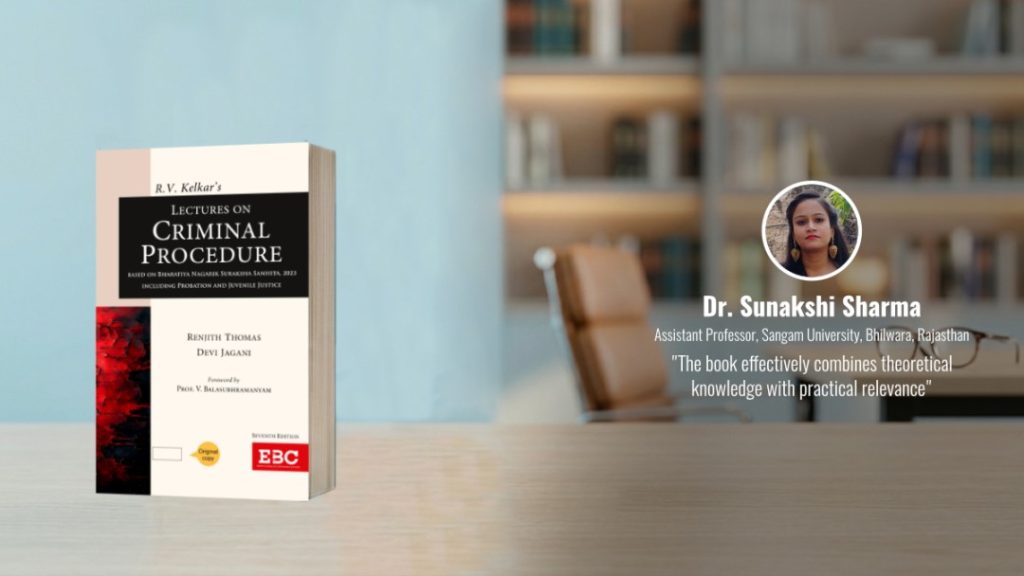
This review of R.V. Kelkar’s Lectures on Criminal Procedure, revised by Renjith Thomas and Devi Jagani, is authored by Dr. Sunakshi Sharma, Assistant Professor at Sangam University, Bhilwara, Rajasthan. It evaluates the book’s structure, clarity, and continued relevance to criminal procedure law. The revised edition retains Kelkar’s analytical rigor while incorporating updated case laws and amendments, making it valuable for students and practitioners alike.
After going through this book in detail, I found it to be an exceptionally well-written and thoughtfully structured resource. The subject has been presented with remarkable clarity, making even complex legal concepts easy to understand. In legal education, where students often find theoretical discussions challenging, a book that explains concepts in a simple and systematic manner is truly valuable. This book succeeds in achieving that objective while maintaining academic rigor.
Clarity of Concepts
One of the aspects I appreciated the most is the clarity with which the concepts have been explained. The author has presented the subject in a logical sequence, allowing readers to build their understanding gradually. The language is simple, precise, and easy to follow, making the book accessible to students at different stages of legal education.
Rather than merely presenting legal principles, the book explains them in a way that strengthens conceptual understanding. This approach helps readers grasp even intricate topics with confidence and ease.
Practical and Student-Friendly Approach
The book effectively combines theoretical knowledge with practical relevance. It goes beyond explaining legal provisions by presenting the subject in a manner that encourages analytical thinking and deeper understanding. The well-organized structure and reader-friendly style make learning more engaging and less intimidating.
I believe this practical approach makes the book particularly useful not only for classroom study but also for revision and self-learning.
Updated and Comprehensive Content
Another noteworthy feature of the book is its updated content. It reflects the latest developments in the subject and presents information that is relevant to the current academic and legal landscape. The comprehensive coverage ensures that readers receive a balanced understanding of both foundational principles and contemporary developments.
The author’s attention to detail and commitment to accuracy further enhance the credibility and usefulness of the book.
A Valuable Academic Companion
What further enhances the value of this book is its ability to serve as a dependable academic companion throughout a student’s legal journey. Whether used for regular classroom study, examination preparation, or quick reference, the book provides concise yet comprehensive explanations that make learning more effective. The author’s balanced approach to presenting the subject enables readers to develop both conceptual clarity and analytical skills. I believe this combination of simplicity, accuracy, and practical relevance makes the book a worthwhile addition to the personal library of every law student and an equally useful reference for teachers and legal practitioners
Why I Recommend This Book
In my opinion, the greatest strength of this book lies in its ability to simplify complex legal concepts without compromising academic depth. Its clarity, practical utility, and contemporary approach make it an excellent academic resource for law students, teachers, researchers, and legal practitioners alike.
Whether someone is studying the subject for the first time or revisiting it for academic or professional purposes, this book serves as a reliable and comprehensive guide.
Overall, I found this book to be an insightful and worthwhile read. Its lucid presentation, practical orientation, and up-to-date content make it a valuable contribution to legal literature. I would confidently recommend it to students, academicians, and legal professionals seeking a clear, comprehensive, and dependable resource for understanding the subject.