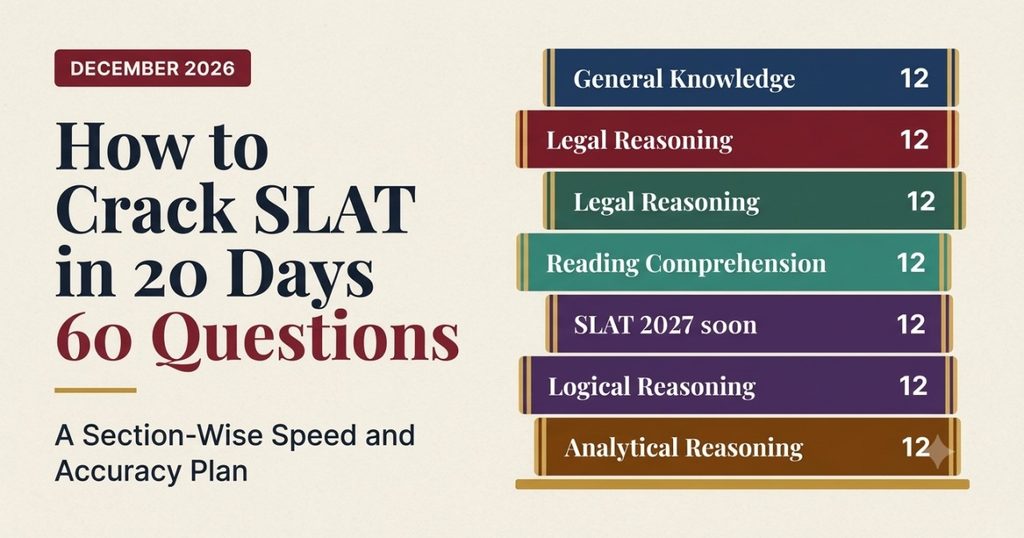
With SLAT 2027 Computer-Based Tests scheduled for December 19 and December 26, 2026, learning how to crack SLAT 2027 in 20 days comes down to mastering speed without sacrificing precision. Conducted by Symbiosis International (Deemed University), an institution recognized under Section 3 of the University Grants Commission Act, 1956, SLAT is the gateway to five-year integrated law programmes at Pune, Noida, Hyderabad, and Nagpur. Because candidates must answer 60 objective questions in just 60 minutes with zero negative marking, a structured 20-day sprint can dramatically lift your final percentile.
Also read: SLAT Mock Test Analysis: What Your Score Means
Regulatory Framework and Admission Rules
Admission to five-year integrated law courses (B.A. LL.B., B.B.A. LL.B., and B.Com. LL.B.) across Symbiosis Law Schools operates under a dual regulatory framework:
- Bar Council of India (BCI) Standards: Under Section 7(1)(h) and Section 49(1)(af) of the Advocates Act, 1961, read with Rule 5(b) and Schedule III of the Bar Council of India Rules of Legal Education, 2008, candidates entering an integrated five-year law degree must complete their Senior Secondary (10+2) examination with at least 45% aggregate marks (40% for SC/ST candidates).
- University Selection Regulations: Under the Symbiosis International (Deemed University) Admission Regulations, 2027, shortlisting for the Personal Interaction (PI) round relies strictly on the SLAT Computer-Based Test (CBT) score. Final merit lists scale the 60-mark entrance score up to 70 marks and combine it with 30 marks from the PI round.
- Best-of-Two Attempts and Accommodations: Candidates may appear on both December 19 and December 26, 2026, and the university considers the higher score after statistical normalization (adjusting raw scores across shifts for uniform difficulty). Under Section 17 of the Rights of Persons with Disabilities Act, 2016, and official SLAT guidelines, eligible PwD candidates receive 20 minutes of compensatory time over the standard 60-minute duration.
- Compliance and Disqualification: Registration closes on December 4, 2026. Carrying prohibited electronic devices or missing any component of the PI process leads to immediate disqualification from the merit list.
SLAT 2027 Exam Pattern and Time Allocation Matrix
Understanding the SLAT 2027 exam pattern allows you to budget every second of your 60-minute window. All five sections carry equal weightage, and you can switch freely between sections during the test.
| Section Name | Questions | Marks | Ideal Time Budget | Target Accuracy | Core Preparation Focus |
| General Knowledge (GK) | 12 | 12 | 6 Minutes | 85%+ | Static awards, international bodies, constitutional milestones, and 2026 current affairs. |
| Legal Reasoning | 12 | 12 | 14 Minutes | 90%+ | Principle-fact application in torts, contracts, criminal law, and constitutional basics. |
| Logical Reasoning | 12 | 12 | 13 Minutes | 85%+ | Syllogisms, statement-assumption, cause-effect, blood relations, and seating arrangements. |
| Analytical Reasoning | 12 | 12 | 13 Minutes | 80%+ | Percentages, ratios, averages, number series, and basic data interpretation sets. |
| Reading Comprehension | 12 | 12 | 14 Minutes | 85%+ | Main idea identification, inference questions, tone analysis, and contextual vocabulary. |
| Total | 60 | 60 | 60 Minutes | 85%+ | Attempt all 60 questions since there is no negative marking. |
The 20-Day Section-Wise Speed and Accuracy Plan
Following a disciplined SLAT 2027 section wise strategy ensures that you build conceptual clarity first before transitioning into high-speed mock drills.
- Days 1 to 6 (Foundation and Concept Consolidation): Dedicate two hours daily to Legal Reasoning principles (void agreements, negligence, strict liability, and general criminal defences) and two hours to Analytical and Logical Reasoning shortcuts. Spend 45 minutes each evening revising monthly current affairs digests from January to November 2026.
- Days 7 to 13 (Sectional Speed Drills): Switch to timed 15-minute sectional tests. Practice solving 12 Legal Reasoning questions in under 13 minutes by reading the legal principle carefully and applying it strictly to the given facts without bringing in outside assumptions. For Reading Comprehension, skim the questions before reading the passage to locate answers faster.
- Days 14 to 18 (Full-Length 60-Minute CBT Mocks): Attempt one full-length 60-minute mock test every alternate day under strict exam conditions. Start with General Knowledge in the first six minutes to bank quick marks, move to Legal Reasoning and Reading Comprehension while your focus is sharpest, and finish with Analytical and Logical Reasoning.
- Days 19 to 20 (Revision, Formula Review, and Logistics): Stop learning new topics. Revise your GK error log, mathematical shortcut formulas, and legal maxims. Download your admit card (released on December 11 for Test 1 and December 18 for Test 2) and verify your original government photo ID.
Frequently Asked Questions (FAQs)
Yes. Because SLAT tests foundational aptitude across 60 direct questions rather than lengthy reading passages, focused daily practice and timed mocks over 20 days are sufficient to achieve a competitive score.
No. There is zero negative marking for incorrect answers in SLAT 2027, so you should never leave any question unattempted.
Yes. Candidates can register for both December 19 and December 26, 2026. If you take both tests, Symbiosis considers your higher normalized score for shortlisting.
While cut-offs vary yearly based on normalization and seat intake, aiming for 44 to 48 marks out of 60 puts you in a strong position for an SLS Pune shortlist, while 39 to 43 marks is typically competitive for SLS Noida.
Continue the SLAT 2027 series