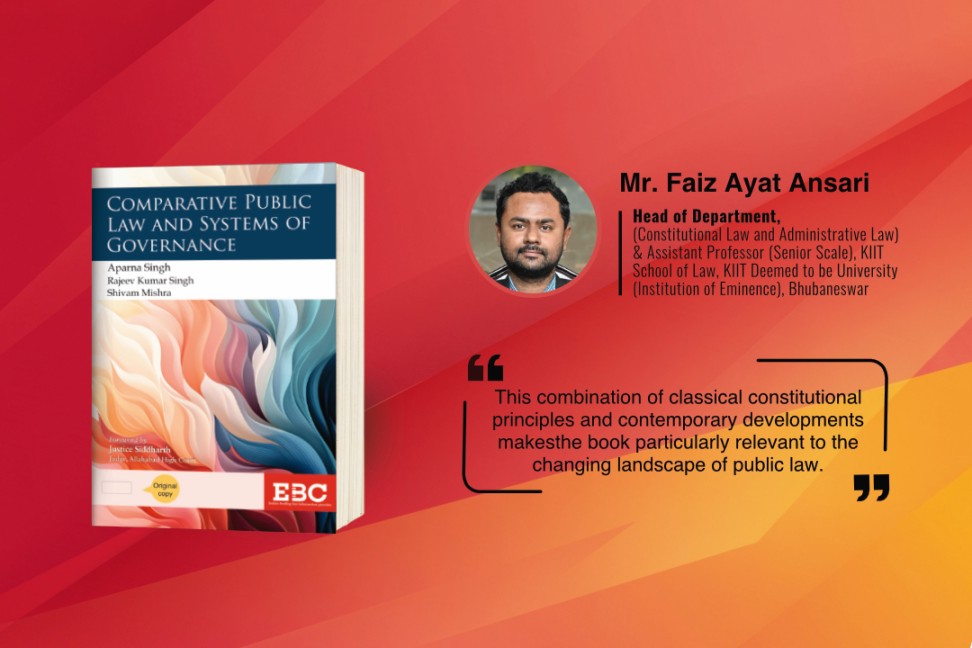
In an increasingly interconnected world, constitutional systems cannot be understood in isolation. Questions concerning judicial independence, fundamental rights, the separation of powers, federalism, administrative accountability, digital governance and climate change have become matters of global legal and political significance. Understanding how different jurisdictions approach these challenges is therefore essential for students, researchers, teachers and practitioners of public law
It is in this context that Comparative Public Law and Systems of Governance, authored by Aparna Singh, Rajeev Kumar Singh and Shivam Mishra, with a foreword by Justice Siddharth, Judge, Allahabad High Court, and published by Eastern Book Company, makes a valuable contribution to contemporary legal scholarship. Comprising 17 chapters organised into four thematic parts, the book offers a comprehensive exploration of comparative public law, connecting foundational constitutional principles with the evolving challenges of modern governance.
Moving Beyond Traditional Comparative Constitutionalism
One of the most notable features of this work is its approach to comparative public law. Rather than presenting constitutional systems as separate country-wise accounts, the authors adopt an analytical and problem-oriented methodology. The book examines important constitutional doctrines and institutional arrangements across India, the United States, the United Kingdom, South Africa, France, Germany, Canada and Australia, among other jurisdictions.
The discussion covers foundational concepts such as the rule of law, separation of powers, judicial review, constitutional amendments, the basic structure doctrine and fundamental rights. At the same time, it engages with emerging questions involving artificial intelligence, digital constitutionalism, climate governance, populism and technological regulation.
This combination of classical constitutional principles and contemporary developments makes the book particularly relevant to the changing landscape of public law. It encourages readers to understand not only what constitutional doctrines mean, but also how they operate within different political, institutional and social contexts
A Thoughtfully Structured Resource for Students and Teachers
The book is divided into four parts: Foundations of Comparative Public Law; Constitutional Structures and Processes; Comparative Institutions and Governance; and Transformative Dimensions of Public Law. This organisation provides a logical progression from fundamental concepts to more specialised and contemporary areas of inquiry
Its pedagogical design deserves particular appreciation. Each chapter begins with an “In This Chapter” section, offering readers a roadmap of the topics and concepts that follow. This feature is especially useful for students approaching complex constitutional theories or unfamiliar comparative jurisdictions
Equally valuable is the “For Discussion” section at the end of each chapter. Rather than encouraging simple memorisation, these questions invite readers to examine competing constitutional approaches, evaluate institutional choices and develop independent arguments.They can also serve as useful starting points for classroom discussions, seminars, research assignments and postgraduate dissertations.
The detailed Table of Cases and comprehensive Subject Index further enhance the book’s academic utility. These features make it easier for readers to locate relevant authorities and revisit specific legal concepts
Exploring Constitutional Foundations and Structures
The first part establishes the conceptual foundations of comparative public law. It introduces the objectives and methods of comparative constitutional analysis, including the horizontal application of rights, data governance and environmental constitutionalism.
The subsequent chapters examine constitutional design and different forms of government. Readers are introduced to rigid, flexible and blended constitutional arrangements, as well as federal, unitary, hybrid and post-revolutionary frameworks. The comparative treatment of parliamentary, presidential and semi-presidential systems helps explain how political institutions function across different constitutional settings
The discussion of the rule of law and separation of powers is particularly significant. By contrasting the relatively strict separation of powers associated with the United States with the fusion of powers characteristic of Westminster-style parliamentary systems, the authors demonstrate how similar constitutional objectives may be pursued through different institutional arrangements.
The second part turns to constitutional structures and processes. It explores judicial independence, judicial appointments, judicial review and constitutional amendment procedures. A particularly important discussion concerns the basic structure doctrine, which is examined through the experiences of India, Germany and Canada, alongside broader constitutional theory.
The treatment of Fundamental Rights and Directive Principles also provides a useful. comparative perspective. By tracing their philosophical foundations and examining the approaches of different jurisdictions towards socio-economic rights, the book encourages readers to reflect on the relationship between individual liberty, social justice and constitutional responsibility.
Institutions, Governance and the Challenges of a Changing World
The third part shifts the focus from constitutional foundations to the institutions responsible for implementing and protecting constitutional principles.
Its discussion of comparative administrative law examines the grounds of judicial review, including illegality, irrationality, procedural impropriety and proportionality. It also considers the role of regulatory tribunals and administrative institutions in different legal systems
The chapters on public institutions broaden the discussion to electoral systems, election commissions, ombudsman institutions, local governance and the Right to Information Act, 2005.The historical development of the Ombudsman, from its origins in Sweden to the establishment of the Lokpal and Lokayuktas in India, provides an interesting institutional comparison.
Particularly relevant to contemporary readers are the chapters addressing globalisation, emergency powers, populism and technology. The authors examine how populist political movements and disinformation can place pressure on constitutional institutions and democratic accountability.
The discussion of public law and technology is especially timely. Issues such as surveillance, automated decision-making and algorithmic transparency raise important questions about equality, accountability and individual rights. The book connects these developments with constitutional principles, including Article 14, while also examining regulatory developments such as the European Union’s Digital Services Act.
Climate Governance, Federalism and Constitutional Transformation
The fourth part explores the transformative dimensions of public law. Environmental and climate constitutionalism receives particular attention, with reference to developments in India and other jurisdictions. The discussion brings together important judicial decisions, including Ashgar Leghari and Oposa v. Factoran, alongside international frameworks such as the Paris Agreement and the Rio Declaration
The chapter on federalism is another significant contribution. Instead of treating federalism merely as a division of legislative powers, the authors explore it as a broader legal and political idea. Different forms, including dual, cooperative, competitive, asymmetric and fiscal federalism, are examined through the experiences of countries such as the United States, Canada, Germany, Australia and India
The book also addresses constitutional morality, reformative constitutionalism, majoritarianism and abusive constitutionalism. These discussions are particularly important in understanding how constitutional values can be protected while institutions respond to changing political and technological circumstances.
Recent Indian constitutional developments, including the Electoral Bonds judgment, Supriyo v. Union of India and the Article 370 reference, help connect theoretical discussions with contemporary constitutional practice.
What Could Be Further Developed?
The book’s wide-ranging coverage is impressive, although a few areas offer opportunities for further enrichment in future editions.
First, considering the title Comparative Public Law and Systems of Governance, the discussion of territorial systems of governance could benefit from a more detailed treatment of unitary and confederal arrangements. While federalism receives substantial attention, dedicated discussions of the institutional, fiscal and accountability structures of unitary states and confederal models would make the comparative framework more balanced.
Second, certain themes, particularly constitutional rights, amendment procedures, administrative accountability and electoral integrity, recur across different chapters. Although revisiting these subjects can reinforce important concepts, some consolidation could make the overall narrative more concise and avoid thematic repetition.
These observations, however, do not diminish the book’s considerable academic value. Rather, they identify areas where an already substantial work could become even more comprehensive.
A Valuable Addition to Contemporary Legal Scholarship
Comparative Public Law and Systems of Governance is an ambitious and thoughtfully organised contribution to the study of comparative public law. Its principal strength lies in bringing together foundational constitutional doctrines, comparative institutional analysis and emerging challenges of modern governance within a single academic resource.
The book is particularly useful for LL.M. students, undergraduate law students, research scholars, teachers and those preparing for judicial and civil services examinations. Its structured chapter introductions, discussion questions, comparative examples and extensive treatment of contemporary developments make it suitable for both independent study and classroom teaching
By encouraging readers to look beyond individual constitutional systems and examine how different jurisdictions respond to common challenges, the authors offer an important framework for developing comparative and critical legal thinking
Despite the scope for greater coverage of unitary and confederal systems and some streamlining of recurring themes, the work stands out as a relevant, intellectually engaging and forward- looking textbook. Eastern Book Company deserves appreciation for bringing out a publication that helps equip the next generation of legal scholars and practitioners to understand constitutional democracy through a broader comparative lens
For anyone seeking to understand how constitutional principles, public institutions and systems of governance interact across jurisdictions, this book is a worthwhile addition to their academic and professional reading.
Want the deeper dive? Grab the reference book.