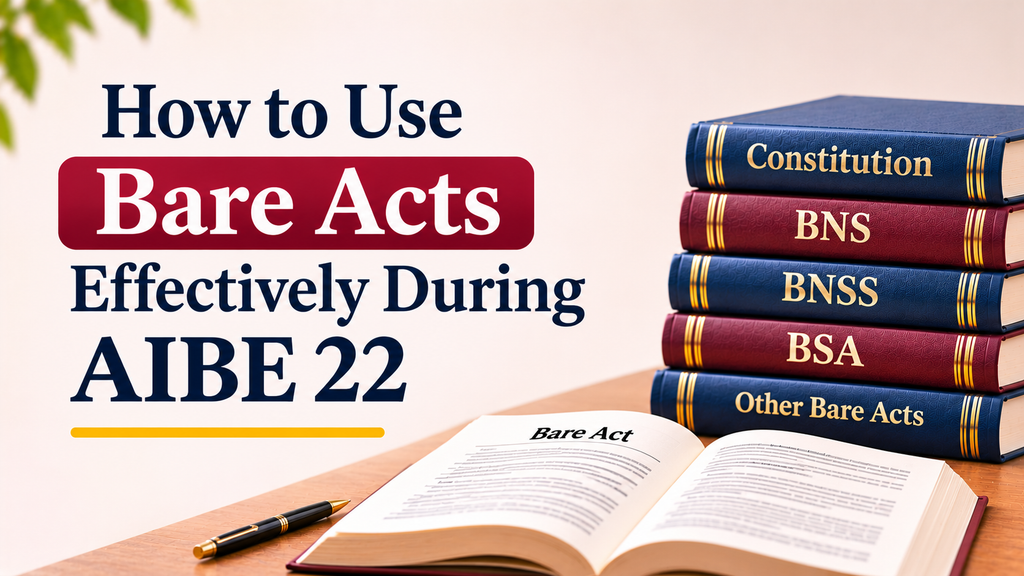
Knowing how to use bare acts for AIBE can decide whether you finish the paper with time to spare. A bare act is the plain text of a law, with no commentary or notes. The All India Bar Examination (AIBE) is an open-book test, and AIBE 22 is on 29 November 2026. This guide is written for law graduates and final-year LL.B. students, and explains what is allowed and how to search quickly.
Legal Background
- The Advocates Act, 1961 governs the legal profession. Section 24 lists who can be enrolled as an advocate, and Section 49 lets the Bar Council of India (BCI) make rules.
- Passing AIBE leads to the Certificate of Practice under the BCI Certificate and Place of Practice (Verification) Rules, 2015.
- The BCI sets the exam conditions, including which materials are permitted. Using unfair means can lead to cancellation, and impersonation can amount to cheating by personation under Section 319 of the Bharatiya Nyaya Sanhita, 2023 (BNS).
What Is Allowed in the AIBE 22 Hall
Sources say the question paper permits “Bare Acts without notes”. Details vary between sources, so check your admit card.
| Allowed | Not allowed |
|---|---|
| Clean, printed bare acts | Textbooks, guides and commentaries |
| Both old and new criminal codes | Handwritten notes and loose papers |
| One clean copy per Act | Annotated editions |
| Admit card and photo ID | Highlighted, underlined or marked copies, often refused at centres |
| Phones, smartwatches, calculators and bags |
Sources conflict on tabs, printouts and photocopies, and one says “minimal short notes” may be allowed at the invigilator’s discretion. Do not plan around that. Carry unmarked printed copies from a recognised publisher.
Bare Acts for AIBE 22: What to Carry
Recent papers have used both old and new criminal laws. The BNS replaced the Indian Penal Code (IPC), the Bharatiya Nagarik Suraksha Sanhita, 2023 (BNSS) replaced the Code of Criminal Procedure (CrPC), and the Bharatiya Sakshya Adhiniyam, 2023 (BSA) replaced the Evidence Act.
| Subject | Questions | Bare acts to carry |
|---|---|---|
| Constitutional Law | 10 | Constitution of India |
| Criminal Procedure | 10 | CrPC and BNSS |
| Civil Procedure | 10 | Code of Civil Procedure, 1908 |
| Penal Law | 8 | IPC and BNS |
| Evidence | 8 | Evidence Act and BSA |
| Contract, Property, Negotiable Instruments | 8 | Contract Act 1872, Specific Relief Act 1963, Transfer of Property Act 1882, Negotiable Instruments Act 1881 |
| Family Law | 8 | Hindu Marriage Act 1955, Hindu Succession Act 1956, Special Marriage Act 1954 |
| ADR | 4 | Arbitration and Conciliation Act, 1996 |
| Professional Ethics | 4 | Advocates Act, 1961 and BCI Rules |
If space is tight, prioritise the first seven rows, which carry 62 of 100 marks. Tort, Administrative Law and PIL are largely uncodified, so bare acts will not answer them.
The Search Ladder: Finding Answers Fast
Narrow every question step by step:
Identify the Act
        ↓
Find the Chapter
        ↓
Locate the Section and sub-section
        ↓
Check the proviso (an exception to the rule)
        ↓
Read the Explanation and Illustrations- Use the index first when the question gives only a keyword.
- Read provisos and explanations, because exceptions often sit there.
- Check footnotes for amendments and enforcement dates.
Three-Pass Strategy for AIBE 22
- Pass one: answer questions you already know. These need no lookup.
- Pass two: answer questions that need a quick lookup, capped at about two minutes each.
- Pass three: attempt doctrine and application questions, which the Act cannot answer directly.
One source puts the paper at 100 questions in three hours, about 90 seconds a question. Confirm timing on your admit card, and keep roughly 30 minutes for review.
Common Mistakes to Avoid
- Carrying marked or highlighted copies
- Using outdated editions, since amendments can change the answer
- Searching for every question instead of answering what you know
- Forgetting the new BNS, BNSS and BSA section numbers
Practise Before the Exam
- Keep two sets: a marked study copy and a clean exam copy.
- Take timed mock tests using only the clean copies.
- Practise with bare acts for AIBE using the real search ladder, not by flipping pages.
- Arrange your volumes in subject order on the desk.
FAQs
Yes, sources say bare acts without notes are allowed. Check the admit card.
Avoid it. Marked copies are often refused.
Yes, carry both sets, since papers have used both.
Sources conflict, so carry printed copies from a recognised publisher.
No. Tort, Administrative Law and PIL are mostly uncodified.
No, so attempt every question.
Some of the top books for AIBE:
- R.V. Kelkar’s Lectures on Criminal Procedure: Based on Bharatiya Nagarik Suraksha Sanhita, 2023
- V. P. Sarathi’s Law of Evidence: Based on Bharatiya Sakshya Adhiniyam, 2023
- B.M. Gandhi’s Penal Law: Covering Bharatiya Nyaya Sanhita 2023, Dowry Prohibition Act, JJ Act, MTP Act, POCSO Act, DV Act, and More
- EBC’s Master Guide To All India Bar Examination (AIBE Exam Guide)
- All India Bar Examination Bare Acts Without Notes and Comments | AIBE Bare Acts Combo Set of 25 Books | Covering Old and New Criminal Laws
- All India Bar Examination – Solved Papers 2015-2025
- Universal’s Guide to All India Bar Examination | AIBE Complete Syllabus Guide