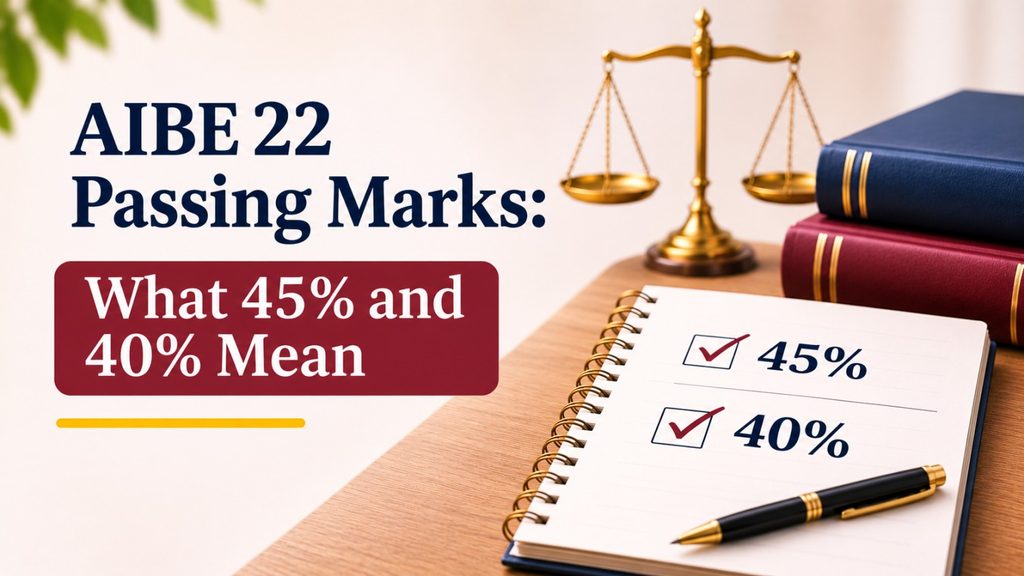
The AIBE 22 passing marks are 45% for General and OBC candidates and 40% for SC, ST and PwD candidates, which is 45 and 40 marks on a 100-mark paper. But the score that actually qualifies has moved in recent exams. This guide is written for law graduates taking the All India Bar Examination (AIBE) on November 29, 2026, so legal terms are explained plainly. It covers the rules, how cut-offs move, and what happens next.
Main article: AIBE 22 Exam 2026: Complete Guide to Dates, Registration, Syllabus, and Eligibility
AIBE 22 Passing Marks at a Glance
| Category | Qualifying percentage | Marks out of 100 |
|---|---|---|
| General | 45% | 45 |
| OBC | 45% | 45 |
| SC and ST | 40% | 40 |
| PwD (persons with disability) | 40% | 40 |
Each correct answer earns one mark, and there is no negative marking, so a blank and a wrong answer cost the same.
The Legal Basis
- Advocates Act, 1961: Section 49(1)(ah) lets the Bar Council of India (BCI) frame rules for the exam. Section 24 sets enrolment eligibility, and Sections 29 and 33 limit court practice to advocates.
- BCI Rules, Part VI, Chapter III, Rules 9 to 11: inserted in 2010. Rule 10(1)(d) says the BCI decides the passing percentage, so the figure is not frozen by law. Rule 10(1)(e) allows re-attempts without a limit, and Rule 11(1) requires a Certificate of Practice, meaning permission to practise in courts, within 30 days of the result.
- Section 35, Advocates Act: punishes professional misconduct.
- Bharatiya Nyaya Sanhita, 2023: Sections 318 and 319 cover cheating and personation.
- Rights of Persons with Disabilities Act, 2016: supports inclusion, though the lower PwD threshold comes from BCI rules.
Why the Qualifying Score Moves
Two things can change the number after the exam. Withdrawal removes a faulty or validly objected question, with no bonus mark, so the paper is marked out of a smaller total. Moderation is the BCI’s Monitoring Committee lowering the qualifying marks after reviewing the paper and result.
| Exam | Marked out of | General and OBC | SC, ST, PwD | Why it moved |
|---|---|---|---|---|
| AIBE XX | 95 | 43 | 38 | Five questions withdrawn |
| AIBE XXI | 100 | 42 | 37 | Moderated down by three |
| AIBE XXII | Not announced | Not announced | Not announced | Decided after the exam |
In AIBE XXI, 1,75,701 candidates appeared, 1,15,805 qualified, and 59,876 did not. The pass rate was 65.92%, and 20 results were held over alleged malpractice.
Exam → provisional answer key → objections → withdrawals → result → possible moderation → Certificate of Practice (within 30 days)
What the AIBE 22 Cut-Off Means for You
The percentage is published in advance, but the final score is not. In the last two cycles, the qualifying score came out below 45 and below 40. Do not plan around those lower numbers. They came from harder or flawed papers, and there is no promise of a repeat. The AIBE 22 result is tentatively expected between January 7 and 10, 2027.
Is the AIBE Hard to Pass?
Two thirds of AIBE XXI candidates qualified, but the paper’s composition matters. Twenty-seven of its 100 questions could not be answered from a Bare Act, up from 13 in AIBE XX. The exam is open book, so tabbing helps with retrieval, but doctrine and principles have to be learned beforehand. With 100 questions in about three hours, each question gets roughly 90 seconds.
What If You Do Not Pass
You can sit again, since the rules set no limit on attempts. If you enrolled with a State Bar Council before passing, you hold a provisional enrolment certificate. It lets you work under a senior advocate but not practise independently or appear in court, and it is valid for two years from enrolment. Pass within that window to keep the enrolment effective.
Penalties and Remedies
Malpractice can mean withheld results, cancellation and criminal action under the Bharatiya Nyaya Sanhita, plus misconduct proceedings under Section 35 of the Advocates Act. For a disputed question or result, use the BCI’s objection and grievance channels first. A serious unresolved case can go to the High Court through a writ petition under Article 226, a request for a court order against unfair official action.
FAQs
45 for General and OBC, and 40 for SC, ST and PwD, out of 100.
Yes, through withdrawn questions or moderation by the BCI.
42 for General and OBC, and 37 for SC, ST and PwD, after moderation.
No
There is no limit under the rules.
Within 30 days of the result, under Rule 11(1).
Two years from enrolment.
Some of the top books for AIBE:
- R.V. Kelkar’s Lectures on Criminal Procedure: Based on Bharatiya Nagarik Suraksha Sanhita, 2023
- V. P. Sarathi’s Law of Evidence: Based on Bharatiya Sakshya Adhiniyam, 2023
- B.M. Gandhi’s Penal Law: Covering Bharatiya Nyaya Sanhita 2023, Dowry Prohibition Act, JJ Act, MTP Act, POCSO Act, DV Act, and More
- EBC’s Master Guide To All India Bar Examination (AIBE Exam Guide)
- All India Bar Examination Bare Acts Without Notes and Comments | AIBE Bare Acts Combo Set of 25 Books | Covering Old and New Criminal Laws
- All India Bar Examination – Solved Papers 2015-2025
- Universal’s Guide to All India Bar Examination | AIBE Complete Syllabus Guide