AIBE 22 important topics are easy to identify once you look at the marks. The All India Bar Examination (AIBE) is on 29 November 2026, with 100 questions across 19 subjects. Seven subjects carry 62 marks, so smart revision starts there. This guide is written for law graduates and final-year LL.B. students, and explains each key area in plain language.
Legal Background
- The Advocates Act, 1961 governs the legal profession. Section 24 lists who can be enrolled as an advocate, and Section 49 lets the Bar Council of India (BCI) make rules.
- Passing AIBE leads to the Certificate of Practice under the BCI Certificate and Place of Practice (Verification) Rules, 2015.
- The syllabus covers both old criminal laws (IPC, CrPC, Evidence Act) and the new ones: the Bharatiya Nyaya Sanhita, 2023 (BNS), the Bharatiya Nagarik Suraksha Sanhita, 2023 (BNSS) and the Bharatiya Sakshya Adhiniyam, 2023 (BSA).
AIBE 22 Important Topics by Weightage
| Tier | Subjects | Questions |
|---|---|---|
| High | Constitutional Law, BNSS/CrPC, CPC, BNS/IPC, Evidence/BSA, Family Law, Contract and Property group | 62 |
| Medium | Tort, ADR, Professional Ethics, Labour, Taxation, PIL | 25 |
| Low | Administrative, Company, Environmental, Cyber, Land Acquisition, IP | 13 |
Sources say the weightage is unchanged from AIBE 21. Confirm it on the BCI notice.
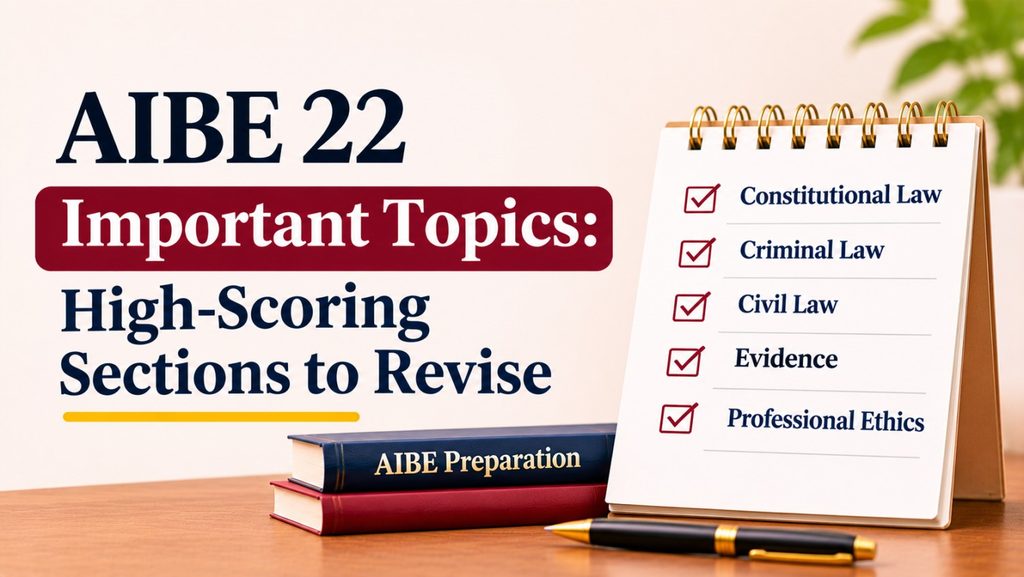
High-Scoring Sections to Revise
| Subject | Qs | High-yield provisions |
|---|---|---|
| Constitutional Law | 10 | Articles 14, 19, 21, 32 and 226 (equality, freedoms, life, and writ powers of the Supreme Court and High Courts); Article 368 (amendment) |
| Criminal Procedure | 10 | BNSS Section 173 (FIR), Section 35 (arrest), Section 482 (anticipatory bail, protection from arrest before it happens) |
| Civil Procedure | 10 | CPC 1908 Sections 9 (jurisdiction), 10 (res sub judice, a pending case), 11 (res judicata, a decided case), Order VII (plaint) and Order VIII (written statement) |
| Penal Law | 8 | BNS Section 103 (murder punishment), Section 318 (cheating), private defence and general exceptions |
| Evidence | 8 | BSA Section 63 (electronic records), admissions, confessions, dying declarations, burden of proof |
| Family Law | 8 | Hindu Marriage Act 1955, Hindu Succession Act 1956, Special Marriage Act 1954, Muslim personal law |
| Contract and Property | 8 | Contract Act 1872 Sections 10 and 73, Specific Relief Act 1963, Transfer of Property Act 1882, Negotiable Instruments Act 1881 Section 138 |
Tip: for Section 138 (cheque dishonour), learn the sequence: demand notice within 30 days, 15 days to pay, then a complaint within one month.
Medium-Weight Topics
- Tort and Consumer (5): negligence, the Motor Vehicles Act, 1988 and the Consumer Protection Act, 2019
- ADR (4): the Arbitration and Conciliation Act, 1996, which lets parties settle disputes outside court, and the Mediation Act, 2023
- Professional Ethics (4): the BCI Rules on advocates’ duties and the Advocates Act provisions on professional misconduct
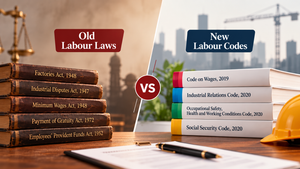
- Labour (4): the new Labour Codes, which merge older laws, so check what the syllabus treats as current
- Taxation (4): income tax and GST basics, and check which income tax law is treated as current
- PIL (4): public interest litigation, where a person can approach a court on behalf of others under Articles 32 and 226
Low-Weight Topics for the Last Day
Revise one quick point each:
- Administrative Law (3): natural justice, meaning a fair hearing
- Company Law (2): the Companies Act, 2013
- Environmental Law (2): the Environment (Protection) Act, 1986
- Cyber Law (2): the Information Technology Act, 2000
- Land Acquisition (2): the 2013 Act on compensation and rehabilitation
- IP (2): the Patents Act 1970, Copyright Act 1957 and Trade Marks Act 1999
Smart Revision Strategy
- Revise AIBE 22 important topics in tier order: high first, then medium, and skim the low tier last.
- Learn old and new section numbers together, such as IPC 302 and BNS 103.
- Use short notes and daily mock tests, not new textbooks.
- Remember there is no negative marking, so attempt every question.
- Keep clean bare acts handy, since sources say bare acts without notes are allowed.
FAQs
Constitutional Law, CrPC/BNSS and CPC, with 10 questions each.
100 questions across 19 subjects.
Yes, since the syllabus names both.
Quick points from Cyber Law and Environmental Law, since they are short.
No.
Some of the top books for AIBE:
- R.V. Kelkar’s Lectures on Criminal Procedure: Based on Bharatiya Nagarik Suraksha Sanhita, 2023
- V. P. Sarathi’s Law of Evidence: Based on Bharatiya Sakshya Adhiniyam, 2023
- B.M. Gandhi’s Penal Law: Covering Bharatiya Nyaya Sanhita 2023, Dowry Prohibition Act, JJ Act, MTP Act, POCSO Act, DV Act, and More
- EBC’s Master Guide To All India Bar Examination (AIBE Exam Guide)
- All India Bar Examination Bare Acts Without Notes and Comments | AIBE Bare Acts Combo Set of 25 Books | Covering Old and New Criminal Laws
- All India Bar Examination – Solved Papers 2015-2025
- Universal’s Guide to All India Bar Examination | AIBE Complete Syllabus Guide