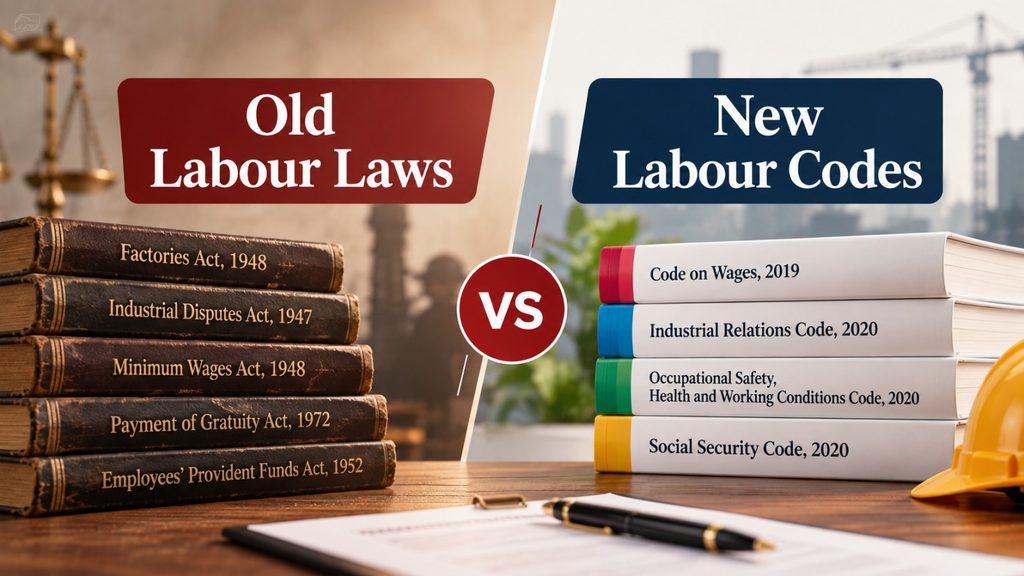
Confused about what changed? This guide to old labour laws vs new labour codes explains how 29 central laws became four codes. It suits employees, HR teams, business owners and law students, so jargon is explained in plain language when first used.
India’s labour framework was a maze of overlapping Acts with conflicting definitions. The four labour codes merge them into simpler statutes. The codes took effect on 21 November 2025 and repealed 29 central Acts. Final Central Rules followed on 8 May 2026, while many states are still notifying theirs. Which rules apply to you depends on the “appropriate government” (the Central or State Government that regulates your establishment).
Old Laws and Their New Codes
| New Code | Key Old Laws Replaced |
|---|---|
| Code on Wages, 2019 | Payment of Wages Act 1936, Minimum Wages Act 1948, Payment of Bonus Act 1965, Equal Remuneration Act 1976 |
| Industrial Relations (IR) Code, 2020 | Trade Unions Act 1926, Industrial Employment (Standing Orders) Act 1946, Industrial Disputes Act 1947 |
| Code on Social Security, 2020 | EPF Act 1952, ESI Act 1948, Payment of Gratuity Act 1972, Maternity Benefit Act 1961, Employees’ Compensation Act 1923 |
| OSH Code, 2020 | Factories Act 1948, Contract Labour Act 1970, Inter-State Migrant Workmen Act 1979, Mines Act 1952 |
Old Labour Laws vs New Labour Codes: Key Differences
| Issue | Old Position | New Position |
|---|---|---|
| Wages definition | Different in each Act | One definition, Section 2(y) Code on Wages; allowances capped at 50% of total pay |
| Minimum wage | Only scheduled jobs | All workers, plus a national floor wage |
| Standing orders | 100 or more workers | 300 or more workers (IR Code) |
| Layoff, retrenchment, closure approval | 100 or more workers | 300 or more workers (Section 77, IR Code) |
| Strike notice | Public utilities only | All establishments, 14 days (Section 62) |
| Factory threshold | 10 (with power), 20 (without) | 20 and 40 |
| Contract labour | 20 workers | 50 workers |
| Gratuity | Five years of service | One year for fixed-term employees (Section 53, Social Security Code) |
| Gig workers | Not recognised | Recognised; schemes under Section 114 |
Code-wise Highlights
Code on Wages, 2019. Employers must pay wages on time, pay men and women equally for the same work, and pay at least minimum wages. Because allowances are capped, basic pay usually rises, which increases PF and gratuity contributions.
IR Code, 2020. It covers unions, standing orders (written service rules) and disputes. Fixed-term employment is formally recognised, and retrenched workers benefit from a reskilling fund. Disputes go first to conciliation, then to a two-member Industrial Tribunal.
Code on Social Security, 2020. It covers provident fund, ESI, gratuity, maternity benefit (26 weeks for eligible women) and employee compensation. Gig and platform workers (people working outside a traditional employer relationship) can access benefit schemes. New EPF, pension and EDLI schemes were notified on 29 June 2026.
OSH Code, 2020. It covers safety, health and working conditions through a single licence and registration. Certain workers get free annual health check-ups, and women may work night shifts with consent and safety measures.
Procedure: Moving to Compliance
- Confirm whether central or state rules apply to you.
- Restructure salaries to meet the 50% wage rule.
- Update appointment letters, payslips and registers.
- Obtain registrations and licences under the OSH Code.
- Review standing orders, retrenchment and gratuity policies.
Small establishments below the thresholds are exempt from certain duties, and governments can vary thresholds by notification. Managerial staff fall outside the definition of “worker” for dispute purposes.
Penalties and Remedies
- Wages Code: fines up to Rs 50,000 for a first offence, with harsher penalties for repeats.
- IR Code: illegal strikes and lockouts can attract fines and imprisonment.
- OSH Code: penalties for safety violations, higher where a worker dies.
- Remedies: complaints to inspectors, conciliation, tribunals and appeals.
FAQ
No. The 29 Acts stand repealed, with limited transitional protections.
It may, since higher basic pay raises PF deductions, though total cost to company stays similar.
Fixed-term employees. Other employees generally still need five years.
Yes. For most private businesses, the State Government is the appropriate government.
Yes, through social security schemes under the Social Security Code.
For a deeper understanding, you can refer to these resource: