


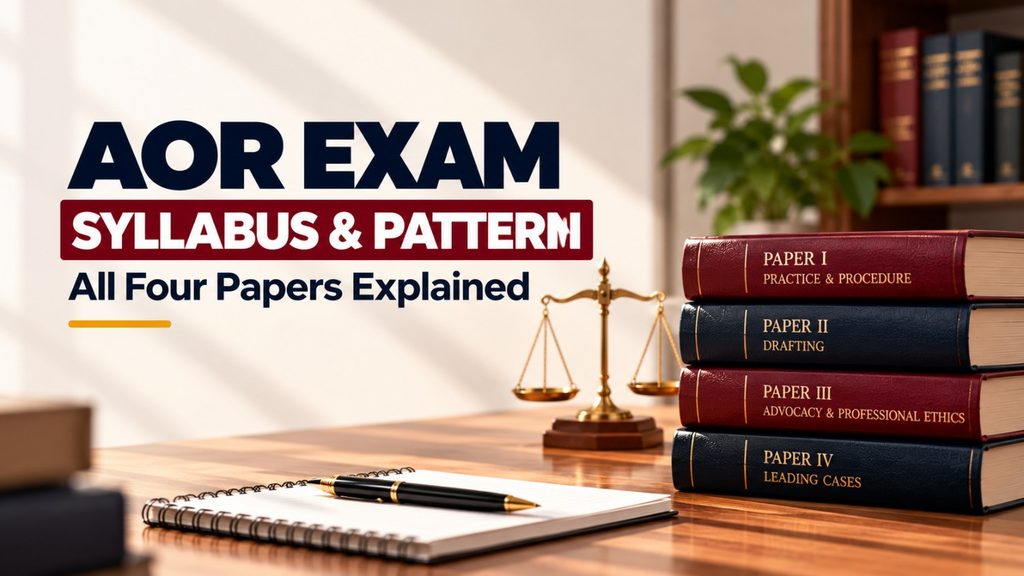
The AOR exam syllabus decides who may file and argue cases in the Supreme Court of India. An Advocate-on-Record (AOR) is an advocate entitled to both act (file papers and take procedural steps) and plead (argue) for a party in the Court. This guide explains the AOR exam syllabus and pattern, the four papers, the rules behind them and the latest schedule update.
Legal Background: Why the AOR Exam Exists
- Article 145 of the Constitution: allows the Supreme Court to make rules regulating its own practice and procedure.
- Supreme Court Rules, 2013: the current rulebook, which replaced the 1966 Rules. Order I defines an AOR, and Order IV, Rule 1(b) says only an AOR may file an appearance or act for a party.
- Order IV, Rule 5: sets eligibility and the examination requirement.
- Regulations regarding Advocates-on-Record Examination: fix the subjects (Regulation 4) and re-appearance rules (Regulation 11).
- Advocates Act, 1961: you must first be enrolled on a State Bar Council roll, and the Bar Council of India Rules govern professional conduct.
AOR Exam Pattern
The Advocate-on-Record exam is a pen-and-paper test of four papers, each carrying 100 marks, so 400 in total. The December 2026 sitting spreads them over four days at New Delhi, with a fee of ₹750. As widely reported, candidates need 50% in each paper and 60% in aggregate. Confirm this in the Regulations.
| Paper | Marks | Focus |
|---|---|---|
| 1. Practice and Procedure of the Supreme Court | 100 | Supreme Court Rules, jurisdiction, filing |
| 2. Drafting | 100 | Petitions, appeals, affidavits |
| 3. Advocacy and Professional Ethics | 100 | Duties, conduct, contempt |
| 4. Leading Cases | 100 | Prescribed judgments |
AOR Exam Syllabus: Paper-by-Paper
Paper 1: Practice and Procedure
- Supreme Court Rules, 2013: filing, listing and registry procedure
- Constitutional provisions on the Court’s original, appellate, advisory and review jurisdiction
- Procedural laws such as the Code of Civil Procedure, the criminal procedure code (now the Bharatiya Nagarik Suraksha Sanhita, 2023, as notified) and the Limitation Act, 1963
Paper 2: Drafting
Expect special leave petitions (SLPs, requests for permission to appeal), writ petitions, civil and criminal appeals, review and curative petitions, transfer petitions and affidavits. Marks reward correct format and precise grounds.
Paper 3: Advocacy and Professional Ethics
- AOR duties under Order IV, including conduct on adjournments
- Bar Council of India Rules on professional standards
- Section 35 of the Advocates Act (professional misconduct) and the Contempt of Courts Act, 1971
Paper 4: Leading Cases
The December 2026 notification lists 86 landmark judgments, with headnotes (short summaries) on the Court’s website. Study the legal principle and its use in practice, not just the facts.
Latest Update: Is There an AOR Exam in 2026?
The Court announced on 30 April 2026 that the regular exam will not be held this year, citing the overall strength of AORs (3,791 as of 13 April 2026). The next full exam is likely in 2027.
A limited exam is scheduled for 19, 20, 22 and 23 December 2026, only for candidates eligible to re-appear under Regulation 11(i) or 11(ii). Applications closed on 15 October.
Outcomes and Remedies
| Situation | Position |
|---|---|
| Non-AOR wants to file a case | Not permitted under Order IV, Rule 1(b) |
| Fails a paper | May re-appear under Regulation 11 |
| Passes all papers but under 60% aggregate | May re-appear in one paper later, as reported |
| AOR misconduct | Suspension or removal from the roll under Order IV, as reported |
Preparation Tips
- Read the Supreme Court Rules, 2013 line by line.
- Practise drafting under timed conditions.
- Make short notes on each prescribed case’s principle.
FAQs
Four, of 100 marks each.
Widely reported as 50% per paper and 60% in aggregate.
Four years’ practice and one year’s training under an approved AOR.
Only the December 2026 sitting for re-appearing candidates.
Likely 2027, with dates to be notified.
Also Read:



AOR vs Senior Advocate: What Each Can Do in Supreme Court
[…] AOR Exam Syllabus and Pattern: All Four Papers Explained […]