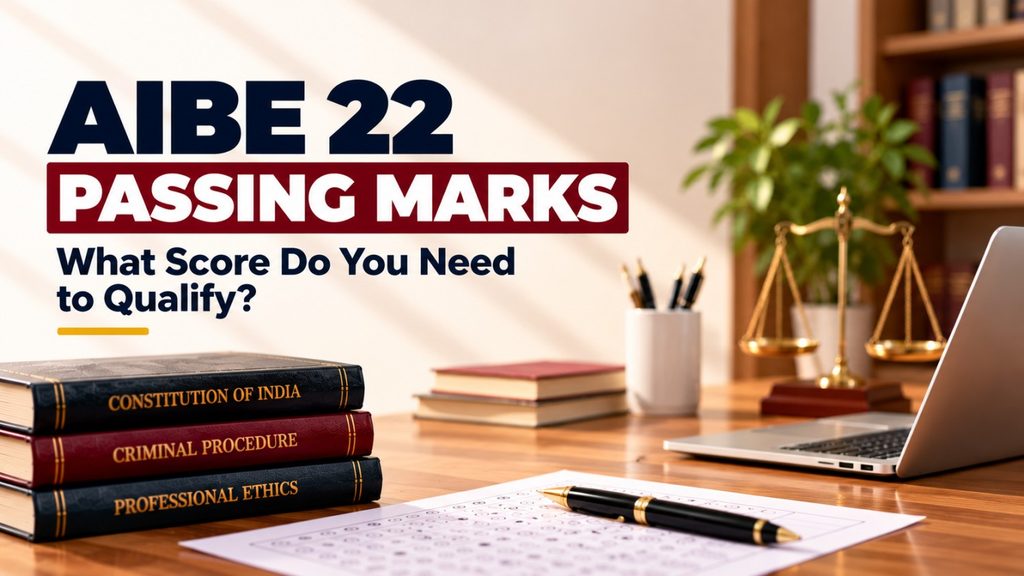
If you are sitting the All India Bar Examination on 29 November 2026, the first thing to know is the AIBE 22 passing marks. The exam has 100 multiple-choice questions, and clearing it earns the Certificate of Practice (CoP), the document that allows an enrolled advocate to appear in court. This guide explains the qualifying score, the law behind it, and what follows.
AIBE 22 Passing Marks at a Glance
| Category | Passing percentage | Marks out of 100 |
|---|---|---|
| General / OBC | 45% | 45 |
| SC / ST / PwD (persons with disabilities) | 40% | 40 |
- No negative marking: wrong answers do not reduce your score.
- No merit list: you either qualify or you do not.
Who Must Take the AIBE?
Law graduates from a BCI-recognised university, including categories added by BCI notifications, must clear the exam to practise. It is a qualifying test, not an entrance test.
The Law Behind the Exam
The exam rests on statute, not just notices.
- Advocates Act, 1961: the main law governing lawyers. Section 24 lists who can be enrolled on a State Bar Council’s roll (its register of advocates). Sections 29 and 30 give enrolled advocates the right to practise, and Section 33 bars everyone else from appearing in court.
- Section 49(1)(ah): empowers the Bar Council of India to frame rules on the conditions for the right to practise. The AIBE is conducted under this power.
- Bar Council of India Rules, Part VI, Chapter III: make a pass in the AIBE compulsory for the CoP. Advocates enrolled before 1 September 2010 are exempt.
- Certificate and Place of Practice (Verification) Rules, 2015: require periodic verification of the certificate and the advocate’s place of practice.
Can the AIBE 22 Passing Marks Change?
Yes, in practice. The AIBE qualifying marks are applied after moderation, meaning the removal of faulty or disputed questions. For AIBE 19, the pass marks were 42 out of 93 for General/OBC, and 37 out of 93 for SC/ST after seven questions were withdrawn. For AIBE 21, reports say the AIBE cut-off was reduced by three marks for all categories. Treat 45 and 40 as the usual benchmark, not a promise.
AIBE 22 Timeline
Notification (18 Jul) > Registration (19 Aug to 27 Oct) > Admit card (14 Nov)
> Exam (29 Nov) > Provisional answer key > Result (7 to 10 Jan 2027, tentative) > CoP
BCI has said it will hold the exam twice a year, so a missed attempt need not mean a long wait.
What Score Should You Aim For?
Since there is no negative marking, attempt every question. A safe target is 55 to 60 correct answers, which leaves room for moderation and doubtful questions. Practise with bare acts (official statute texts), as the exam is open-book, and check the permitted material in the BCI notification.
Consequences of Passing or Failing
| Outcome | Result |
|---|---|
| Pass | CoP issued, subject to verification rules |
| Fail | Reappear in a later AIBE; no attempt limit reported |
| Practising without a CoP | Possible disciplinary action under Section 35 (professional misconduct) |
| Unlawful practice by non-advocates | Up to six months’ imprisonment under Section 45 |
Recent Developments
BCI told the Supreme Court it will conduct the AIBE twice a year. AIBE 21 results were declared in 2026, with 1,15,805 candidates qualifying. AIBE 22 registration opened on 19 August and closed on 27 October.
FAQs
45 out of 100 for General/OBC and 40 out of 100 for SC/ST/PwD candidates.
No
Yes, if questions are withdrawn after moderation.
No limit has been reported. Verify this in the notification.