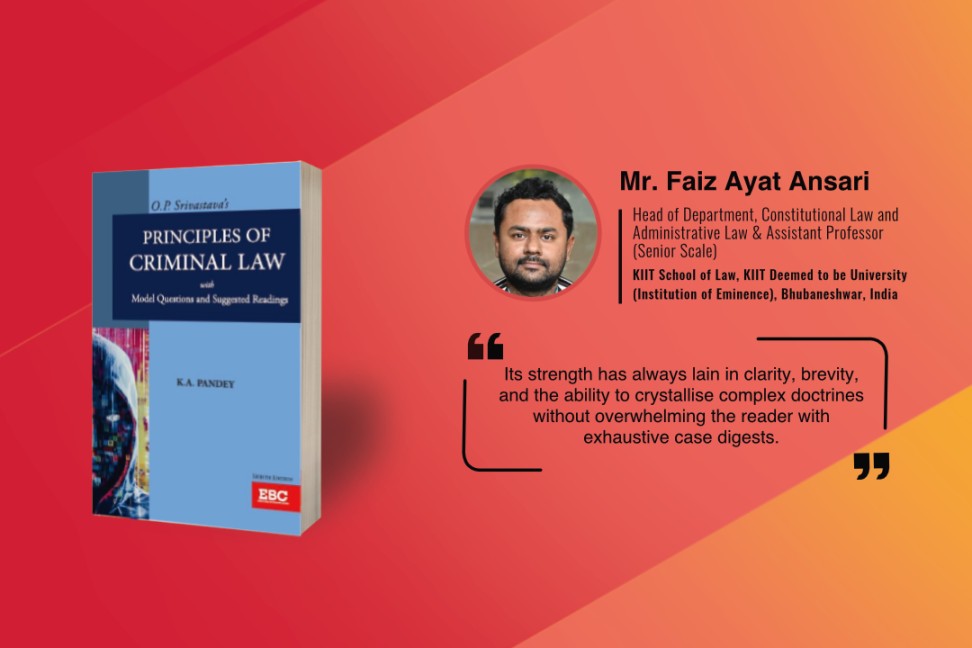
O.P. Srivastava’s Principles of Criminal Law, revised and updated by Professor K.A. Pandey in its eighth edition of 2023 (with a 2026 reprint), stands as a compact yet authoritative textbook on the foundational doctrines of Indian criminal law. Published by Eastern Book Company, this work focuses squarely on the general principles rather than a section-by-section commentary on the entire substantive code. It addresses the essential building blocks of criminal liability: the fundamental elements of crime, stages in the commission of an offence, constructive joint criminality (including common intention and common object), abetment and criminal conspiracy, the theory and modes of punishment, and the general exceptions that negative liability.
The book’s structure is logical and student-friendly. After preliminary observations and tables of statutes and cases, it proceeds through discrete chapters that mirror the traditional pedagogical sequence followed in most Indian law schools for Criminal Law-I. The exposition is substantiated by important judicial decisions of the Supreme Court and High Courts, and the edition incorporates contemporary developments, notably the judicial elaboration of constitutional morality in the criminal law domain.Model questions and answers, suggested readings, and a subject index further enhance its utility for undergraduate students, competitive examination aspirants, teachers, and practitioners seeking a quick refresher on first principles.
The volume is deliberately concise. Its strength has always lain in clarity, brevity, and the ability to crystallise complex doctrines without overwhelming the reader with exhaustive case digests. Professor Pandey’s revisions have kept the text current with post-2013 and post-2018 developments in case law while preserving the original author’s lucid style. The Gujarat Law Reporter has rightly observed that the work “crystallises the principles of criminal law by explaining the fundamentals… with relevant sections” and brings the edition up to date through detailed treatment of significant decisions.
Yet the 2026 reprint appears against a dramatically altered legislative landscape. On 1 July 2024 the Bharatiya Nyaya Sanhita, 2023 (BNS) replaced the Indian Penal Code, 1860 (IPC) as the principal substantive criminal statute of India. The BNS reduced the number of sections from 511 to 358, reorganised chapters, introduced new offences (organised crime, terrorism, mob lynching, snatching, sexual intercourse by deceitful means), omitted or substantially altered colonial-era provisions (sedition, adultery, the residual aspects of Section 377), and modified several definitions and sentencing frameworks. While many core principles of liability—mens rea, actus reus, joint liability, inchoate offences, and general exceptions—retain substantial continuity, the statutory scaffolding has changed. A textbook whose chapter on punishment still refers expressly to “Sections 53 to 75 IPC” and whose entire conceptual architecture is framed around the IPC therefore requires systematic revision if it is to remainfully relevant for contemporary teaching and practice.
This review examines the book’s enduring strengths, analyses its content in detail, and offers a critical assessment of the urgent need for alignment with the BNS, while affirming that the work remains fundamentally sound as an exposition of first principles.
Pedagogical Strengths and Scholarly Value
The principal virtue of Srivastava’s treatise, as revised by Pandey, is its pedagogical clarity. Criminal law can appear labyrinthine to a first-year student confronting mens rea, the distinction between intention and knowledge, the stages of crime, or the intricacies of common intention under the old Section 34. The book meets this challenge by breaking doctrines into manageable components, illustrating them with leading cases, and maintaining a readable prose style free of unnecessary jargon.
Particularly effective is the treatment of the fundamental elements of crime. The classic maxim actus non facit reum nisi mens sit rea is explained with precision, and the discussion of intention, knowledge, recklessness, and negligence is anchored in Indian authorities rather than remaining abstractly English. The stages of crime—intention, preparation, attempt, and commission—are delineated with care, and the often-difficult boundary between preparation and attempt receives balanced analysis supported by decisions such as State of Maharashtra v. Mohd. Yakub and Abhayanand Mishra v. State of Bihar. The chapters on constructive joint criminality (common intention and common object) and on abetment and conspiracy are similarly lucid. Cases such as Barendra Kumar Ghosh, Mahbub Shah, and more recent authorities are woven into the narrative without reducing the text to a mere case digest.
The chapter on punishment is noteworthy for its engagement with penological theory. Beyond enumerating the forms of punishment recognised under the IPC, it discusses deterrence, retribution, reformation, and the continuing controversy surrounding capital punishment, including the “rarest of rare” doctrine and modes of execution. The addition of material on constitutional morality reflects judicial developments after Navtej Singh Johar, Joseph Shine, and related decisions, situating criminal law within the broader constitutional framework of dignity, equality, and privacy.
Model questions and suggested readings make the book especially useful for examination preparation. Students can test their understanding against typical university and judicial-service questions, while the reading lists point toward deeper scholarship. The subject index and tables of cases and statutes facilitate quick reference. In an era when many textbooks have grown unwieldy, the relative brevity of this volume is itself a pedagogical advantage: it can be read cover-to-cover in a reasonable time and still leave the student with a coherent conceptual map.
For teachers, the book provides a reliable skeleton around which classroom discussion, problem questions, and comparative analysis can be built. Practitioners and judges may consult it for a rapid restatement of first principles when more specialised commentaries are unnecessary. In short, the work succeeds in its primary ambition: to present the general principles of criminal law comprehensively and interestingly.
Content Coverage: A Chapter-Wise Appreciation
The book’s architecture follows a classical sequence. After preliminary observations on the nature and historical development of criminal law, it turns to the fundamental elements of crime. Here the dual requirements of actus reus and mens rea are examined, together with the limited role of strict liability and the principle of legality (nullum crimen sine lege). Extraterritorial jurisdiction receives attention, reflecting the globalisation of crime and the corresponding expansion of Indian criminal jurisdiction.
The chapter on stages in the commission of a crime carefully distinguishes mere intention or preparation from attempt and completed offence. The discussion of attempt draws on both statutory language (the old Section 511) and judicial tests, offering students a clear framework for application to hypothetical facts. Constructive joint criminality occupies a substantial portion of the text. Common intention under Section 34 and common object under Section 149 are analysed with reference to their distinct requirements and the evidentiary challenges they pose. The treatment is nuanced: it acknowledges the policy rationale for group liability while warning against over-extension that would dilute individual culpability.
Abetment and criminal conspiracy are handled with equal care. The three forms of abetment (instigation, conspiracy, and intentional aiding) are illustrated, and the relationship between abetment and the principal offence is clarified. Conspiracy is examined both as an independent offence and as a form of abetment, with attention to the evidentiary peculiarities of this inchoate crime.
The chapter on punishment (explicitly referencing Sections 53 to 75 of the IPC) surveys the forms of punishment, sentencing principles, and the special rules governing enhanced punishment for subsequent offences. Capital punishment receives extended treatment, including constitutional challenges and the evolution of the rarest-of-rare standard. Finally, the general exceptions—mistake of fact, judicial acts, accident, necessity, infancy, insanity, intoxication, consent, private defence, and the various justifications and excuses—are set out systematically. Each exception is explained with its statutory language, rationale, and leading authorities, enabling students to appreciate both the scope and the limits of these defences.
Throughout, the revising author has incorporated contemporary case law and has added valuable material on constitutional morality, thereby linking traditional doctrines to modern constitutional values. The overall result is a coherent, self-contained introduction to the general part of criminal law as it stood under the IPC regime.
The Imperative for Revision in Light of the Bharatiya Nyaya Sanhita
Despite these strengths, the 2023 edition and its 2026 reprint confront a fundamental problem of currency. The Bharatiya Nyaya Sanhita, 2023 came into force on 1 July 2024, comprehensively replacing the IPC. While the BNS preserves a large measure of continuity in the general principles of liability, it reorganises the statute, renumbers almost every provision, introduces new offences and sentencing options, and modifies the language or scope of several key doctrines. A textbook that continues to cite “Sections 53 to 75 IPC” for punishments and that frames every discussion around IPC terminology is, from the standpoint of current law, already dated.
The structural changes are significant. The BNS reduces the total number of sections from 511 to 358 and reorders chapters thematically. Offences against women and children receive a dedicated chapter. Definitions are consolidated. Community service is introduced as a form of punishment for the first time. New offences—organised crime (Sections 111–112), terrorist acts (Section 113), mob lynching as an aggravated form of murder (Section 103(2)), snatching, and sexual intercourse by deceitful means—have no direct IPC counterparts. Sedition (old Section 124A) has been omitted and replaced by a differently worded provision on acts endangering the sovereignty, unity and integrity of India (Section 152). Adultery and the residual criminalisation of consensual adult sexual conduct have disappeared.
Even where substantive continuity exists, the statutory references have changed. Murder is now primarily addressed under Section 103; culpable homicide under Section 105; the general exceptions appear in Chapter III; abetment, conspiracy and attempt are gathered in Chapter IV; and the scheme of punishments is found in Chapter II. A student or practitioner consulting the current edition of Srivastava will find every statutory citation requiring mental translation into the new numbering. For examination candidates expected to cite the BNS, this is a practical handicap. For classroom teaching, it creates an unnecessary layer of confusion.
Moreover, certain doctrinal nuances have shifted. The introduction of community service expands the penological toolkit and invites fresh discussion of restorative justice. The explicit recognition of mob lynching as a distinct aggravating circumstance for murder alters the analysis of group liability in communal or identity-based violence. The consolidation and slight reformulation of definitions of “document,” “movable property,” and electronic records affect the discussion of offences against property and forgery. Although the core requirements of mens rea and actus reus remain intact, the surrounding statutory environment has evolved enough to demand textual updating.
The book’s treatment of constitutional morality, while welcome, now sits within a legislative framework that itself claims to reflect Indian values and to discard colonial residues. A revised edition could productively examine the extent to which the BNS realises or falls short of that claim, using the book’s existing analytical framework as a foundation.
In short, the principles themselves remain largely valid, but their statutory expression and certain penological and definitional details have changed. Without revision, the book risks becoming a historical account of the general part under the IPC rather than a guide to the living law.
Continuity, Change, and the Enduring Relevance of First Principles
It is important not to overstate the rupture. Many of the doctrines that form the heart of Srivastava’s work—intention and knowledge, the stages of crime, common intention, abetment, the structure of general exceptions, and the basic theory of punishment—survive in recognisable form under the BNS. The principle of legality, the presumption of innocence, and the requirement of a guilty mind continue to structure criminal liability. Judicial interpretations developed under the IPC will, for the most part, remain persuasive under the corresponding BNS provisions until new case law emerges. The book’s conceptual map therefore retains substantial value even in its present form.
What is required is not a complete rewriting but a careful updating: replacement of all IPC section numbers with their BNS equivalents, incorporation of the new offences and sentencing options into the relevant chapters, revision of the discussion of punishment to include community service and any altered maxima or minima, and an expanded treatment of group liability in light of the mob-lynching provision. Comparative tables showing IPC–BNS correspondences would be of immense practical assistance. Discussion of the policy choices underlying the BNS—its emphasis on offences against women and children, its treatment of organised crime and terrorism, and its selective decriminalisation—would enrichthe existing material on constitutional morality and penology.
Such a revision would preserve the book’s distinctive strengths—clarity, brevity, and focus on first principles—while restoring its status as a fully contemporary teaching tool. Until that revision appears, teachers and students will need to supplement the text with the BNS itself and with the growing body of comparative literature on the new criminal codes.
O.P. Srivastava’s Principles of Criminal Law, as revised by K.A. Pandey, remains a fundamentally sound and pedagogically effective exposition of the general principles of Indian criminal law. Its clear= organisation, judicious selection of case law, engagement with contemporary constitutional developments, and student-oriented features (model questions, suggested readings, index) make it a valuable resource for law students, examination candidates, and anyone seeking a concise restatement of first principles. The 2023 edition successfully updated the text in light of judicial developments up to that point and preserved the original author’s accessible style.
Nevertheless, the enactment and coming into force of the Bharatiya Nyaya Sanhita, 2023 have rendered the statutory framework of the book obsolete. Continued reliance on IPC section numbers, the absence of discussion of new offences and sentencing options, and the lack of alignment with the reorganised structure of the BNS constitute significant limitations for any reader operating under the current law. A thorough revision is therefore both necessary and desirable.
Eastern Book Company and Professor Pandey are well placed to undertake that task. A ninth edition that systematically maps the old principles onto the new statutory scheme, incorporates the novel features of the BNS, and retains the book’s trademark clarity would ensure that this classic work continues to serve the next generation of Indian lawyers. Until such a revision appears, the present edition can still be used profitably for its doctrinal analysis, provided readers are alerted to the need for constant cross-reference to the BNS.
In an era of rapid legislative change, textbooks that combine enduring conceptual insight with up-to-date statutory fidelity are indispensable. Srivastava’s Principles, once revised, is well positioned to remain one of them.
Want the deeper dive? Grab this book here.
Also Read:
- Retrenchment and layoff threshold increased to 300 workers: what it means
- Right to Self-Defence in India: What the Law Actually Allows