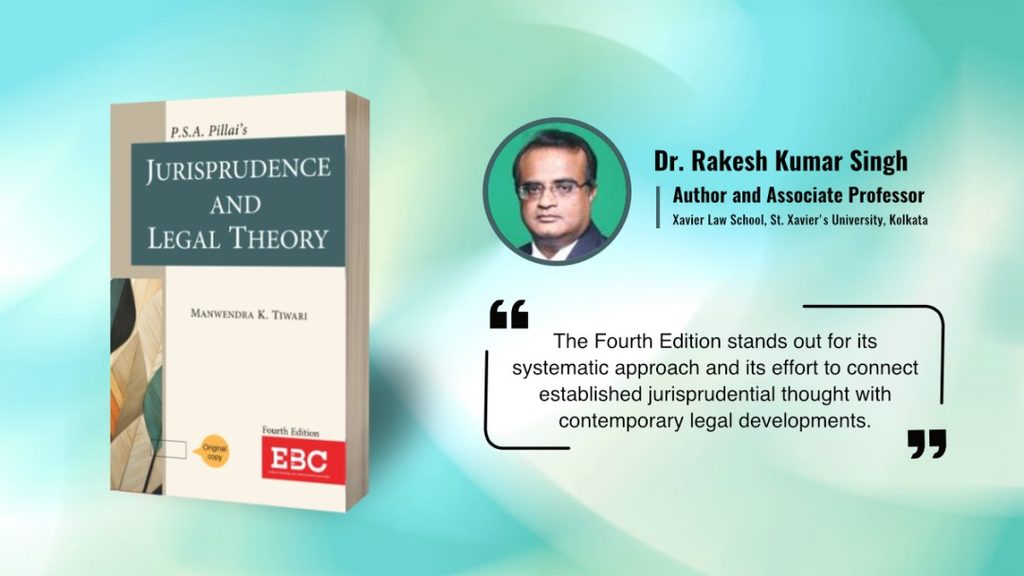
Jurisprudence and Legal Theory by P.S.A. Pillai, revised by Dr. Manwendra K. Tiwari, is acomprehensive and academically valuable work that provides students with a clear conceptualfoundation for understanding law. The Fourth Edition successfully brings together classical jurisprudential principles with contemporary legal developments, making the work particularly relevant to present-day legal education. Rather than approaching law merely as a collection of rules, the book encourages readers to examine the underlying concepts, principles, values, and theories that shape the legal system. It enables students to look beyond the mechanical application of legal rules and appreciate the intellectual foundations upon which law is built.
Key Highlights of the Fourth Edition
The Fourth Edition stands out for its systematic approach and its effort to connect established jurisprudential thought with contemporary legal developments. Some of its notable features include:
- A comprehensive treatment of Principles of Jurisprudence, Elements of Law, and Legal theories.
- Integration of classical jurisprudential principles with contemporary legal perspectives.
- Focused discussions on important concepts such as Law and Equity, General and Special Laws, and Professional Opinion.
- Exploration of contemporary themes including Legal Values of Modern Democracy
- and the Economic Approach of Law.
- Dedicated discussions on Division of the Law and Public Policy through two useful Appendices.
- References to significant contemporary judicial developments, including Janhit Abhiyan v. Union of India, (2023) 5 SCC 1.
- Emphasis on developing conceptual clarity, analytical thinking, and legal reasoning among students.
A Systematic Structure for Learning Jurisprudence
The book is organised into three Parts and two Appendices, providing a systematic treatment of jurisprudence and legal theory.
Part I – Principles of Jurisprudence
Comprising 16 chapters, Part I deals with the Principles of Jurisprudence. It introduces the fundamental concepts necessary for understanding the nature, purpose, and functioning of law. The section establishes an essential conceptual foundation for students beginning their study of jurisprudence.
Part II – Elements of Law
Part II, consisting of 16 chapters, focuses on the Elements of Law. It contains discussions that are particularly useful for developing conceptual clarity and strengthening students’ ability to analyse legal principles and their application.
Among the distinctive topics covered are:
- Law and Equity
- General and Special Laws
- Professional Opinion
These discussions help students understand the different dimensions through which legal rules and principles operate.
Part III – Legal Theories
Part III, comprising nine chapters, deals with Legal Theories and broadens the discussion beyond foundational jurisprudential concepts.
Of particular significance are the chapters on:
- Legal Values of Modern Democracy
- The Economic Approach of Law
These chapters introduce students to contemporary perspectives on law, democracy, justice, and the relationship between legal institutions and economic considerations. They also encourage readers to appreciate law as a dynamic discipline that interacts with wider social, political, and economic developments.
The Role of Public Policy and the Structure of Law
The two Appendices further enhance the academic scope of the book.
Appendix I – “Division of the Law” provides a useful foundation for understanding the classification and structure of law.
Appendix II – “Public Policy” examines the important role of public policy in law-making and legal interpretation.
Together, these supplementary discussions connect theoretical concepts with broader questions concerning the operation, interpretation, and development of legal systems.
Connecting Jurisprudence with Contemporary Judicial Developments
An important feature of the Fourth Edition is its engagement with contemporary judicial developments. The book includes references to significant decisions such as Janhit Abhiyan v. Union of India, (2023) 5 SCC 1, concerning the constitutional validity of reservation for Economically Weaker Sections (EWS).
The inclusion of contemporary developments adds practical relevance to the theoretical discussion. It enables students to appreciate how jurisprudential principles and legal theories operate within the framework of constitutional and judicial discourse.
Why This Book Matters for Law Students
Jurisprudence is often regarded as one of the more theoretical areas of legal education. However, a sound understanding of jurisprudence is essential for developing the ability to critically examine legal concepts and institutions.
This book is particularly useful because it:
- Builds a strong conceptual foundation in jurisprudence and legal theory.
- Helps readers understand the principles and reasoning underlying legal rules.
- Connects legal theory with contemporary constitutional and judicial developments.
- Encourages critical and analytical thinking.
- Explores the relationship between law, democracy, justice, public policy, and economics.
- Assists students in developing a deeper understanding of the nature, purpose, and functioning of law.
By approaching jurisprudence from both foundational and contemporary perspectives, the book helps students appreciate that the study of law extends beyond memorising statutes, rules, and precedents.
Jurisprudence as the “Knowledge and Grammar of Law”
One of the central strengths of the book is its ability to present jurisprudence as the “knowledge and grammar of law.” This perspective enables students to move beyond the mechanical study of legal rules and develop an understanding of the concepts and reasoning underlying them. The book demonstrates how jurisprudential inquiry can provide a framework for understanding questions concerning law, justice, rights, democracy, public policy, and social and economic considerations. By combining foundational principles, elements of law, legal theories, public policy, and contemporary judicial developments, the Fourth Edition provides a well-rounded perspective on jurisprudence and legal theory.
Who Should Read This Book?
The Fourth Edition is particularly recommended for:
- LL.B. students studying jurisprudence and legal theory.
- LL.M. students seeking a deeper conceptual understanding of the subject.
- Law teachers looking for a structured academic reference.
- Researchers and scholars exploring jurisprudential and theoretical questions.
- Readers interested in understanding the philosophical and conceptual foundations of law.
Its structured presentation and comprehensive coverage make it useful both as a textbook for students and as a reference work for teachers and researchers.
A Valuable Resource for Legal Education
The Fourth Edition of Jurisprudence and Legal Theory successfully combines the intellectual foundations of jurisprudence with contemporary legal developments. Its structured organisation, diverse range of topics, and references to modern judicial developments make it a valuable addition to legal education.
Overall, the book presents jurisprudence not simply as a theoretical subject, but as an essential framework for understanding how law is conceived, interpreted, developed, and applied. It enables readers to engage with law at a deeper conceptual level and encourages them to examine the principles and values that shape the legal system. The work is strongly recommended for LL.B. and LL.M. students, teachers, and researchers seeking to strengthen their conceptual understanding of jurisprudence and legal theory.