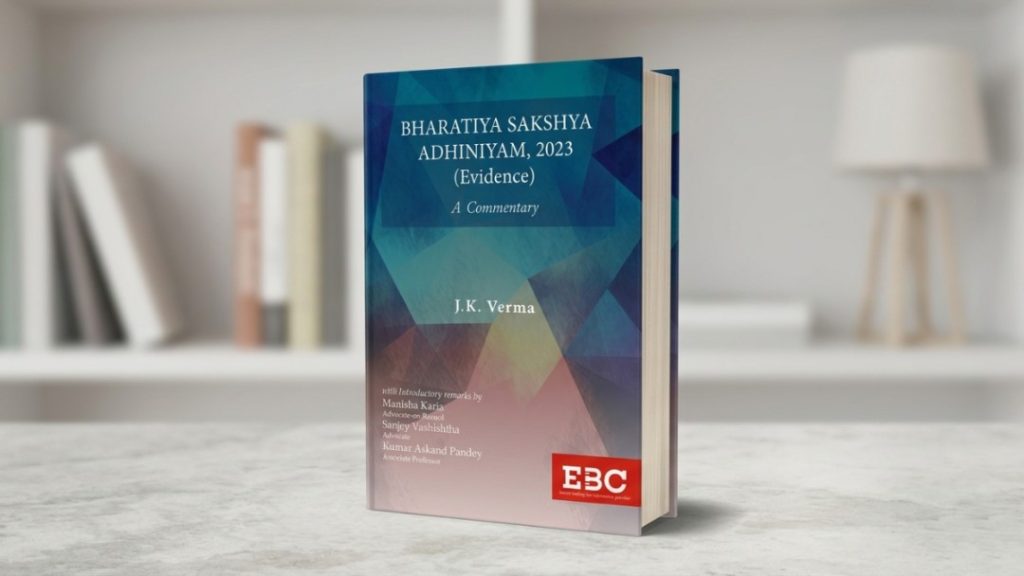
The Bharatiya Sakshya Adhiniyam, 2023 came into force on July 1, 2024, replacing the Indian Evidence Act, 1872. The Act contains 170 sections, three more than the Indian Evidence Act’s 167. For law students today, the BSA is not optional reading — it is the governing law of evidence across all civil and criminal proceedings in India. Here are the 10 sections that matter most.
1. Section 2 — Definitions
Every statute begins with its definitions, and in the BSA, Section 2 does exceptional heavy lifting. It defines key terms including “Court,” “Fact,” “Relevant,” “Facts in Issue,” “Document” — which explicitly includes electronic records — “Evidence,” “Proved,” “Disproved,” “Not Proved,” “May Presume,” “Shall Presume,” and “Conclusive Proof.” Understanding these definitions is non-negotiable — every other section of the Act is read through this lens
IEA Equivalent: Section 3
2. Section 3 — What Evidence May Be Given
Section 3 lays down the foundational admissibility rule: evidence may be given only of facts in issue and of facts declared relevant under the Act — nothing more. Courts entertain only relevant matters, and Chapter 2, Sections 3 to 50 of the BSA detail the rules of relevancy outlining admissible facts. This is the first principle of evidence law and the starting point for every argument on admissibility.
IEA Equivalent: Section 5
3. Section 4 — Res Gestae
Sections 4, 5, 6, and 8 collectively form the basis for the doctrine of res gestae — facts so closely connected with a fact in issue as to form part of the same transaction are relevant, regardless of time or place. This doctrine frequently arises in criminal trials and is a staple of law school examinations and moot courts alike.
IEA Equivalent: Section 6
4. Sections 15–21 — Admissions
Sections 15 to 21 deal comprehensively with admissions — oral, documentary, or electronic statements that suggest an inference about a fact in issue or a relevant fact. Section 15 defines an admission; Sections 16 to 21 specify who can make admissions and in what circumstances they are binding. Admissions are among the most commonly litigated evidentiary issues in civil proceedings.
IEA Equivalent: Sections 17–23
5. Sections 22–24 — Confessions
Sections 22 to 24 govern confessions — including confessions obtained by inducement, threat, or promise (Section 22); confessions made to a police officer (Section 23); and confessions by a co-accused in a joint trial (Section 24). The BSA introduces stricter guidelines to ensure that evidence obtained through coercion is inadmissible, making this cluster critically important in criminal law practice.
IEA Equivalent: Sections 24–30
6. Section 26(a) — Dying Declaration
Section 26(a) governs dying declarations — statements made by a person regarding the cause of their death or the circumstances of the transaction resulting in their death. Indian courts have consistently treated a reliable dying declaration as sufficient to base a conviction upon, even without corroboration. This section is examined in almost every evidence law paper across Indian law schools
IEA Equivalent: Section 32(1)
7. Section 45 — Expert Testimony
Section 45 governs the admissibility of expert opinion — covering medical experts, handwriting analysts, forensic scientists, digital forensic experts, and more. Sections 39 to 45 collectively deal with expert testimony, and in an era of digital evidence and forensic investigation, this provision is more relevant than ever. Crucially, the grounds on which an expert opinion is based are also relevant and must be disclosed.
IEA Equivalent: Section 45
8. Section 63 — Admissibility of Electronic Records
One of the BSA’s most significant innovations, Section 63 sets out the conditions for admissibility of electronic records in court — including the requirement of a certificate authenticating the electronic record. The BSA modernises the legal framework to include electronic records and digital evidence, ensuring they are legally recognised and appropriately handled in judicial proceedings. In 2026, no litigator can afford to be unfamiliar with this section.
IEA Equivalent: Section 65B
9. Section 104 — Burden of Proof
Sections 104 to 120 deal with the burden of proof. Section 104 states the general rule: whoever desires a court to give judgment as to any legal right or liability dependent on facts must prove those facts. This is the onus probandi principle — the backbone of how cases are won and lost. Students must also know Section 105, which shifts the burden to the accused when a special exception is claimed.
IEA Equivalent: Section 101
10. Sections 142–144 — Examination, Cross-Examination, and Re-Examination
Sections 142 to 144 and 158 of the BSA deal with examination-in-chief, cross-examination, and re-examination of witnesses. Effective witness examination — particularly cross-examination — is critical to a case’s outcome. These sections govern the sequence, scope, and limits of witness questioning, and are indispensable for any student preparing for moot courts, trial advocacy, or judicial service examinations.
IEA Equivalent: Sections 137–139
For further reading and detailed analysis, refer to this resource.