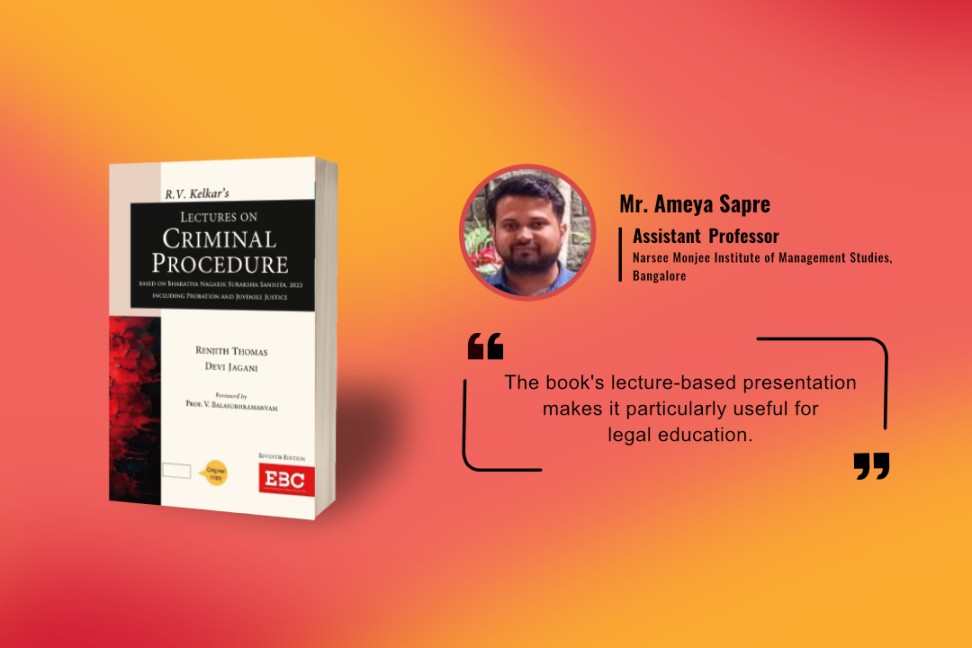
As India’s criminal justice system transitions from the CrPC to the Bharatiya Nagarik Suraksha Sanhita, 2023, the demand for clear, classroom-ready resources on the new procedural framework has never been higher. In this review, Mr Ameya Sapre, Assistant Professor at the Narsee Monjee Institute of Management Studies, Bangalore, examines the 7th Edition of R.V. Kelkar’s Lectures on Criminal Procedure by Renjith Thomas and Devi Jagani, assessing how well the book’s established lecture-based approach adapts to the BNSS, and what it offers students, teachers, and practitioners navigating this shift.
Adapting the Kelkar Approach to the BNSS
One of the significant strengths of the book is its adaptation of the established Kelkar approach to the requirements of the Bharatiya Nagarik Suraksha Sanhita, 2023. As the criminal justice system undergoes a significant transition from the CrPC to the BNSS, there is a growing need for accessible academic resources that can introduce students and legal professionals to the new procedural framework. The book addresses this need by presenting the relevant concepts in a structured and comprehensible manner.
A Lecture-Based and Academically Accessible Structure
As an Assistant Professor myself, its lecture-based structure, supported by relevant judicial decisions and exercises, makes complex procedural concepts easier to deliver to students, while maintaining sufficient analytical depth for academic study. The organisation of the material makes it suitable for classroom teaching as well as individual study. The inclusion of judicial decisions and exercises further assists readers in connecting procedural principles with their practical application.
Understanding the Transition from CrPC to BNSS
The book is particularly valuable in the transitional phase following the replacement of the CrPC, as it helps students and readers understand the structure and operation of the BNSS in a coherent manner. For students who have previously encountered criminal procedure through the CrPC framework, the book provides a useful foundation for understanding the contemporarystatutory position. It also enables readers to approach the BNSS systematically rather than viewing the transition merely as a change in statutory terminology.
Comprehensive Coverage of Core Procedural Areas
The book covers major areas of criminal procedure, including arrest, investigation, search and seizure, cognizance, bail, trials, judgments, appeals, revision and sentencing. Such coverage provides readers with an understanding of the procedural journey of a criminal case, from the initial stages of investigation through trial and subsequent remedies. The treatment of these areas also makes the book useful for readers seeking to strengthen their understanding of the fundamental principles and mechanisms governing criminal proceedings under the new procedural framework.
Procedural Safeguards and the Changing Criminal Justice System
Its discussion of procedural safeguards, technological developments, plea bargaining, probation and juvenile justice broadens its relevance beyond a purely statutory commentary. These aspects are particularly significant in understanding how criminal procedure operates within a broader framework of rights, fairness and access to justice. The inclusion of technological developments also reflects the changing nature of criminal justice administration and the increasing role of technology in investigation and procedural processes. This enables the book to engage with contemporary dimensions of criminal procedure while retaining its foundational character.
Relevance for Classroom Teaching and Academic Study
The book’s lecture-based presentation makes it particularly useful for legal education. Complex procedural concepts can often be difficult for students to understand when encountered solely through statutory provisions. The structured treatment adopted in the book helps make these concepts easier to explain, understand and revise. The combination of statutory provisions, relevant judicial decisions and exercises further strengthens its academic utility. It provides teachers with a useful resource for classroom discussion while giving students a structured foundation for further study.
A Useful Resource During the Current Legal Transition
The transition from the CrPC to the BNSS represents an important development in India’s criminal justice framework. In this context, academic resources that explain the new procedural regime in a clear and organised manner are particularly valuable. The 7th Edition of R.V. Kelkar’s Lectures on Criminal Procedure responds to this requirement by presenting the contemporary framework while retaining the accessible and systematic character associated with the work.
A Foundational Resource for Students, Teachers and Practitioners
While advanced researchers may need to supplement it with recent judicial decisions and specialised literature, the book remains a useful foundational resource for students, teachers, researchers and practitioners seeking a comprehensive understanding of criminal procedure under the BNSS. Its broad coverage, accessible presentation and inclusion of contemporary developments make it relevant to readers at different stages of their academic and professional engagement with criminal procedure.
Concluding Observations
The 7th Edition also stands out for the way it brings together statutory provisions, judicial interpretation and practical learning aids within a single framework. Some of its key features include:
- BNSS-focused coverage: Provides a structured understanding of criminal procedure under the Bharatiya Nagarik Suraksha Sanhita, 2023.
- Systematic presentation: Arranges procedural concepts in a logical sequence, helping readers follow the progression of a criminal case.
- Judicial decisions: Uses relevant case law to assist readers in understanding how procedural provisions are interpreted and applied.
- Classroom-friendly approach: The lecture-based format makes complex concepts easier to explain, discuss and revise in an academic setting.
- Practical learning: Exercises and illustrations help students connect statutory principles with procedural practice.
- Contemporary relevance: Addresses developments such as technology in criminal procedure, plea bargaining, probation and juvenile justice.
- Useful across levels: Serves as a foundational reference for students while also offering value to teachers, researchers and practitioners.
Want the deeper dive? Grab the reference book.