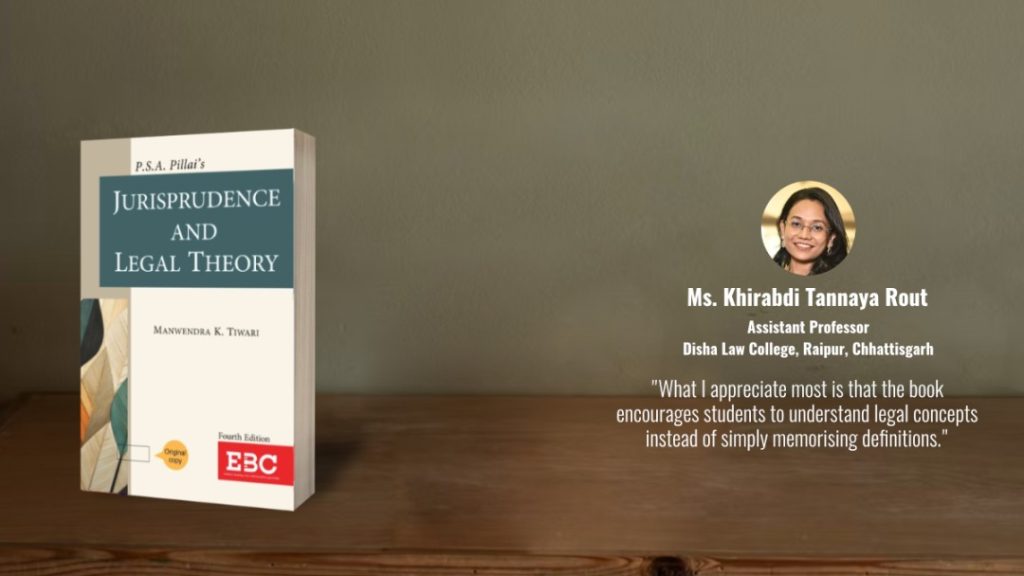
P.S.A. Pillai’s Jurisprudence and Legal Theory remains one of the most trusted texts for understanding the foundations of legal thought in India. In this review, Ms. Khirabdi Tannaya Rout, Assistant Professor at Disha Law College, Raipur, shares her perspective on why the book continues to be a valuable resource for law students and educators alike.
Jurisprudence Is a Subject That Demands Patience
Among the core subjects taught in law schools, jurisprudence is often the one students find the most abstract. Unlike subjects that revolve around statutory provisions or procedural rules, jurisprudence asks students to engage with ideas, theories, and competing philosophies about the nature and purpose of law. It requires a different way of thinking, and many students take time to become
comfortable with it.
When students ask where they should begin, I often recommend Jurisprudence and Legal Theory by P.S.A. Pillai because it provides a structured introduction without making the subject appear more intimidating than it already is.
A Clear Introduction to Legal Theory
One of the strengths of this book is its organisation. Topics such as Natural Law, Positivism, the Historical School, the Sociological School, rights, justice, and legal reasoning are introduced in a logical sequence, allowing readers to build their understanding gradually.
The language is generally straightforward, making the text accessible to undergraduate students. While jurisprudence itself remains intellectually demanding, the book avoids unnecessary complexity in its explanations.
Useful for Building Conceptual Clarity
What I appreciate most is that the book encourages students to understand legal concepts instead of simply memorising definitions. A sound grasp of jurisprudence helps students analyse judgments, interpret legislation, and appreciate why legal systems develop in particular ways.
The chapters connect reasonably well with one another, helping students see relationships between different schools of thought rather than treating them as isolated theories.
Not the Only Book Students Will Ever Need
Like most introductory textbooks, this book has its limitations. Students who wish to explore jurisprudence in greater depth may eventually need to consult original writings of thinkers such as Austin, Hart, Dworkin, Kelsen, or Fuller, along with classroom discussions and recent academic literature.
However, as a starting point, P.S.A. Pillai provides a solid foundation on which students can build.
A Practical Choice for Law Students
The book works well alongside classroom teaching and is equally useful during examination preparation. Its systematic presentation makes revision manageable, particularly for students encountering jurisprudence for the first time.
Rather than offering ready-made answers, it provides a framework that helps students understand the subject more confidently.
In my experience, Jurisprudence and Legal Theory by P.S.A. Pillai remains a dependable introductory text for students beginning their study of jurisprudence. Its greatest strength lies in presenting difficult ideas in a clear and organised manner while encouraging conceptual understanding.
For students looking for a book that explains the fundamentals without overwhelming them, it is a worthwhile place to begin, even though deeper study will naturally require consulting additional sources and engaging with classroom discussions