The general principles of criminal liability constitute one of the most fundamental areas of legal study. They provide the conceptual foundation for understanding when an act or omission becomes an offence, how criminal responsibility is determined, and under what circumstances an individual may be held liable under criminal law. A clear understanding of these principles is essential not only for law students but also for academicians, legal practitioners, and researchers seeking to develop a sound understanding of criminal jurisprudence.
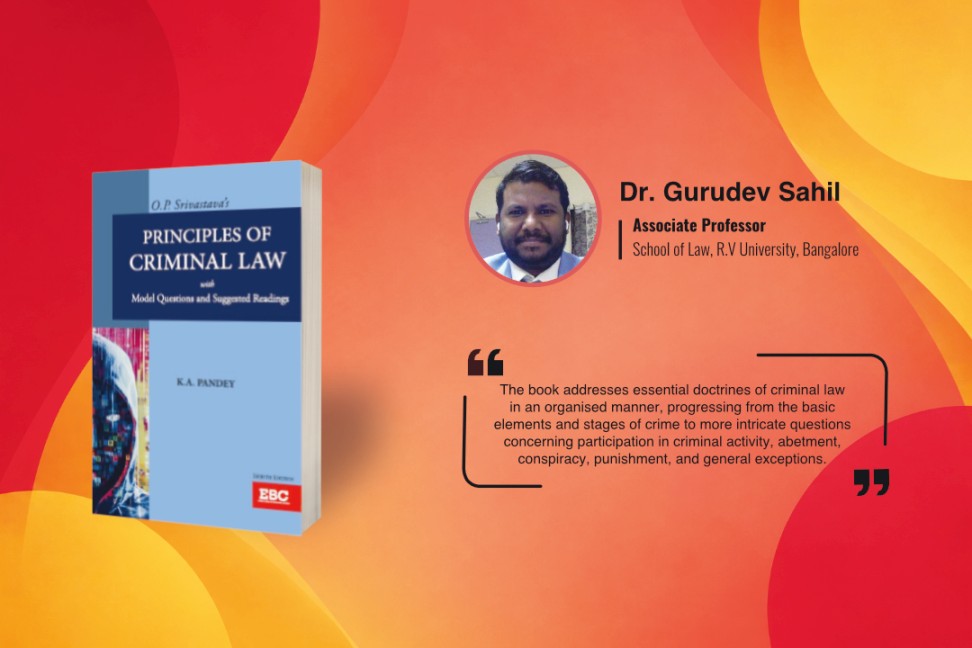
Principles of Criminal Law by O.P. Srivastava, carefully revised by Prof. K.A. Pandey, offers a systematic treatment of the foundational concepts governing criminal liability. The book addresses essential doctrines of criminal law in an organised manner, progressing from the basic elements and stages of crime to more intricate questions concerning participation in criminal activity, abetment, conspiracy, punishment, and general exceptions. Its emphasis on judicial decisions, supported by model questions and suggested readings, makes it a useful resource for academic study and revision.
The book’s principal strength lies in its structured presentation of concepts that can otherwise appear abstract and demanding. By bringing together doctrinal explanations and judicial interpretations, it helps readers appreciate how general principles of criminal liability are developed, understood, and applied within the legal system.
Understanding the Foundations of Criminal Liability
The study of criminal law begins with an examination of the circumstances in which conduct attracts criminal responsibility. The distinction between a wrongful act and a legally punishable offence depends upon the application of established legal principles. Concepts such as the physical elements of an offence, the requisite mental element, and the relationship between conduct and criminal responsibility are therefore central to the subject
A sound understanding of these foundational concepts enables students to examine criminal liability beyond the mere identification of prohibited conduct. It encourages them to consider the legal requirements that must be established before responsibility can be imposed. The book provides an organised entry into these fundamental questions, helping readers approach criminal law through its underlying principles. This approach is particularly valuable for students encountering the subject for the first time, as well as those preparing for examinations that require conceptual clarity rather than simple memorisation of statutory provisions. By placing foundational doctrines within a broader framework of criminal jurisprudence, the text offers readers a basis for understanding the more complex questions that arise in the determination of criminal responsibility.
The Stages of Crime and the Development of Criminal Conduct
An important aspect of criminal law is the distinction between the different stages through which criminal conduct may develop. The progression from intention and preparation to attempt and the commission of an offence raises significant questions concerning the point at which criminal liability may arise.
These distinctions are important because not every wrongful intention or preparatory act, necessarily attracts the same legal consequences as an attempt or a completed offence. Understanding the stages of crime helps students appreciate the relationship between individual conduct, the degree of criminality involved, and the legal consequences that may follow
The systematic treatment of these concepts in the book supports a clearer understanding of the principles governing criminal responsibility at different stages. It also provides a foundation for analysing questions that frequently arise in legal education, including the distinction between preparation and attempt and the circumstances in which conduct becomes legally punishable.
For students, this part of criminal law is especially significant because it requires the application of legal principles to factual situations. A structured explanation of the relevant doctrines can therefore assist in developing the analytical skills needed to address problem-based questions in examinations and legal discussions.
Common Intention and Common Object: Understanding Collective Criminal Liability
Criminal liability is not always confined to the individual who directly performs a prohibited act. In certain circumstances, the law also recognises responsibility arising from participation in collective criminal conduct. The principles relating to common intention and common object are central to understanding how criminal liability may extend to individuals acting together. Although these concepts concern collective conduct, they involve distinct legal requirements and should not be treated as interchangeable. Their application requires careful attention to the circumstances of the case, the nature of the participation involved, and the relevant statutory framework.
The book’s inclusion of these doctrines within its broader treatment of criminal liability is valuable for students seeking to understand the relationship between individual responsibility and group conduct. These principles also demonstrate the importance of judicial interpretation in determining the scope of criminal liability in complex factual situations. By examining such doctrines alongside the other general principles of criminal law, readers can develop a more comprehensive understanding of how the law addresses offences involving multiple participants.
Abetment and Criminal Conspiracy
Abetment and criminal conspiracy raise important questions about the extent to which criminal responsibility may arise from encouraging, facilitating, or agreeing to participate in unlawful activity. These doctrines demonstrate that criminal law is concerned not only with the direct commission of offences but also, where the applicable legal requirements are satisfied, with forms of participation that contribute to criminal conduct. Their study requires an appreciation of the relevant legal ingredients and the circumstances in which a person’s conduct may attract liability. It also requires a careful distinction between mere association or knowledge and conduct that fulfils the requirements of a recognised offence. The book’s coverage of abetment and criminal conspiracy broadens the reader’s understanding of criminal responsibility. These topics are particularly important for law students because they involve the interpretation of statutory provisions and the application of legal principles to varying factual circumstances. The treatment of these subjects within a structured account of criminal law helps readers appreciate how different forms of participation are addressed within the broader framework of criminal liability.
Theories of Punishment and the Objectives of Criminal Justice
The question of punishment occupies a central place in criminal jurisprudence. While criminal law establishes the circumstances in which conduct may be treated as an offence, theories of punishment seek to explain the purposes and justification of imposing penal consequences. Different approaches to punishment reflect different understandings of the objectives of criminal justice. These may include deterrence, retribution, prevention, reformation, and the rehabilitation of offenders. Each approach raises questions about the relationship between individual accountability, public safety, social interests, and the possibility of reform. An understanding of these theories enables students to examine punishment as more than a consequence mechanically attached to the commission of an offence. It encourages consideration of the broader principles that inform sentencing and the objectives that a criminal justice system seeks to achieve. By incorporating theories of punishment into its discussion of general criminal law, the book provides readers with an opportunity to connect the technical rules governing liability with the wider philosophical questions underlying criminal justice. This subject is also relevant to practitioners and researchers who wish to revisit the conceptual foundations of punishment and understand how different theories contribute to debates concerning the purposes and limits of penal sanctions
General Exceptions and the Limits of Criminal Responsibility
General exceptions form another essential component of criminal law. They address circumstances in which conduct that might otherwise fall within the definition of an offence may not attract criminal liability because the applicable legal conditions for an exception are satisfied.
These principles are important because criminal responsibility cannot be determined solely by examining whether a prohibited act has occurred. The surrounding circumstances, the state of mind of the person concerned, and other legally recognised conditions may also be relevant to the determination of liability.
The study of general exceptions therefore requires careful attention to both the scope of the relevant provisions and the factual circumstances in which they may apply. It also illustrates the importance of distinguishing between the commission of an act and the ultimate legal determination of responsibility for that act.
The book’s inclusion of general exceptions alongside the other foundational doctrines offers a more complete picture of criminal liability. It enables readers to examine not only the circumstances in which criminal responsibility arises but also the legal limits that qualify its application.
The Importance of Judicial Decisions in Understanding Criminal Law
One of the notable strengths of the book is its consistent engagement with judicial decisions. Legal principles are often expressed through statutory language and doctrinal formulations, but their practical significance becomes clearer when examined through judicial interpretation and application.
Court decisions demonstrate how legal rules operate in actual disputes, how competing arguments are assessed, and how general principles are applied to specific facts. They also help students recognise that understanding criminal law involves more than memorising definitions or reproducing statutory provisions.
The use of judicial decisions provides an important bridge between theoretical learning and practical legal analysis. It can assist students in developing the ability to identify relevant legal issues, understand the reasoning behind judicial conclusions, and apply established principles to unfamiliar factual situations.
For teachers, judicially grounded discussions can serve as useful material for classroom explanations and academic debate. For practitioners, they can provide a convenient means of revisiting familiar doctrines and refreshing their understanding of the principles governing criminal responsibility. The emphasis on judicial interpretation consequently strengthens the book’s usefulness as an academic reference.
A Practical Resource for Students and Examination Preparation
The inclusion of model questions and suggested readings enhances the book’s practical value. Legal education requires students to develop not only an understanding of substantive principles but also the ability to communicate legal reasoning in a clear, structured, and legally accurate manner.
Model questions can assist students in assessing their understanding of the subject, identifying areas requiring further study, and practising the organisation of answers. They are particularly useful when preparing for examinations that test both conceptual knowledge and the ability to apply legal principles.
Suggested readings provide an additional avenue for further exploration. They can help students move beyond introductory explanations and engage with more detailed discussions of criminal law, thereby strengthening their understanding of the subject. These features also make the book useful for revision. Its orderly treatment of key doctrines allows readers to revisit important topics without losing sight of their relationship to the wider framework of criminal liability. For law teachers, the text may serve as a supporting resource for planning lectures, explaining complex doctrines, and identifying areas for classroom discussion. Its structured presentation can also assist in organising the subject into manageable themes for academic study
Relevance in the Context of the Bharatiya Nyaya Sanhita, 2023
The introduction of the Bharatiya Nyaya Sanhita, 2023, has brought significant changes to India’s substantive criminal law framework. As legal education and professional practice continue to adapt to the new legislative framework, students and practitioners must pay close attention to the relationship between established principles of criminal jurisprudence and the
provisions currently in force.
In this context, a useful direction for future editions of Principles of Criminal Law would be the inclusion of a comprehensive, section-wise concordance between relevant provisions of the earlier penal law and the corresponding provisions of the Bharatiya Nyaya Sanhita, 2023, wherever applicable. Such a feature could help readers identify legislative changes and understand the continuity or modification of particular legal principles.
A concordance could be particularly beneficial for students transitioning between older textbooks, judicial authorities developed under the previous framework, and the new statutory provisions. It would also assist teachers and practitioners who need to navigate the relationship between established legal doctrine and the revised legislative structure.
This suggestion is intended as a constructive recommendation for future editions rather than a criticism of the book’s existing approach. Given the continuing importance of foundational criminal law principles, additional tools connecting doctrinal explanations with the current statutory framework would further strengthen the text’s academic and practical utility.
Principles of Criminal Law by O.P. Srivastava, revised by Prof. K.A. Pandey, is a reliable and well-organised text on the general principles of criminal liability. Its principal merit lies in its systematic coverage of foundational doctrines, its use of judicial decisions to explain the practical operation of legal principles, and its inclusion of model questions and suggested readings.
The book’s structured approach makes it suitable for law students seeking conceptual clarity, teachers looking for a dependable supporting text, and practitioners who wish to refresh their understanding of essential criminal law doctrines. By covering subjects ranging from the elements and stages of crime to collective criminal liability, abetment, conspiracy, punishment, and general exceptions, it offers a broad introduction to the principal concepts governing criminal responsibility.
The suggested addition of a section-wise concordance with the Bharatiya Nyaya Sanhita, 2023, would make future editions even more useful in the current legislative environment. Nevertheless, the book’s orderly presentation and academic orientation establish its value as a study and reference resource. Overall, it is a dependable, student-friendly, and well-structured text that merits consideration by law students, academicians, and legal professionals seeking a systematic understanding of the general principles of criminal law.
Want the deeper dive? Grab the reference book.