Rail transport remains the backbone of public transportation in India, carrying millions of passengers daily through the vast network operated by Indian Railways. Given the scale of operations, passenger safety and accident liability constitute critical components of railway governance.
To address risks associated with large-scale public transport, India has developed a comprehensive statutory framework governing railway safety, compensation, and administrative accountability. The legal regime combines statutory liability, welfare principles, and specialized adjudicatory mechanisms to ensure protection of passengers.
Statutory Framework Governing Railway Safety
1. The Railways Act, 1989
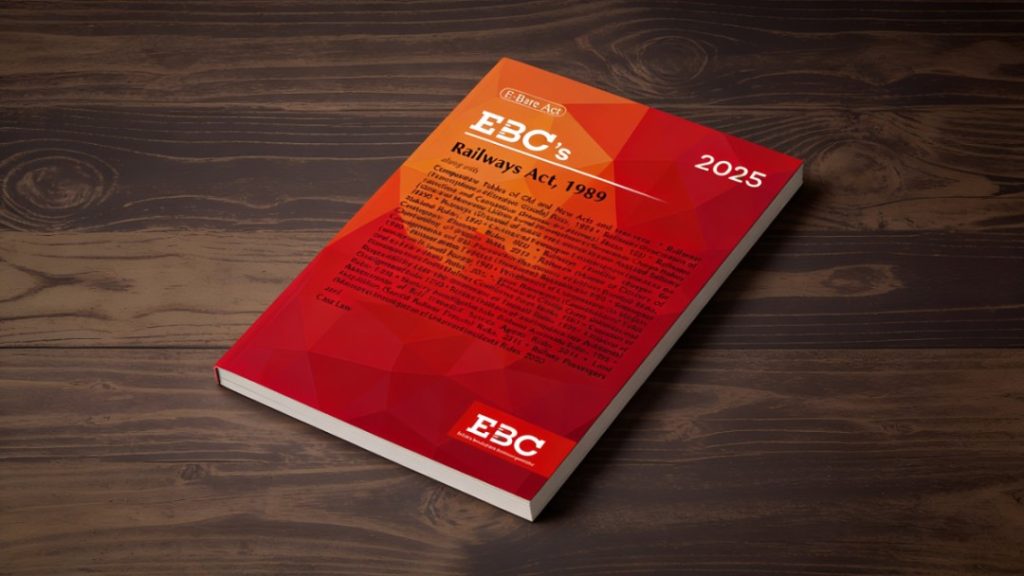
The Railways Act, 1989 forms the principal legislation regulating railway administration and liability.
Key Safety Provisions
- Maintenance of railway infrastructure and rolling stock
- Safe operation of trains
- Regulation of passenger carriage
- Accident reporting obligations
Liability Provisions
Two provisions are central:
Section 124 — Liability in Railway Accidents
Provides compensation where passenger injury or death results from train accidents such as collisions or derailments.
Section 124A — Compensation for Untoward Incidents
Introduces a no-fault liability regime, meaning compensation is payable irrespective of negligence.
“Untoward incidents” include:
- accidental fall from trains,
- terrorist attacks,
- violent attacks,
- robbery or dacoity in trains,
- fire or explosion.
This provision reflects social welfare principles applicable to public transport systems.
Railway Claims Tribunal Mechanism
To ensure speedy justice, Parliament enacted the Railway Claims Tribunal Act, 1987, establishing the Railway Claims Tribunal.
Functions of the Tribunal
- Adjudication of compensation claims
- Claims relating to passenger injury or death
- Loss, destruction, or non-delivery of goods
Passengers or legal heirs can directly approach the Tribunal instead of civil courts, reducing procedural delays.
Nature of Railway Accident Liability in India
Indian railway liability largely operates on strict or no-fault liability principles.
Key Characteristics
- Proof of negligence is not mandatory.
- Railway administration bears statutory responsibility.
- Compensation focuses on victim relief rather than fault determination.
This approach recognizes railways as a state-operated public utility with heightened duty of care.
Exceptions to Compensation Liability
Compensation under Section 124A may be denied if injury or death occurs due to:
- suicide or attempted suicide,
- self-inflicted injury,
- criminal acts by the passenger,
- intoxication or insanity,
- natural causes unrelated to railway operations.
The burden to establish such exceptions generally lies on railway authorities.
Constitutional Dimension of Passenger Safety
Passenger safety also derives protection from Article 21 of the Constitution of India, guaranteeing the Right to Life and Personal Liberty.
Indian courts have interpreted Article 21 to include:
- safe public transport,
- protection from hazardous conditions,
- state accountability in public services.
Thus, railway safety failures may raise constitutional concerns beyond statutory liability.
Institutional Mechanisms Ensuring Safety
Railway safety governance involves multiple authorities:
Railway Board
Formulates national safety policies and operational standards.
Commissioner of Railway Safety (CRS)
An independent authority under the Ministry of Civil Aviation responsible for:
- inspecting railway lines,
- investigating major accidents,
- certifying operational safety.
Railway Protection Force (RPF)
Ensures passenger security and protection of railway property.
Compensation Framework
Compensation amounts are prescribed under the Railway Accidents and Untoward Incidents (Compensation) Rules, 1990.
As per amended rules:
- Compensation for death or permanent disability currently stands at ₹8 lakh.
- Claims are processed through the Railway Claims Tribunal.
The statutory compensation system ensures uniform relief without prolonged litigation.
Judicial Trends in Railway Liability
Indian courts have adopted a beneficial interpretation favoring passengers.
Judicial principles emerging from case law include:
- accidental fall from overcrowded trains qualifies as an untoward incident,
- valid ticket presumption benefits passengers,
- welfare legislation must be interpreted liberally.
Courts consistently emphasize the railway administration’s elevated public duty.
Contemporary Safety Challenges
Despite legal safeguards, challenges persist:
- overcrowding in suburban networks,
- aging infrastructure,
- human operational errors,
- level-crossing accidents,
- modernization and automation risks.
Rapid expansion and modernization demand stronger regulatory oversight and technological integration.
Recent Safety Initiatives
Indian Railways has introduced several reforms, including:
- automatic signaling systems,
- anti-collision technologies,
- track renewal programs,
- centralized traffic control,
- improved accident response mechanisms.
These initiatives aim to reduce accident frequency while strengthening legal compliance.
To know about the topic in a much deeper context, you may check out this resource