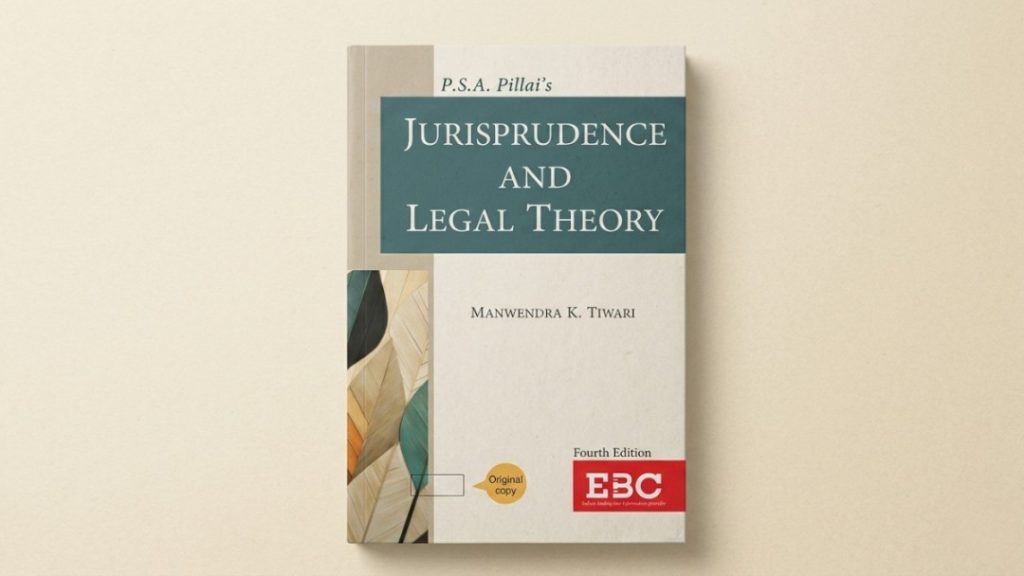
Jurisprudence often feels abstract to many law students, filled with dense theories and philosophical debates. However, P. S. A. Pillai’s Jurisprudence and Legal Theory stands out as a text that bridges this gap effectively. It presents law not merely as a set of written rules, but as a dynamic system shaped by social realities, facts, and evolving legal frameworks.
Overview of the Book
This book offers a comprehensive and practical understanding of jurisprudence and legal theory. Instead of limiting itself to theoretical discussions, it connects legal concepts with real-world applications, making it highly relevant for modern legal education and practice.
One of its strongest aspects is its clear and logical structure, divided into three major parts:
- Principles of Jurisprudence
- Elements of Law
- Legal Theories
This organization allows readers to move systematically from foundational ideas to more complex theoretical frameworks, making it particularly useful for both learning and teaching.
Key Features
1. Well-Structured and Easy to Follow
The division into three parts ensures a smooth learning progression. Students can build their understanding step by step, while teachers can rely on its clarity for structured instruction.
2. Contemporary Explanation of Core Concepts
Concepts such as possession, ownership, rights, and liabilities are explained in a modern legal context. This helps readers connect classical jurisprudential ideas with current legal systems and practices.
3. Balance of Theory and Practical Insight
Unlike purely theoretical texts, this book demonstrates how law operates in real social and factual situations. It shows that law is not static but evolves with societal needs and realities.
4. Strong Normative and Analytical Approach
The book goes beyond definitions to explain:
- How laws are created and interpreted
- The role of the legislature and judiciary
- The importance of constitutional boundaries
This analytical depth makes it valuable for understanding not just what the law is, but why it exists in its current form.
5. Clear Summaries of Jurists
The ideas of both ancient and modern jurists are presented in a concise and accessible manner. This makes complex philosophical contributions easier to grasp without oversimplifying them.
Why This Book Matters
In today’s legal landscape, understanding law requires more than memorizing statutes. It demands an appreciation of how law interacts with society, politics, and human behavior. P. S. A. Pillai’s Jurisprudence and Legal Theory succeeds in delivering this broader perspective while maintaining clarity and accessibility.
For further reading and detailed analysis, refer to this resource.