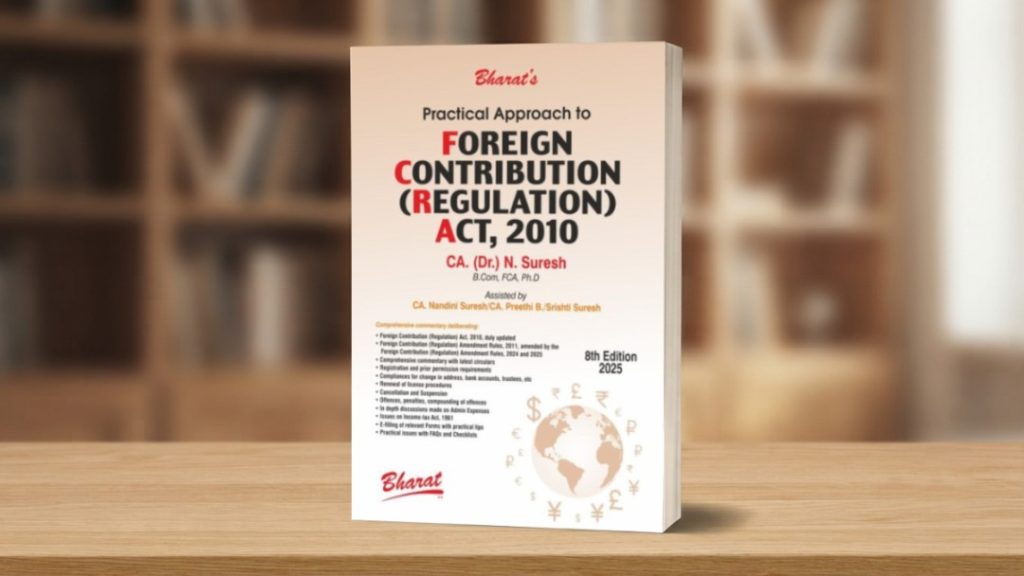
If you run, work with, or donate to a charitable organisation in India, you have probably heard the term FCRA. The Foreign Contribution (Regulation) Act, 2010, commonly called FCRA 2010, is the central law that governs how Indian NGOs, associations, and individuals can receive money, goods, or services from foreign sources. It was enacted to ensure that foreign funding does not compromise India’s sovereignty, security, or public order, while still allowing legitimate charitable and developmental work to continue. This article breaks down the FCRA 2010 framework in plain terms, covering who it applies to, what it requires, and what happens if it is violated.
Background and Purpose
FCRA 2010 replaced an older 1976 version of the law. The core idea has stayed consistent: foreign contributions must be tracked, regulated, and kept separate from ordinary domestic funds, so the government can monitor whether such money is being used for purposes that could affect national interest. The Act is administered by the Ministry of Home Affairs (MHA), and its procedural details are laid out in the Foreign Contribution (Regulation) Rules, 2011 (FCRR 2011), later revised through the Foreign Contribution (Regulation) Amendment Rules, 2020.
Who Needs FCRA Registration
Any person, association, NGO, trust, or Section 8 company that wishes to receive foreign contribution for a definite cultural, economic, educational, religious, or social purpose must either register under FCRA or obtain prior permission for a specific transaction. This applies whether the organisation is large and long-established or newly formed.
Key Legal Provisions Under FCRA 2010
- Section 3 lists persons who cannot accept foreign contribution at all, including candidates for election, judges, government servants, members of legislatures, political parties, and media organisations or their editors and columnists.
- Section 6 deals with the acceptance of foreign hospitality by certain officials and requires prior permission from the government.
- Section 7 prohibits an FCRA-registered entity from transferring foreign contribution to any other person or organisation, a rule made absolute by the 2020 amendment.
- Section 8 caps how much of the foreign contribution can be spent on administrative expenses. This limit was reduced from 50% to 20% after the 2020 amendment.
- Sections 11 and 12 set out the process and conditions for grant of registration or prior permission, and state that a registration certificate is valid for five years.
- Section 13 allows the government to suspend a certificate pending inquiry.
- Section 14 empowers the government to cancel a registration certificate, provided the organisation is given a reasonable opportunity to be heard.
- Section 33 penalises furnishing false information or concealing material facts while seeking registration, with imprisonment up to six months, a fine, or both.
- Section 35 provides general punishment for contravening any provision of the Act.
The Registration Process, Step by Step
- Check eligibility. The organisation must normally exist for three years and have spent at least Rs. 15 lakh on core activities in the preceding three financial years (raised from Rs. 10 lakh by the 2020 amendment).
- Apply online. Registration is sought through Form FC-3A, or prior permission through Form FC-3B if the organisation is newer and seeking funds for a specific project from a specific donor.
- Verification. The MHA conducts scrutiny, often including an intelligence and background check of the organisation and its key functionaries.
- Grant of certificate. If approved, the certificate is issued, valid for five years.
- Open a designated FCRA account. All foreign contribution must first be received into a single FCRA account at the State Bank of India, New Delhi Main Branch, before being transferred to a utilisation account.
- Annual filing. An annual return in Form FC-4 must be filed every financial year, even if no funds were received.
- Renewal. Renewal must be sought within six months before the five-year certificate expires.
Rights and Obligations at a Glance
| Aspect | What the Organisation Can Do | What the Organisation Must Do |
|---|---|---|
| Receiving funds | Accept foreign contribution once registered or granted prior permission | Route all funds through the SBI FCRA account first |
| Spending funds | Use funds for the stated charitable purpose | Keep administrative spending within 20% |
| Sharing funds | Use funds within the organisation | Not transfer contribution to any other entity |
| Reporting | Maintain internal records | File Form FC-4 annually, without exception |
| Renewal | Apply for renewal before expiry | Undergo fresh scrutiny at each renewal |
Penalties and Consequences
| Violation | Consequence |
|---|---|
| False information in application (Section 33) | Imprisonment up to 6 months, fine, or both |
| General contravention (Section 35) | Imprisonment up to 5 years, fine, or both, depending on the offence |
| Non-filing of annual returns | Penalty and possible suspension of registration |
| Cancellation of certificate | Bar on fresh registration or prior permission for 3 years |
| Minor or technical defaults | May be compounded (settled with a fine) under Section 41 rather than prosecuted |
Frequently Asked Questions
Only if the NGO intends to receive foreign contribution. Purely domestically funded organisations do not need it.
Any donation, delivery, or transfer of currency, article, or security from a foreign source, including foreign individuals, companies, or trusts.
Yes, through prior permission for a specific donor and purpose, without needing the three-year track record required for full registration.
The certificate’s validity may lapse, and the organisation can lose the ability to receive or use foreign contribution until renewal is granted.
No. It must be used strictly for the purpose stated in the registration or permission.
Ready to go beyond this? Reference book, right here.