A Practical Guide to the Art and Science of Contract Drafting
In an era where legal education increasingly emphasises transactional skills alongside doctrinal knowledge, Drafting Contracts: Basic Principles by Dr. Ajar Rab emerges as a refreshing and practical contribution to the field of contract drafting. The book provides an accessible and systematic introduction to the fundamentals of drafting, making it particularly useful for law students, young advocates, academicians, and professionals seeking to developm their contractual drafting skills.
Understanding the Fundamentals of Contract Drafting
The book distinguishes itself by focusing on the fundamentals and methodology of contract drafting, rather than simply reproducing contractual precedents. Dr. Ajar Rab begins by examining the nature, objectives, and stages of contract drafting before
systematically taking the reader through the various steps involved in preparing a contractual document.
The discussion covers important aspects such as understanding client requirements, conducting appropriate legal research, preparing contractual documents, reviewing drafts, and finalising agreements. This structured approach enables readers to appreciate drafting as a process that requires careful thought, analysis, and precision.
From Client Requirements to the Final Contract
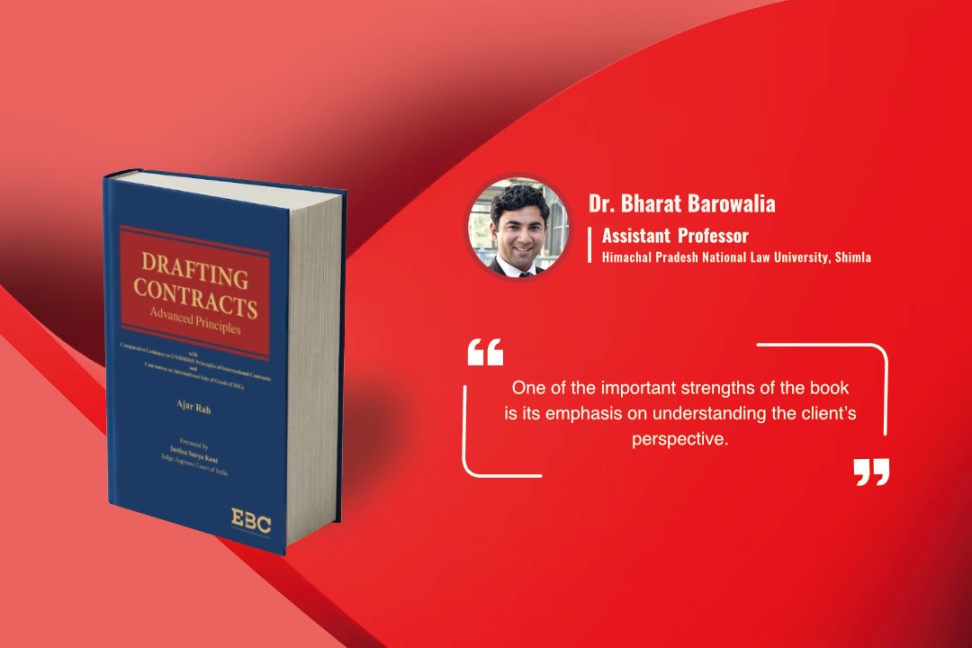
One of the important strengths of the book is its emphasis on understanding the client’s perspective. Effective contract drafting requires more than knowledge of legal provisions; it requires an understanding of the client’s objectives, commercial interests, potential risks, and expectations.
The author highlights the significance of foresight, risk assessment, ethical considerations, and negotiations in the drafting process. These discussions reflect the practical realities of transactional practice and help readers understand why a well-drafted contract must anticipate potential issues rather than merely respond to existing ones.
The Importance of Clarity and Precision
The book also provides valuable insights into contract language and legal writing. Complex drafting concepts are explained in a simple and reader-friendly manner, making the subject approachable even for those encountering contract drafting for the first time.
The emphasis on plain English, precision, clarity, and coherence is particularly noteworthy. In contractual documents, ambiguity can have significant legal and commercial consequences. The book therefore encourages readers to adopt a drafting style that communicates obligations, rights, and responsibilities with greater clarity.
Bridging Legal Education and Professional Practice
A significant contribution of Drafting Contracts: Basic Principles is its ability to bridge the gap between academic learning and professional practice. Contract drafting is sometimes approached as a mechanical exercise involving the adaptation of precedents. The book moves beyond this approach and encourages readers to understandcontracts as strategic legal instruments. A contract does not merely record an agreement; it also allocates rights, responsibilities, obligations, and risks between the parties.
This practical orientation makes the book particularly relevant to contemporary legal education, where students are increasingly expected to develop professional and transactional skills alongside their understanding of legal doctrine.
Learning Beyond Precedents
The author’s approach encourages readers to develop their own analytical and drafting abilities instead of relying exclusively on precedents. While precedents remain an important resource for practitioners, effective drafting requires the ability to assess the specific circumstances of a transaction and tailor contractual provisions accordingly.
This emphasis makes the book useful not only as an introductory text but also as a practical reference for readers seeking to improve their drafting methodology.
Scope for Further Enrichment
Given the breadth and evolving nature of contract drafting, future editions could further enrich the discussion by incorporating additional illustrations from emerging commercial sectors and technology-driven transactions.
Examples relating to contemporary areas of commercial activity would complement the book’s strong foundational approach and could further enhance its relevance for readers dealing with increasingly complex and technology-enabled transactions.
A Valuable Resource for Aspiring Legal Professionals
Overall, Drafting Contracts: Basic Principles is a well-structured, insightful, and highly practical work. Dr. Ajar Rab successfully presents contract drafting as both a technical discipline and a strategic professional skill.
The book’s accessible writing style, practical orientation, and emphasis on clarity and risk assessment make it a valuable resource for law students, academicians, advocates, in-house counsel, and professionals interested in developing effective contract drafting skills.
Rather than treating drafting as a mere exercise in reproducing contractual language, the book encourages readers to think critically about the purpose, structure, language, and commercial implications of a contract. In doing so, it offers a useful foundation for anyone seeking to develop the skills necessary for effective and thoughtful contract drafting.
Connecting Doctrine with Practice
Another significant feature of the book is its ability to connect procedural law with its practical application. Criminal procedure is an area where the interpretation and implementation of statutory provisions directly affect the rights of individuals and the functioning of the criminal justice system. By bringing together statutory provisions, judicial decisions, procedural safeguards, and practical exercises, the book encourages readers to appreciate not only what the law provides but also how procedural principles operate in real world situations. This approach makes the work particularly useful for students developing a foundational understanding of criminal procedure as well as teachers seeking to encourage classroom discussions on contemporary procedural issues.
Want the deeper dive? Grab the reference book.