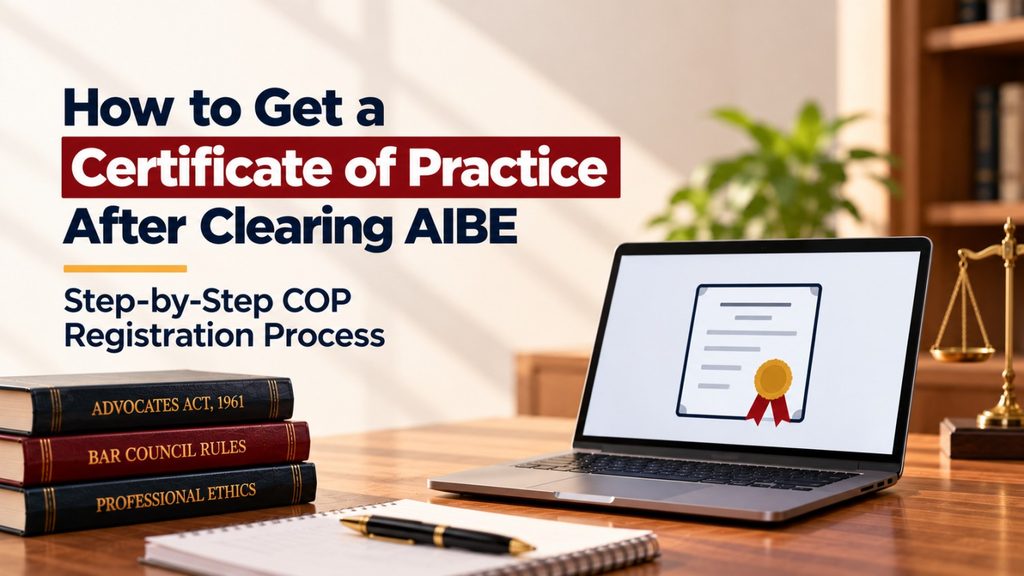
Passing the All India Bar Examination (AIBE) is a major landmark in a legal career. However, clearing the exam alone does not automatically grant you the full authority to represent clients in a court of law. To secure lifelong practice rights across Indian courts, qualifying advocates must complete the AIBE COP registration process to obtain their official Certificate of Practice (COP).
The Certificate of Practice is the statutory license issued under the authority of the Bar Council of India (BCI). It converts a candidate’s temporary, provisional state enrollment into a permanent right to practice law. This guide explains the legal provisions, mandatory documentation, and procedural steps required to secure your COP without administrative delays.
Legal Framework Governing the Certificate of Practice
The requirement to hold a Certificate of Practice is grounded in the statutory powers vested in the Bar Council of India to regulate the legal profession.
Key Statutory Provisions
- Section 24(1)(f) and Section 49(1)(ah) of the Advocates Act, 1961: Gives the Bar Council of India the statutory authority to lay down conditions and rules for enrollment and establish the prerequisite of clearing a national qualifying examination.
- All India Bar Examination Rules, 2010: Mandates that every advocate enrolled with a State Bar Council must pass the AIBE to qualify for a permanent Certificate of Practice.
- Bar Council of India Certificate and Place of Practice (Verification) Rules, 2015: Governs the periodic verification of practicing advocates, ensuring that only actively practicing or qualified advocates hold a valid COP to curb fake or non-practicing entries on the rolls.
- Rule 9 of the Bar Council of India Rules: Restricts an advocate’s provisional practice period to two years from the date of enrollment with a State Bar Council. Passing AIBE and receiving the COP fulfills this legal requirement.
Step-by-Step Procedure to Obtain Your Certificate of Practice
Completing the AIBE COP registration process requires coordinating between the official BCI examination portal and your respective State Bar Council.
Phase 1: Scorecard Retrieval and Profile Audit
- Check Result Status: Log in to the official AIBE candidate portal and download your scorecard showing a clear “PASS” result.
- Audit Personal Particulars: Ensure that your name, father’s name, and State Bar Council enrollment number on the scorecard match your state provisional enrollment certificate exactly. Any spelling mismatch will cause delays during verification.
Phase 2: Submission and Verification through State Bar Council
- State Notification: Following result declarations, State Bar Councils (such as the Bar Council of Maharashtra & Goa, Bar Council of Delhi, or Bar Council of Uttar Pradesh) release specific physical or online submission notifications.
- Document Compilation: Candidates must submit an application form along with self-attested copies of their LL.B. degree certificate, provisional State Bar enrollment certificate, AIBE admit card, AIBE passing scorecard, and identity proof.
- Physical Collection or e-COP: Depending on the State Bar Council, physical certificates are distributed through local district bar association offices, while digital versions (e-COP) can be accessed via official BCI mobile applications or portal dashboards.
Comparative Matrix: Provisional Enrollment vs. Certificate of Practice
| Parameter | Provisional State Enrollment | Certificate of Practice (COP) |
| Issuing Authority | Respective State Bar Council | Bar Council of India (via State Bar) |
| Validity Period | Maximum 2 years from enrollment | Permanent (subject to periodic BCI verification rules) |
| Prerequisite | LL.B. degree from a recognized university | Qualifying score in the AIBE |
| Scope of Practice | Restricted provisional court appearances | Unrestricted right of audience in all Indian courts |
| Vakalatnama Rights | Restricted in certain judicial forums | Full entitlement to file Vakalatnama independently |
Post-COP Obligations and Bar Association Membership
Securing your COP grants the statutory legal right to practice law, but full operational integration into court premises requires additional local compliance:
- Local Bar Association Enrollment: To file a Vakalatnama (a formal document authorizing an advocate to represent a client in court) in a specific court complex, advocates must register as members of the local District Bar Association or High Court Bar Association.
- Advocate Identity Card: State Bar Councils issue a permanent Advocate Identity Card displaying the advocate’s permanent enrollment number and COP details.
- Rule 49 Compliance: Advocates holding a valid COP must strictly refrain from taking up full-time salaried employment unless they voluntarily surrender their practice license under Rule 49 of the BCI Rules.
Frequently Asked Questions (FAQs)
No. Passing AIBE makes you eligible for permanent practice, but you must complete document verification through your State Bar Council to obtain the physical or digital COP.
Processing times vary by State Bar Council, typically ranging from a few weeks to a few months following result verification.
Yes, provided your provisional enrollment period of two years has not lapsed, and you can produce your passing AIBE scorecard upon request.
File a rectification request immediately with the BCI helpdesk along with a supporting affidavit and a copy of your State Bar enrollment certificate before COP generation.
Most State Bar Councils include the COP fee in the initial AIBE or enrollment fees, but nominal administrative charges may apply depending on state rules.